

Let me start with a confession. When the news broke that Anthropic had yanked its two most powerful models off the internet, my first reaction was the same lazy one everybody had. “Oh great, the AI got too smart, the government panicked.” Clean story. Fits the movie we’ve all been running in our heads since 2023.
Then I read the actual directive, the timeline, and the legal mechanism. The real story is weirder, and frankly more important, than the killer-robot version. So let me walk you through what happened, why it happened, and the one move that keeps your stack from getting vaporized next time. Because there will be a next time.
The timeline that tells the whole story
June 9: Anthropic launches Claude Fable 5 and Mythos 5. Fable 5 is the public one with safety classifiers baked in. Mythos 5 is the same model with some guardrails stripped, handed to a few vetted partners. Biggest launch they’ve ever done.
June 12, 5:21 PM Eastern: a letter from Commerce Secretary Howard Lutnick lands on Dario Amodei’s desk. By Friday night, both models are dark. Worldwide.
Seventy-two hours. The most powerful AI on the planet had a shorter shelf life than a grocery store rotisserie chicken. And it didn’t die of natural causes.
Why it actually went dark
Here’s where everyone gets it wrong, so slow down with me.
The government did not order a shutdown. The directive said no foreign national may access Fable 5 or Mythos 5. Not overseas, not inside the US, not even Anthropic’s own foreign-national employees. Anybody in that bucket, anywhere, cut off.
Now picture the engineering problem. You cannot run a real-time citizenship check on every prompt hitting AWS Bedrock, Google Cloud, Microsoft Foundry, Snowflake, and the direct API. So Anthropic did the only thing that guaranteed compliance: it killed both models for the entire planet. Every other Claude model stayed online. The “shutdown” was a side effect. The actual order was a nationality filter that couldn’t be built any other way.
The stated reason, and why it crumbles
Officially, this is about a jailbreak: a technique that amounts to telling the model to read a codebase and flag the security holes. Anthropic reviewed the demo and says it surfaced a few already-known, minor bugs. Not zero-days. Not a cyberweapon. Stuff people already had in their bug trackers.
And here’s the line that should end the debate. OpenAI’s GPT-5.5 does the same thing with no jailbreak at all. You just ask. Code analysis is something every developer and security researcher on earth uses daily. So, the thing one model got recalled for is a thing its rivals do openly, and the whole industry depends on.
Then there’s the detail almost nobody is amplifying, from Axios: an official said Commerce moved after another company claimed it had jailbroken Mythos, and that the government had already asked Anthropic to delay launch and gotten told no. A competitor’s claim, plus a refused request to wait, preceded a national security order against the company that refused. I’m not telling you what that means. I’m saying you don’t have to squint hard to see a pattern there.
The executive order everyone keeps misnaming
Quick cleanup, because the internet is calling this an “executive order” and it isn’t one. The mechanism was the Export Controls Reform Act of 2018, the dual-use provision, run as a Commerce directive. Same family of law used for advanced chips and weapons tech, aimed at an American frontier AI model for the first time ever. That precedent is the real headline.
The actual executive order in this story is the irony nobody’s connecting. In July 2025, the administration signed EO 14320, “Promoting the Export of the American AI Technology Stack,” built to push American AI onto the world. So, the same government that wrote an order to spread American AI just used export law to yank an American model off the global market. The apparatus designed to project AI power got pointed inward to contain it.
And one more. On June 10, one day after launch, Amodei published an essay arguing governments should have standing authority to block frontier models that fail safety testing, comparing it to the FAA grounding planes. Two days later, that exact authority hit his own company. The CEO handed over the rationale on Monday and caught the kill switch by Friday. You can’t make it up.
So how do you safeguard your stack?
Here’s the part that should change how you build today.
If your workflow ran on Fable 5 this week, it broke this weekend. Not because the model failed. Not because you did anything wrong. Because a letter you never saw made your dependency vanish overnight. Plenty of enterprise teams discovered that their contracts and SLAs said nothing about a regulatory shutdown, because no one had planned for a world where an AI model could be switched off in the middle of a response.
The usual fix is multi-model routing: build through an abstraction layer, swap engines without rebuilding the car. Necessary, but not enough, since the whole lesson here is that any single provider’s model can be pulled by forces outside your control and theirs.
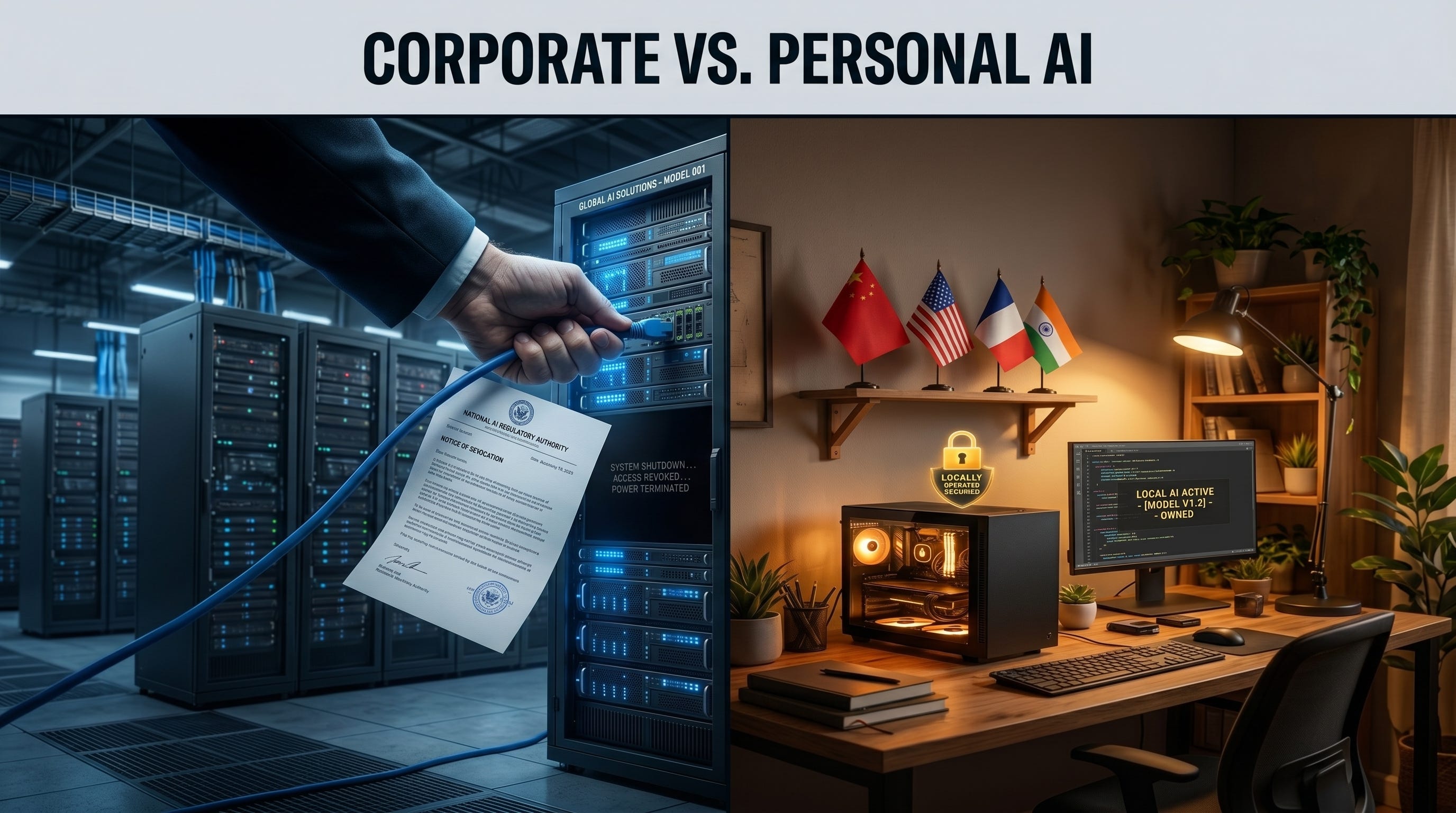
Which brings me to the safeguard hardly anyone is naming: open-weight models you host yourself. A government letter can force a company to switch off an API. It cannot reach into your own servers and delete weights you already downloaded and run locally. No remote off switch exists. That is a fundamentally different risk profile than renting intelligence through someone else’s door.
And open weights in 2026 are no longer the consolation prize. Several land within a hair of the proprietary leaders, and the smaller ones run on hardware that fits under your desk. But here’s the wrinkle that fits this story perfectly: a directive about keeping a model out of foreign hands is best dodged using models that are themselves, mostly, foreign. Here’s the lay of the land.
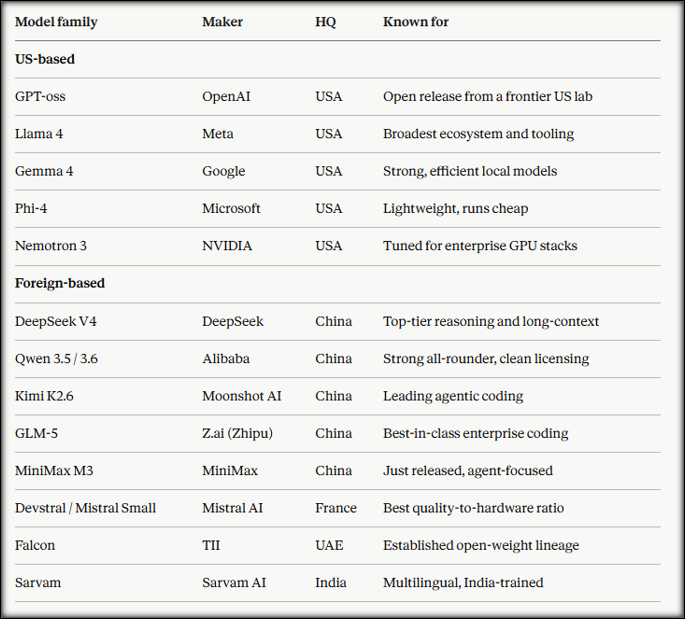
Licenses vary widely (Apache 2.0, MIT, and custom open-weight terms are all common). Always check the current model card before commercial use.
Look at that split. The strongest open-weight options at the frontier skew heavily Chinese right now, with a solid American tier and a few standouts from Europe, the UAE, and India. So, the honest caveat writes itself: self-hosting trades a tidy API bill for GPU costs, ops work, and running your own guardrails, and your hedge against one government’s reach can quietly raise your exposure to another’s. There’s no move on this board with zero tradeoffs. Only knowing which one you’re choosing on purpose.
What this actually comes down to
The scary-AI framing is comforting because it’s simple. The machine got too strong, the grownups stepped in. The truth is messier and more useful: a model got pulled for a capability its rivals share, through an export law never before aimed at AI, against a company already suing the people who sent the letter, the same week its CEO argued for exactly that power.
The model was never the fragile part. Your dependency was. The lesson isn’t “AI is dangerous.” It’s “renting your core capability from a single source is a single point of failure, and now we have the receipt.”
So, own a fallback you control. Treat every API model as a tenant, never the foundation. And next time a headline tells you to fear the machine, look at the paperwork instead. That’s usually where the actual story is hiding.
I’ll be exploring Open-Source models this weekend…
What are your plans to protect your stack…?
SOURCES:
Axios: Trump admin blocks foreign access to Anthropic’s most powerful AI
Quartz: Anthropic disables Claude Fable 5 and Mythos 5 after U.S. export order
Snyk: What the Fable 5 and Mythos 5 Suspension Means for Security Teams
FifthRow: US Export-Control Order and Global Suspension of Fable 5 and Mythos 5
explainX: Why Did the US Gov Ban Fable 5? The Full Anthropic Story
andrew.ooo: What the US Export Control Order Means (and what to do if your stack ran on it)
Hugging Face: Best Open-Source LLMs in 2026 (licenses and origins)
Background on EO 14320, Promoting the Export of the American AI Technology Stack (K&L Gates)