


By the end of this, you’ll know which model to hand which job, and roughly what each finished job costs you.
The verdict first. On Sept. 22, OpenAI and Anthropic shipped cheaper models 90 minutes apart, one day after SpaceXAI shipped Grok 4.7. The same week, Google’s open-source agent runtime, AX, became the most discussed AI post on Hacker News. Most coverage is ranking who got smarter. The bigger change is the price of keeping smart AI working on a job for hours. On independent tests, GPT-6 Sol does the same benchmark work as its predecessor for about half the money. Claude Opus 5.5 scores higher and costs a bit more per job. For most people, Sol is the new default, and Opus 5.5 is the one you call when the answer has to be right.
How AI billing works, in plumber terms
Think about hiring a plumber. The hourly rate is right there on his website. The invoice is what makes you sit down. A $60-an-hour plumber who needs three hours costs you $180, while the $100 guy who's done in one hour costs you $100 and leaves before your coffee gets cold.
AI works the same way. Companies advertise a price per million tokens. A token is a chunk of text, roughly three-quarters of a word. That’s the hourly rate. What you pay for a finished job depends on how many tokens the model burns getting there, and agents burn a lot, because they read, try, check, and try again.
Then there’s cached input, which is text the model already read that it can reuse at a discount. Paying full price to re-read it every turn is like your plumber charging you to find your kitchen again every time he walks back from the van. Five trips means five kitchen-finding fees. By trip six you’re wondering if he’s billing you for the van too.
This week’s launches go after the invoice. OpenAI now discounts cached reads by 90%. Anthropic cut Opus 5.5’s cached reads 60%, to $0.20 per million tokens. And Lovable, a company that builds apps with AI, told Anthropic that Opus 5.5 finishes jobs in a third to half fewer steps. Fewer steps means a smaller invoice, even before anyone touches the hourly rate.
What you can hand an agent now that was too pricey in August
This part changes what a regular person or a five-person team can get done.
You can hand off an overnight job. A developer at the legal software company Clio gave Opus 5.5 an engineering task across six code repositories and let it run unattended. It stayed on the job for more than 18 hours and needed minimal rework, in his words on Anthropic’s launch page. An agent, for anyone new here, is AI that takes actions on its own. A chatbot tells you how to rename the files. An agent renames them.
You can keep a big pile of documents loaded without going broke. Say your agent works from 50,000 tokens of contracts, notes, or a product manual, and re-reads them every turn. On GPT-6 Sol, cached reads cost $0.20 per million tokens, so each re-read costs about 1 cent. At Sol’s full input rate, it would be about 10 cents. Over a few hundred turns, that gap buys lunch.
You can run research that gets fact-checked. In Anthropic’s own test, Opus 5.5 wrote company earnings reports from a copy of the web where the real numbers were hard to find. A grader failed any report with an invented figure or quote. Opus 5.5 passed 16 of 18 times, and Anthropic says Opus 5 and Fable 5.1 passed none. That’s the vendor grading its own homework, so treat it as a promising sign.
You can put AI on paperwork. In a Box demo SpaceXAI promoted, Grok 4.7 checked a $2 million insurance claim against the policy and caught $146,000 in duplicate invoices and missed deductions, the kind of thing a tired human skims past at 4 p.m. on a Friday. It's a demo, so expect less on your own files.
And you can send routine work to the cheap seats. GPT-6 Luna ran Artificial Analysis’s independent test tasks for about 7 cents each. At that price, you can hand Luna the grunt work, like sorting your inbox or tagging support tickets.
The cost-per-job table
Artificial Analysis, an independent testing firm, runs every model through the same set of tasks and publishes what each run costs. A higher score means smarter on their test. “Effort” is a dial for how long the model thinks before answering. More effort usually means better answers and a bigger invoice.
The AI Signal Receipt: what a finished job costs
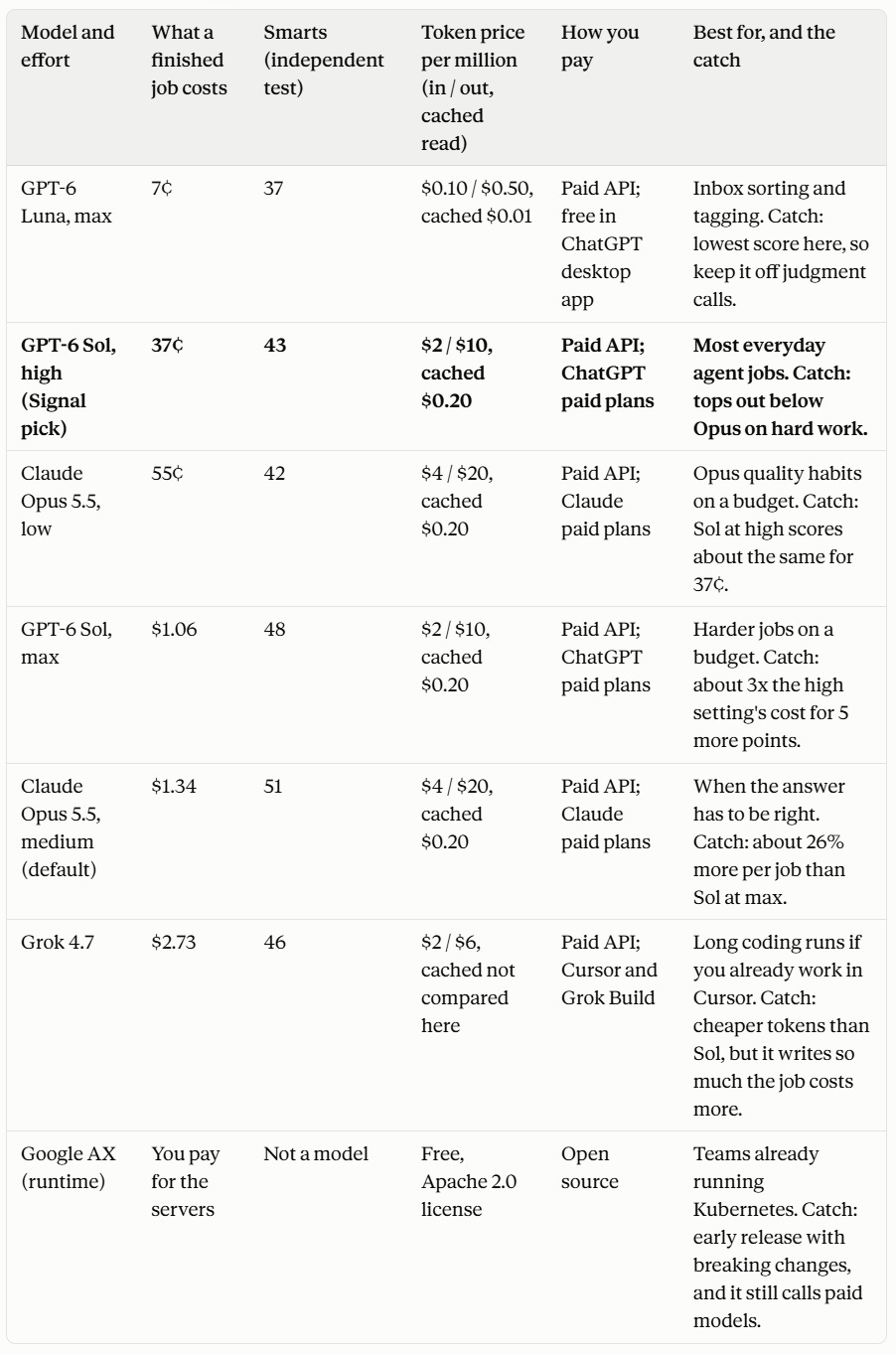
Checked Sept. 22, 2026. Scores and per-job costs come from Artificial Analysis’s independent test set. This market reprices every few weeks, so re-check before you budget.
If you’re spending less than about 55 cents a job, Sol scores higher than any Opus 5.5 setting at the same price. If you can spend more, Opus 5.5 at its default setting beats Sol at its maximum, and it costs about 26% more per job ($1.34 vs. $1.06).
On licensing: every model here is paid and closed, billed per token through each company’s API. The chat apps are a different deal. GPT-6 Sol and Luna are in ChatGPT’s paid plans and Codex, and Free and Go users get Luna in the desktop app. Opus 5.5 is on Claude’s paid plans. Google’s AX is free and open source under the Apache 2.0 license, which lets you use and modify it commercially. Free software still needs servers, though. AX expects a Kubernetes cluster (a system for running lots of software containers across many computers) plus a container registry, and it still calls paid models to do the thinking. A free runner wrapped around a paid brain is still a paid setup.
Where the cheap price tag lies
Claim: OpenAI says Sol and Luna are 50% cheaper (Sept. 22). Receipt: OpenAI measured that against GPT-5.6’s promotional pricing, per its own announcement. Artificial Analysis measured about 50% lower cost per task for Sol and about 60% for Luna (Sept. 22), and found their intelligence scores roughly level with GPT-5.6. So they’re cheaper, and about as smart as before.
Claim: Anthropic says Opus 5.5 costs about 40% less to run than Opus 5 on typical work (Sept. 22). Receipt: Digital Applied points out that the saving compares each model at its default effort, which is medium on Opus 5.5 and high on Opus 5 (Sept. 22). The saving is real for anyone using defaults.
Claim: SpaceXAI says Grok 4.7 is twice as fast at half the price of comparable models (Sept. 21). Receipt: Grok 4.7’s output tokens cost less than Sol’s ($6 vs. $10 per million), and Artificial Analysis still measured $2.73 per test task, more than double Sol at max (Sept. 22). The reason is chattiness. Artificial Analysis counted roughly 81,000 output tokens per task at its highest setting, against 36,000 for Grok 4.6 (reported Sept. 22). It has a lower hourly rate than Sol and a much bigger invoice.
Claim: Google’s AX repository says it can run billions of autonomous agent workloads. Receipt: there’s no published benchmark of that yet. The project’s own demo showed about 250 agent sessions across 8 machines, and its README warns of major breaking changes before a stable release (reported Sept. 22).
Claim: the 18-hour unattended run. Receipt: that’s one customer quote on Anthropic’s launch page (Sept. 22), with no neutral test behind it yet. It’s encouraging, and it isn’t proven.
The two-model setup that sends routine work to Luna
The setup I’d copy looks like this. Picture a weekly competitor price report. Luna visits the pages and pulls the prices into a list. Sol writes the report. Opus 5.5 gets called once, at the end, to check every number against the source. The cheap model goes first, and the expensive one goes last, only when it’s needed.
Put the stuff that never changes, your instructions and reference documents, at the start of every request, so the cache can reuse it. OpenAI now lets you change the effort dial or switch tools mid-job without losing that cache, and GitHub told OpenAI these caching changes more than halved the text Copilot had to process from scratch, across billions of requests.
For two years the question at every launch was how smart the new model is. The question on your desk now is how many of these you can afford to leave running, and which job you’d hand over first. Agents still fail. They still need someone reading the output in the morning. But the price of trying just dropped, and I don’t think it’s going back up.
So what
Do this: Pick one job that eats your Friday afternoon every week. Run it through GPT-6 Sol at high effort, then check your bill to see what that one finished job cost. That number beats any chart.
Skip this: Choosing a model by its price per million tokens alone. Grok 4.7 charges less than Sol per output token and costs the most per test task in the table.
Wait on this: Google’s AX, unless you already run Kubernetes. The README itself warns of major breaking changes.
Steal this line: “Don’t ask what the tokens cost. Ask what the finished job costs.”
Sources:
The verdict
TechCrunch: OpenAI launches GPT-6 Sol and Luna, boasting lower cost and fewer mistakes (Sept. 22, 2026). Backs the 90 minutes between the Opus 5.5 and GPT-6 Sol launches.
SpaceXAI: Introducing Grok 4.7 (Sept. 21, 2026). Backs the Grok 4.7 release and its $2 / $6 pricing.
DEV Community: Google Open Sourced AX, an Orchestrator for Billions of AI Agents. Hacker News Isn’t Buying the Number. (Sept. 22, 2026). Backs AX becoming the most discussed AI post on Hacker News.
Artificial Analysis: GPT-6 Sol and Luna push the cost efficiency frontier (Sept. 22, 2026). Backs Sol doing the same work for about half the cost per task.
Digital Applied: GPT-6 Sol vs Claude Opus 5.5, Cost per Task and Benchmarks (Sept. 22, 2026). Backs Opus 5.5 scoring higher and costing more per task.
How AI billing works, in plumber terms
OpenAI: Introducing GPT-6 Sol and Luna (Sept. 22, 2026). Backs the 90% cached-read discount.
Quartz: Anthropic launches Claude Opus 5.5 at lower cost, higher performance (Sept. 22, 2026). Backs the 60% cut to $0.20 per million cached tokens.
Anthropic: Introducing Claude Opus 5.5 (Sept. 22, 2026). Backs Lovable’s “a third to half fewer steps.”
What you can hand an agent now that was too pricey in August
Anthropic: Introducing Claude Opus 5.5 (Sept. 22, 2026). Backs the Clio 18-hour run across six repositories and the 16 of 18 research reports.
Vellum: GPT-6 Sol and Luna Benchmarks Explained (Sept. 22, 2026). Backs cached reads at $0.20 per million on Sol and $0.01 on Luna.
BigGo Finance: SpaceXAI Launches Grok 4.7 After Months of Delays (Sept. 22, 2026). Backs the Box demo: $2 million claim, $82,000 in duplicate invoices.
Artificial Analysis: GPT-6 Sol and Luna push the cost efficiency frontier (Sept. 22, 2026). Backs Luna at about 7 cents per test task.
The cost-per-job table
Digital Applied: GPT-6 Sol vs Claude Opus 5.5, Cost per Task and Benchmarks (read Sept. 22, 2026). Backs the Sol and Opus 5.5 scores and costs at each effort level, plus the 26% gap.
Mixed: Grok 4.7 ties GPT-6 Astra’s cheapest setting, and costs $2.73 per task against $0.82 (Sept. 22, 2026). Backs Grok 4.7’s score of 46 and $2.73 per task.
OpenAI: Introducing GPT-6 Sol and Luna (Sept. 22, 2026). Backs ChatGPT availability, including Luna for Free and Go users in the desktop app.
InfoQ: Google Open-Sources AX, a Kubernetes Style Orchestrator for Autonomous AI Agents (Sept. 22, 2026). Backs AX’s Apache 2.0 license.
Where the cheap price tag lies
OpenAI: Introducing GPT-6 Sol and Luna (Sept. 22, 2026). Backs the 50% cut being measured against GPT-5.6 promotional pricing.
Artificial Analysis: GPT-6 Sol and Luna push the cost efficiency frontier (Sept. 22, 2026). Backs the measured 50% and 60% cost-per-task drops and flat intelligence scores.
Digital Applied: Claude Opus 5.5, Pricing, Benchmarks and Breaking Changes (Sept. 22, 2026). Backs the 40% saving being measured at different default effort levels.
BigGo Finance: SpaceXAI Launches Grok 4.7 After Months of Delays (Sept. 22, 2026). Backs the 81,000 vs 36,000 output tokens per task.
DEV Community: Google Open Sourced AX, an Orchestrator for Billions of AI Agents (Sept. 22, 2026). Backs the billions claim, the 250-session demo, and the breaking-changes warning.
The two-model setup that sends routine work to Luna
The Next Web: OpenAI cuts GPT-6 prices in half with Sol and Luna (Sept. 22, 2026). Backs keeping the cache while changing effort or tools, and GitHub’s more-than-half figure.
Deep dive and weekly updates: subscribe for free at aisignal.veletica.com.