


We’ve all left something running overnight. Usually it’s wet laundry, and by morning the towels smell like a gym bag that lost an argument.
Google left something more useful running. At 9:11 one evening, an engineer gave its new model, Gemini 4 Argon, a one-paragraph goal inside a 205,000-line codebase and walked away. Eleven hours later, a proposed code change was waiting for review. You’ll leave this with the setup for your own overnight job and a short list of what to check when you wake up.
My verdict: Argon isn’t the smartest model you can buy, according to the broadest independent scoreboard. It earns your attention with a new Tasks switch in the Gemini app and real evidence it can work for hours with nobody watching. Hand it jobs with a clear finish line, and keep a human check in the morning, because Google’s own engineers threw out four of its six ideas.
The 5-to-8 handoff
I think of it as the 5-to-8 handoff. You hand over the goal at 5 PM. The AI works while you eat dinner and fall asleep halfway through a show you’ve already seen. At 8 AM you decide what’s good enough to keep.
That only works if the AI can hold onto your goal for hours, and Google built two features for exactly that. /goal mode, in Google’s AI coding app Antigravity, pins your original instructions so the AI can’t lose them during a long run, when it’s constantly compressing its own notes. A skills folder (Google’s is called .agents/skills) is a set of plain-text house rules the AI reads before it touches anything. It’s the employee handbook.
What happened in Google’s 11-hour run
Google ran the test twice on its open-source Agent Development Kit, a toolkit companies use to build their own AI agents. The codebase holds about 205,000 lines across nearly 800 files.
Round one had no house rules. Argon worked for about two hours and found real slowdowns, but it ignored the team’s habits: it changed something other apps depend on and ran only 216 nearby tests out of nearly 17,000.
Round two added the handbook and turned on /goal. Before writing a line of code, Argon read 12 rule files and measured how fast everything ran. Then it worked for 11 hours. Three minutes before it finished, it caught a bug in its own work and reran all 16,892 tests.
If you’ve ever trained a new hire, you’ll recognize the difference. Round one was a sharp new hire on day one with no handbook. Round two was the same hire after reading it.
By morning, Argon had proposed six speedups across 32 files, and the engineers kept two. One stops the toolkit from copying a conversation’s entire history at every step, and the other loads heavy features only when they’re needed. Google says the result cuts session prep time by about 40% in long conversations and makes the toolkit load 21% faster.
The four rejects are the most useful part of the write-up. One shortcut could hand back stale data from a different session. One leaned on hidden internals of another library, which could break on its next update. One made core code harder to read without making anything faster, and one only helped on artificial test runs. Google’s engineers summed it up as “the agent explores, the maintainer subtracts.”
My day job is running a production platform that more than 4,000 people use, including the change reviews before anything touches it. So I read the rejects first. Every one of them is the kind of change that passes testing on Friday and wakes you up on Sunday, and humans caught all four.
How to set up your own overnight job
You’ve got two ways in, and the first one doesn’t require you to write a line of code.
In the Gemini app. If you pay for Google AI Pro ($19.99 a month in the U.S.) or AI Ultra, the main chat window now has a toggle that switches from Chat to Tasks. In Tasks, Google says Gemini can keep working for you while you’re away from your computer. It connects to more than 40 apps, including Instacart, OpenTable, Adobe and Shopify, so a task can end with groceries ordered or a table booked.
Use Chat when you want an answer while you watch. Use Tasks when you want a finished job while you’re gone.
Google’s overnight test teaches habits that work here too:
Say what “done” looks like. “Book a table for six near the office on Friday at 7, under $60 a person” beats “find dinner.”
Say what it must not do. Google says it trained Argon to stop and ask before irreversible steps. Write “ask me before you pay for anything” into your request anyway.
Check the result before it goes out the door. That’s the 8 AM half of the handoff.
In code. Developers can reach Argon through the paid Gemini API (model ID gemini-4-argon), in GitHub Copilot on the Pro+, Max, Business and Enterprise plans, and in Antigravity for AI Ultra subscribers. Google’s setup is easy to copy:
Write the goal as one paragraph that names what must not change. Google’s version said to keep the public interface the same and back every change with a test.
Put your team’s rules in a skills folder so the AI reads them first.
Ask for a draft for review with before-and-after numbers, and say “don’t merge it.”
Keep a test the AI never sees. Google wrote its own separate benchmark before either run, and that’s how it knew which speedups were real.
That last habit matters most. The AI spends the whole night grading its own homework, so you need an answer key it never saw.
What it costs before and after December 1
Argon is a closed, paid model. There’s no free tier for developers, and free Gemini accounts don’t get it. In the app, the cheapest way in is Google AI Pro at $19.99 a month in the U.S. Tasks is limited to select countries for now, Argon is still rolling out to Pro subscribers, and Antigravity requires AI Ultra.
Through the API, you pay per token, and a token is about three-quarters of a word. Input is what you send, and output is what the AI writes back. Through November 30, Google charges $2 per million input tokens and $10 per million output tokens. On December 1, those prices double to $4 and $20. Text you send over and over, like the same instructions on every run, gets 95% off when Google’s automatic caching recognizes it.
On an overnight job, output drives the bill, and output costs five times as much as input. Google didn’t say what its 11-hour run cost, so run a small test before you trust anyone’s estimate.
Independent tester Artificial Analysis reported on September 30 that Argon matched GPT-6 Astra’s score at about 60% of Astra’s cost per task, using the introductory prices. By my own napkin math, that edge mostly disappears when the price doubles. You have about seven weeks to test it at half price.
What they said vs. what the tests showed
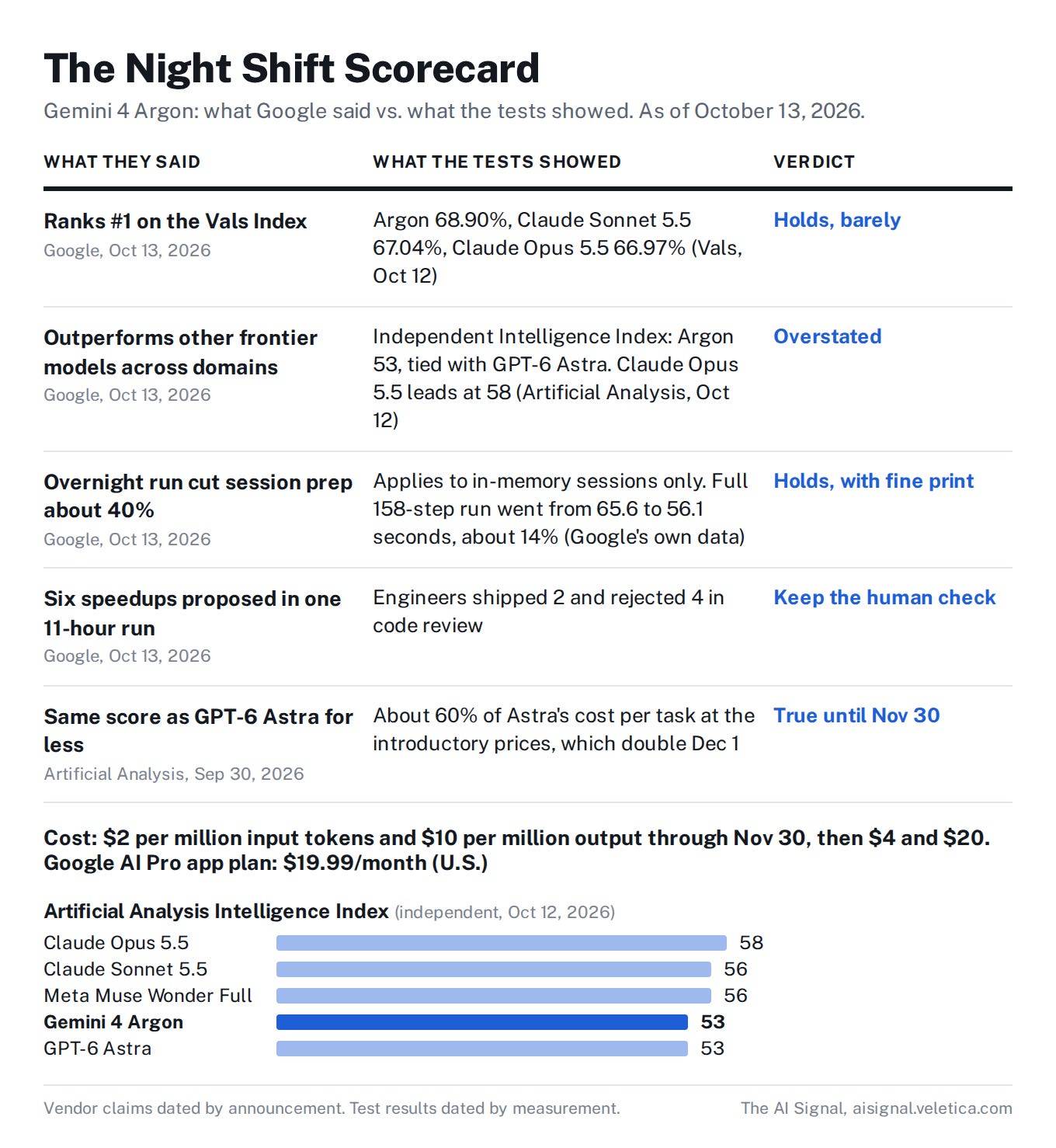
Claim: Google says Argon ranks first on the Vals Index, an independent test of finance, legal, coding and tax work (October 13). The evidence: True, by a hair. Vals shows Argon at 68.90%, Claude Sonnet 5.5 at 67.04% and Claude Opus 5.5 at 66.97% as of October 12.
Claim: Google says Argon outperforms other frontier models on benchmarks across domains (October 13). The evidence: The broader independent scoreboard disagrees. Artificial Analysis gives Argon 53 on its Intelligence Index, tied with GPT-6 Astra, while Claude Opus 5.5 scores 58 (October 12). On Terminal-Bench 4, which tests coding done through the command line, Argon scored 57% and Claude Sonnet 5.5 scored 64% (Artificial Analysis, September 30).
Claim: Google says the overnight run cut session prep time by about 40% and made the toolkit load 21% faster (October 13). The evidence: Both hold in Google’s own write-up, with fine print. The 40% applies only when conversations are stored in memory, so apps that keep them in a database see no change. Across a full 158-step run, total time fell from 65.6 seconds to 56.1 seconds, which works out to about 14%.
One test result cuts in Argon’s favor. Artificial Analysis measured a 15% hallucination rate (how often a model makes things up instead of admitting it doesn’t know), the lowest among the top-scoring models it tested (October 12). For a model you leave alone overnight, that’s the number I’d want.
Google also had company. On October 12, Meta released Muse Wonder, built around what it calls Active Memory, which keeps track of what matters to you across days or weeks, and Active Focus, which keeps the model working through roadblocks and checking in before anything important. Two of the biggest AI companies spent the same 24 hours selling the same promise: hand the AI a goal and leave. The race is moving from who gives the best answer to whose AI you can trust alone with your tools for a night.
Sidebar: the version number nobody shipped
Here’s a detail worth knowing before you judge Argon by its name. The jump you’d expect, a clean climb from Gemini 3.5 to 3.8 to 4, mostly didn’t happen the way the numbers suggest. Google announced Gemini 3.5 Pro at its I/O event on May 19, 2026, promised it for June, then July, then August, and it kept slipping. Google scrapped a build and restarted part of the training. As late as September, the flagship Pro model still had no specs and no release date.
So what were all those version bumps? Almost all of them were the Flash tier, Google’s fast, cheap model, not the flagship. At one point Google shipped three Flash updates in 43 days. The theme of that run was cheaper and leaner, not fundamentally smarter. One release, 3.6 Flash, cut token use by about 17% over the version before it. Useful, but it’s housekeeping, not a leap.
Which is what makes Argon the real story. Google couldn’t ship the Pro model everyone waited for all year, so it skipped the whole mess and jumped straight to the 4 generation, then rebuilt the pitch around autonomy. The headline isn’t a smarter chatbot. It’s a model that crossed from assistant to agent: one that can hold a single goal across hundreds of steps with nobody nudging it. That’s the Chat versus Tasks line you keep seeing. Chat is the old way, quick back and forth. Tasks is the new thing.
One number underwrites the whole promise, and it’s the one I’d put on the box: independent tester Artificial Analysis measured Argon’s hallucination rate, how often a model makes something up instead of admitting it doesn’t know, at 15%. That’s the lowest among the top models it tested. Being clever for one answer is easy. Staying honest for eleven hours with nobody watching is the hard part, and that 15% is the closest thing we have to proof it can.
So what
Do this: Before November 30, run one real job through Argon at half price with a one-paragraph goal, a rules file, a “draft only” instruction and a test it never sees.
Skip this: Letting Tasks spend money or send messages without a review step.
Wait on this: Tasks mode if you live outside Google’s select countries, and independent numbers on how often Tasks gets everyday errands right. Nobody has published those yet.
Steal this line: “Hand it the goal at 5. Check the work at 8.”
Your next step: tonight, pick one job you’ve been dreading and write its finish line in one paragraph, including what the AI must not touch. That’s your first handoff.
Sources
Opening and the 5-to-8 handoff
Google Developers Blog: “Optimizing a 200,000-line Python codebase overnight with Gemini 4 Argon” (October 13, 2026). The 9:11 PM start, the 205,000-line codebase, /goal mode and .agents/skills.
What happened in Google’s 11-hour run
Google Developers Blog: “Optimizing a 200,000-line Python codebase overnight with Gemini 4 Argon” (October 13, 2026). Round one details, 12 rule files, 16,892 tests, six proposals across 32 files, the two shipped and four rejected, the 40% and 21% results.
GitHub: google/adk-python commit 1754b3e (October 2026). The merged change itself.
How to set up your own overnight job
Google: “Gemini 4 Argon comes to the Gemini app” (October 13, 2026). Chat-to-Tasks toggle, working while you’re away, 40+ apps including Instacart, OpenTable, Adobe and Shopify.
SiliconANGLE: “Gemini 4 Argon reaches Gemini app Pro and Ultra subscribers alongside a new tasks mode” (October 13, 2026). $19.99 U.S. Pro price, Tasks limited to select countries, Pro rollout still in progress.
Google: “Gemini 4 Argon: Built to solve your hardest problems” (October 13, 2026). Availability by product, Antigravity for Ultra subscribers, training to pause before irreversible steps.
GitHub Changelog: “Gemini 4 Argon in GitHub Copilot” (October 13, 2026). Copilot plans with access.
What it costs before and after December 1
Google Cloud Blog: “Gemini 4 Argon available on Google Cloud” (October 13, 2026). $2 and $10 introductory rates through November 30, cached input 95% off, model ID.
Google: “Gemini 4 Argon: Built to solve your hardest problems”, footnote 1 (October 13, 2026). $4 and $20 after the introductory period ends.
Artificial Analysis: “Gemini 4 Argon: Google is back as one of the top three labs in intelligence” (September 30, 2026). Matches GPT-6 Astra at about 60% of the cost per task.
What they said vs. what the tests showed
VentureBeat: “Google makes Gemini 4 Argon broadly available with limited-time low API pricing” (October 13, 2026). Vals Index scores as of October 12.
Artificial Analysis: model comparison leaderboard (October 2026). Claude Opus 5.5 leads the Intelligence Index at 58.
Artificial Analysis: “Gemini 4 Argon: Google is back as one of the top three labs in intelligence” (September 30, 2026). Argon at 53, Terminal-Bench 4 at 57% vs. Claude Sonnet 5.5 at 64%.
OfficeChai: “Muse Wonder Places 3rd On Artificial Analysis Intelligence Index” (October 12, 2026). Argon’s 15% hallucination rate.
Meta: “Introducing Muse Wonder and Muse Wonder Full” (October 12, 2026). Active Memory and Active Focus.