

For about two years, “open-source AI” was polite code for “the cheaper thing you settle for.” You ran it locally. You shrugged at the rough edges. You told yourself the twenty-point benchmark gap was fine, because hey, it was free, and free covers a lot of sins.
That sentence is now wrong. Three models are the reason it is wrong.
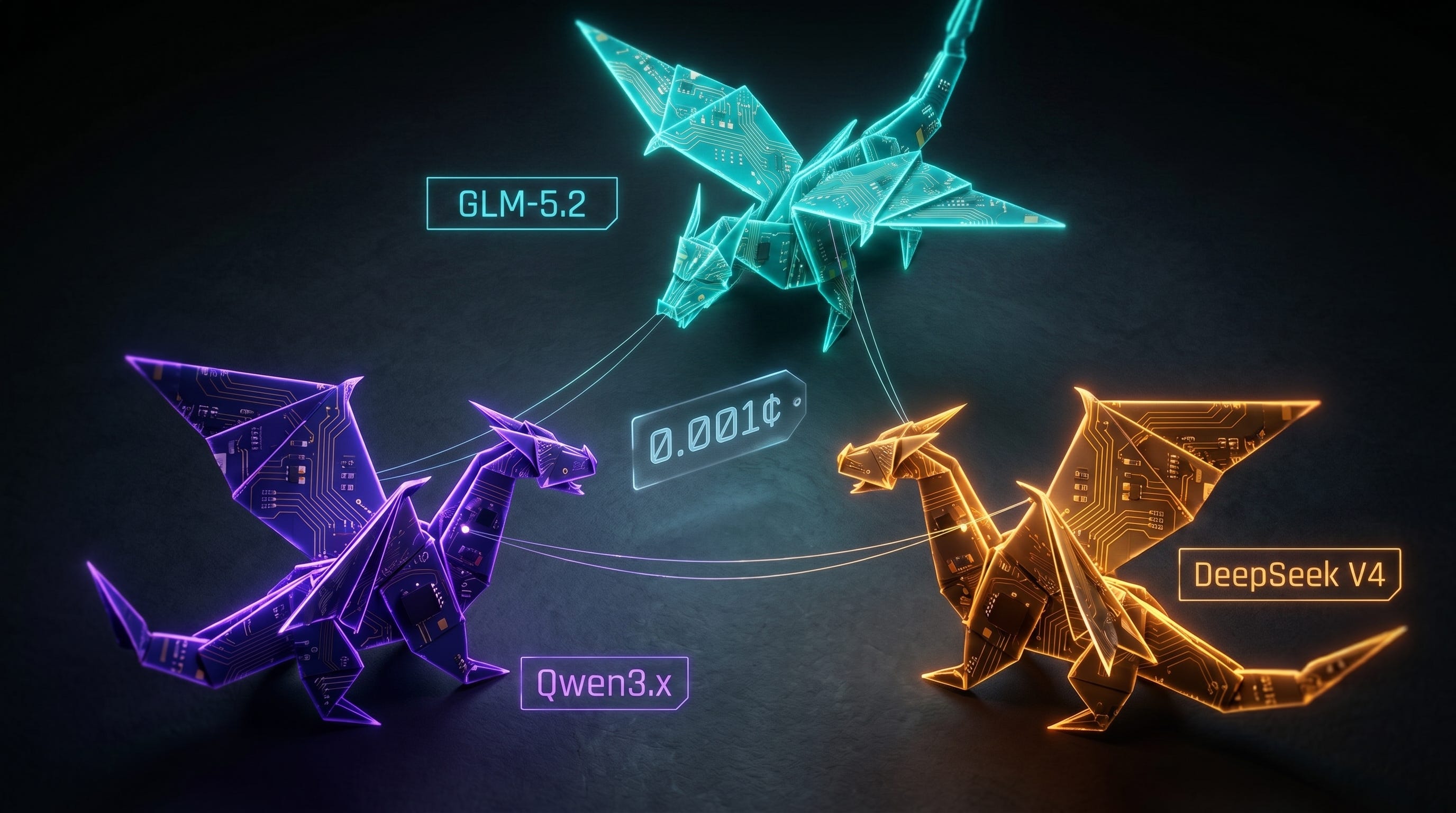
GLM-5.2, DeepSeek V4, and the Qwen3.x family have quietly flipped the entire conversation. The interesting fight in AI right now is not open versus closed. It is open versus open. Multiple labs are shipping weights you can download, self-host, and run at a sliver of frontier pricing, and they are trading real punches on real software-engineering benchmarks. Not vibes. Benchmarks with numbers and independent scorers.
So here's how we do this. I'll show you what each of the three was actually built for, then hand you the stuff nobody prints on the box. Because the stuff they leave off the box is what saves you a wasted weekend.
GLM-5.2 bet on raw intelligence.
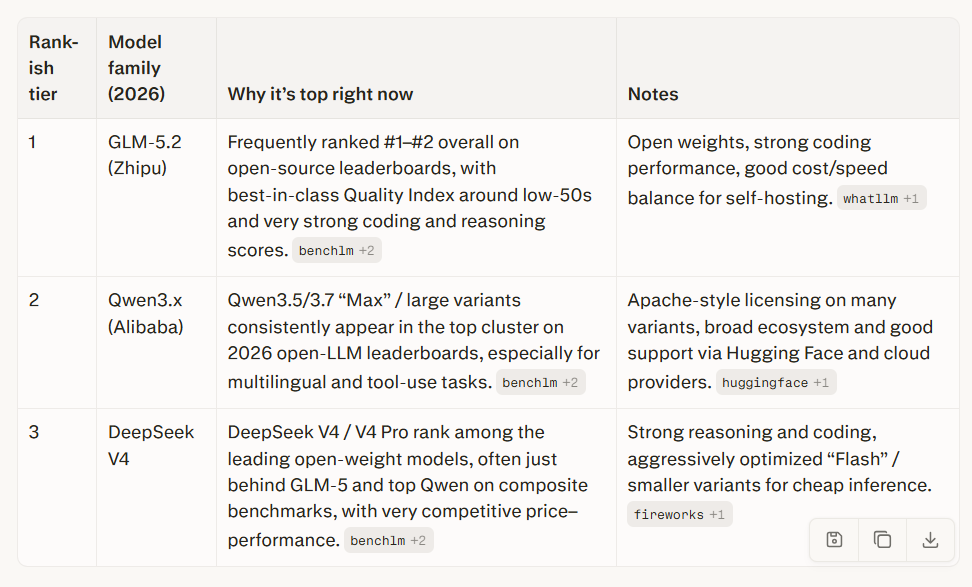
Zhipu AI, which now goes by Z.ai, released GLM-5.2 to its coding subscribers on June 13, 2026, then dropped the open weights on Hugging Face under an MIT license the following week. It is a Mixture-of-Experts model with roughly 744 billion total parameters and about 40 billion active per token, which is the trick that lets something this big stay affordable to run. Only a fraction of the brain fires for any given word.
The headline spec is a genuinely usable one-million-token context window. Not a spec-sheet number you can technically hit and then cry over the bill. Zhipu built a stack of attention tricks specifically so you can actually fill that window without setting your GPU budget on fire.
Here is the part that made people sit up. On the Artificial Analysis Intelligence Index, which is an independent scorer and not the lab grading its own homework, GLM-5.2 posted the top score of any open-weight model as of June 2026, landing in the top five overall against the closed giants. On LiveBench’s agentic coding measure, it beat every proprietary model in the table. An open download. Beating the models you pay dollars per million tokens for. Read that twice.
The catch: no vision support yet. If your workflow needs the model to look at a screenshot or a diagram, GLM-5.2 taps out.
DeepSeek V4 bet on price, and honestly, on physics.
DeepSeek V4 arrived April 24, 2026, MIT-licensed, in two flavors. V4-Pro runs 1.6 trillion total parameters with 49 billion active, which makes it the largest open model released to date. V4-Flash is the lean 284 billion version for when you need answers fast and cheap. Both ship with a one-million-token context window.
The genuinely impressive engineering is under the hood. At full one-million-token context, V4-Pro uses roughly a quarter of the per-token compute and a tenth of the memory footprint compared to the previous generation. That is not a marketing flourish. That is the difference between “we can serve this” and “we filed for bankruptcy serving this.”
Now the money. V4-Pro lists around $0.44 per million input tokens and $0.87 per million output. For a reference point, closed frontier models like Claude Opus and GPT-5.5 sit in the neighborhood of five dollars in and twenty-five to thirty dollars out. That makes V4-Pro somewhere around twenty-eight times cheaper per output token than Opus. Same rough coding class, a rounding error on the invoice.
The honest caveat, and this one is my favorite because it is so on-brand for how AI actually works: DeepSeek V4 landed quietly. The most anticipated open model of the year showed up to a half-empty room. Partly because the industry got obsessed with infrastructure instead of models, and partly because a younger lab’s Kimi K2.6 edged it out on a few coding evals right around the same window. The king arrived, and the crowd was already looking at their phones. Relatable, frankly.
Qwen3.x bet on breadth. And then things got complicated.
Alibaba’s Qwen team plays a different game entirely. Instead of one hero model, they carpet-bomb the ecosystem with sizes, from tiny models that run on a phone up to a 480-billion coding specialist. The Apache 2.0 license on most of them is the cleanest commercial license in the bunch, which is why Qwen quietly became the most-downloaded open model family on the planet, crossing hundreds of millions of downloads and grabbing more than half of all open-source model downloads globally earlier this year.
The reason I say “Qwen3.x” instead of pinning one version is that the family moves fast. Qwen3.5 dropped in February 2026. Qwen3.6 in April. Qwen3.7 in May. If you blinked in Q2, you missed a generation.
But here is the twist the cheerleaders skip. Starting with the Qwen3.6 flagship in April 2026, Alibaba’s top-tier “Max” models went closed. API only. No download, no self-hosting, no weights. The models you can actually run yourself are now the excellent mid-size ones, like the 35-billion-parameter Qwen3.6-35B-A3B that fits on a single consumer GPU and still punches absurdly above its weight. The frontier of the open family left the open commons. That is a real crack in the “open” story, and if you are building on Qwen, you need to know which door just closed.
The asterisks nobody prints on the poster.
Let me be the friend who ruins the hype at the party, because that is the whole job here.
First, “open source” is doing a lot of lying. None of these are open source in the strict sense. You get the weights, not the training data or the full recipe. The accurate term is “open weight.” It matters, because you cannot fully reproduce or audit these models, you can only run them.
Second, a chunk of the flashy benchmark numbers is self-reported by the labs. The ones I leaned on here, from Artificial Analysis and LiveBench, are independent, and I flagged the vendor-reported ones as we went. Treat any single leaderboard number as a starting point, not gospel. Run the model on your own actual tasks before you bet a product on it.
Third, “free” is not free. Self-hosting a 1.6-trillion-parameter model requires serious GPU hardware. The weights are free. The rack of chips to serve them is very much not. For most people, the real win is the cheap API, not the download.
Fourth, the gap is smaller, not gone. On the hardest from-scratch software-engineering tasks, the best open-weight scores land in the low-to-mid 80s, while the top closed frontier models still sit in the high 80s and above. Closing 90 percent of a gap is incredible. It is also not 100 percent, and on your gnarliest problems that last stretch is exactly where things break.
The geopolitics, briefly, because it is genuinely part of the story.
GLM-5.2’s open-weight release timing was widely read as a direct response to the US ordering Anthropic to block foreign access to its top models in mid-June 2026. Washington restricts, Beijing open-sources, developers worldwide grab the free download. That export-control situation shifted again at the end of June, and it is a fast-moving policy fight, so treat any snapshot as temporary. I am not here to tell you who is right. I am here to point out that when access gets restricted at the top, bargaining power quietly slides toward whoever is giving their model away.
So what does this actually mean for you and me?
This is the part that matters more than any leaderboard.
When frontier-adjacent intelligence is available open-weight for pennies, the constraint on what you can build stops being “can we afford to call an LLM.” It becomes “can we design our product intelligently enough to use one.” That is a completely different question, and it is a far more empowering one. The bottleneck moved from your wallet to your imagination. That should genuinely excite anyone who has ever had an idea and no budget.
The takeaway I would hand you today: if you are building anything, spend an afternoon routing your cheap, high-volume tasks to something like DeepSeek V4-Flash and your hard tasks to GLM-5.2, and watch your AI bill do something you have not seen it do in a while, which is go down. Realistic expectation, so nobody comes for me later: these models will not magically replace your judgment, they still trail the closed frontier on the truly hard stuff, and self-hosting is a real infrastructure commitment, not a free lunch. But as a builder’s toolkit, right now, this is the best value that has ever existed. Full stop.
Which Open-Source LLM would you like to try?
SOURCES:
GitHub, official GLM-5 / GLM-5.2 repository (Z.ai): https://github.com/zai-org/GLM-5
DeepSeek-V4-Pro model card and technical report (Hugging Face): https://huggingface.co/deepseek-ai/DeepSeek-V4-Pro
DeepSeek V4 preview release notes (official API docs): https://api-docs.deepseek.com/news/news260424
Official Qwen3.6 repository (Alibaba Qwen team): https://github.com/QwenLM/Qwen3.6
Qwen entry, model family and release history (Wikipedia): https://en.wikipedia.org/wiki/Qwen
Qwen flagship goes closed-weight, analysis (Remio): https://www.remio.ai/post/qwen3-6-open-source-model-beats-a-397b-giant-while-alibaba-quietly-closes-weights-on-its-flagshi
GLM-5.2 open-source coverage (South China Morning Post): https://www.scmp.com/tech/tech-trends/article/3357115/zhipu-ais-stock-rockets-after-chinese-firm-makes-glm-52-open-source
GLM-5.2 launch and geopolitical context (Pandaily): https://pandaily.com/zhipu-ai-glm-5-dot-2-open-source-mit-jun2026
DeepSeek V4 quiet-landing analysis (Lambda): https://lambda.ai/blog/deepseek-v4-the-most-expected-open-source-model
DeepSeek V4 verified specs and pricing (Morph): https://www.morphllm.com/deepseek-v4
Open-weight coding showdown, GLM-5.2 vs DeepSeek V4 vs Qwen3 (Developers Digest): https://www.developersdigest.tech/blog/glm-5-2-vs-deepseek-v4-vs-qwen3-open-weights-coding-showdown
Open-weight model decision framework, June 2026 (Lushbinary): https://lushbinary.com/blog/open-weight-ai-models-comparison-what-to-choose/
Self-hosted open coding LLM benchmarks and LiveBench snapshot (Pinggy): https://pinggy.io/blog/best_open_source_self_hosted_llms_for_coding/
Anthropic statement on Fable and Mythos access changes: https://www.anthropic.com/news/fable-mythos-access