


Last week I sketched out a business idea: AI voice agents that answer the phone for HVAC, roofing, tree trimming and stump grinding companies. Big-ticket trades, where one missed call can mean a lost four-figure job.
Then Google open-sourced AX, a system built to run enormous fleets of AI agents, and my first instinct was to rebuild the whole plan on it by Friday. My second instinct should have been to lie down until the first one passed.
The verdict: not yet. For your first couple dozen customers, AX is a forklift for moving a sofa. A $25.99-a-month server does the job. AX earns its place later, when every customer has a crew of AI workers, and most of them are asleep at any given moment. That second business is the one worth building toward.
I broke down four things: what AX does in plain English, why it stays out of a live phone call, the $26 setup for your first customers, and the When-to-Switch Table for going from 1 customer to 20,000.
What AX does, in plain English
Think of AX as an apartment building for AI agents.
Every agent needs somewhere to live: a computer, files, tools, passwords, and permission to reach certain websites. One agent is easy. Ten thousand is a landlord’s nightmare, especially when most of the tenants are asleep.
Google released AX this month under the Apache 2.0 license, which lets anyone use it commercially for free. It runs on Agent Substrate, a Google engine that became available on Google Kubernetes Engine (GKE) on September 15. Kubernetes is the software that manages apps across lots of machines, basically air traffic control for servers.
Together they let a builder do things that used to take a custom infrastructure team:
Put an idle agent to sleep with its memory and files saved, then wake it in under half a second when work shows up. Google says Substrate resumes agents in under 500 milliseconds.
Pack over 1,000 sleeping agents onto one machine, by Google’s count, because idle agents hand their memory and processor back.
Give each agent a locked room. AX uses four building blocks:
Task is the job.
Workspace holds the files, code, and tools the agent starts with.
Gateway is the short list of websites it may reach, with passwords added outside the agent’s reach.
Model is which AI model it uses.
Plug in outside tools through MCP, a standard connector that lets an AI use things like your calendar or CRM.
Picture it at Bob’s Roofing. Bob has 20 AI employees. One answers the phone, another follows up on estimates, a third asks happy customers for reviews, and the rest handle scheduling, the CRM, and storm-season overflow. At any moment, 19 of them are asleep in the break room while one is on the phone with a man whose oak tree now lives in his attic. AX exists so Bob isn’t paying rent on the 19 who are napping.
Why AX stays out of a live phone call
A phone call is the one moment you never want an agent napping.
Caller: “What times do you have tomorrow?”
Agent: “Great question. Suspending to save compute.”
The live call belongs to the voice model. Gemini 3.8 Live has been generally available since September 15. It hears the caller, reasons, and talks back in a single model.
The older setup was a relay: speech-to-text, then a language model, then text-to-speech. Every handoff adds a pause, and callers hang up on pauses.
The new model also keeps talking while it works. Tool calls, like checking a calendar, now run in the background by default. The caller hears “let me check that” instead of dead air.
Google ships two versions, and the difference matters for trades work:
Gemini 3.8 Live - is the fast, cheap one. Use it when the job is simple: answer questions, take a message, collect an address.
Gemini 3.8 Live Extended Thinking - reasons in the background while it talks. Use it when a call means juggling several tools, like checking the service area, finding an open slot, and booking it.
The quick way to tell them apart: Live talks while it fetches. Extended Thinking talks while it thinks.
The $26 setup for your first customers
For roughly your first 20 contractors, the whole thing can live on one Hostinger KVM 8. That’s 8 processor cores and 32 GB of memory for $25.99 a month.
That works because Gemini runs on Google’s machines, so your server doesn’t need expensive graphics cards. Your server only has three jobs: pass audio back and forth, run the customer dashboard, and keep the database.
The trick that keeps it cheap is treating each customer as a row in a database instead of a separate server. Here’s how that plays out:
When a call hits Mike’s Tree Service, the system looks up Mike’s number.
It loads his hours, service area, prices, and preferred voice.
It starts a Gemini session with Mike’s details inside.
ABC Heating’s call does the same with ABC’s details.
Builders call this multi-tenant: one app, many customers.
A contractor can set everything up through the dashboard with no developer involved. They add hours, services, a service radius, their FAQ, a calendar, their CRM, and a phone number. Then they pick a voice and set when the agent should hand off to a human.
Under the hood, it’s a handful of standard pieces:
A web dashboard for customers.
A Postgres database with pgvector for each customer’s knowledge base. pgvector searches by meaning, so “my AC is blowing warm air” finds the answer filed under cooling problems.
Redis for sessions and queues.
The voice service.
A background worker for summaries and follow-ups.
Docker Compose, a single config file that starts every piece at once, ties it together.
One habit pays off later. Log everything as a named event: call started, lead created, estimate sent, estimate ignored for three days, job completed, review needed. Today those events fill a to-do list. Later, each one can wake up an agent, and that’s the day AX becomes useful.
The When-to-Switch Table
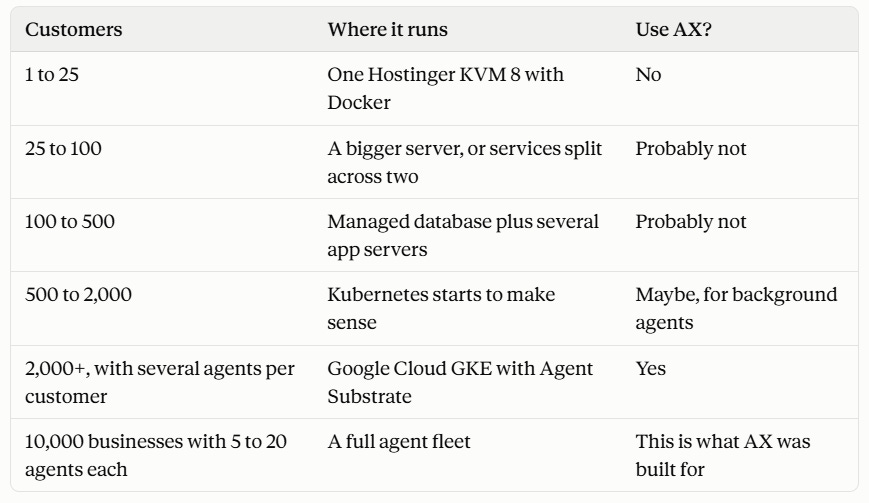
The customer counts are judgment calls. Your real signal to switch is paying for lots of agents that spend most of the day waiting.
Where AX can run: Google says Substrate works on any Kubernetes cluster, so Amazon EKS, Microsoft AKS, or your own hardware can work in principle. Google’s supported path today is GKE in Standard mode, version 1.36 with beta features turned on, or 1.37 and later.
I wouldn’t put AX on a single rented server. You’d be installing a distributed system to solve a problem you don’t have yet.
What it costs, and the license
AX: free and open source under Apache 2.0. There’s no stable release yet; the project says it’s validating design decisions in public first.
Agent Substrate: free and open source. On GKE, it’s open to all customers for testing. Production support goes through an allowlist, meaning you apply and wait.
The cluster underneath: GKE charges $0.10 per cluster per hour, about $72 for a full month. Google’s $74.40 monthly credit covers one single-zone cluster’s fee per billing account. The machines are billed on top. So AX is free the way a free puppy is free.
The voice: At Google’s published rates, Gemini 3.8 Live costs about half a cent per minute of caller audio and about 1.8 cents per minute of the agent’s voice. Extended Thinking bills its thinking at the voice-output rate, so the same call costs more. In Artificial Analysis’s cost test, an hour of input audio ran $0.84 on base Live and $3.50 on Extended Thinking.
A worked example: a seven-minute call where the agent talks the entire time comes to about 16 cents at those per-minute rates. That’s before any thinking tokens and before your phone provider’s per-minute fees.
The server: $25.99 a month for the first two years on the KVM 8.
What they said vs. what the tests showed
Claim: Agent Substrate runs agents at 10 times the density of standard containers (Google, September 15, 2026).
The evidence: No independent benchmark exists yet. Solo.io’s June 12, 2026 walkthrough reported about 250 agent sessions running on 8 Kubernetes pods. That’s a third-party demo, not a controlled test. Treat 10x as vendor-reported.
Claim: Google’s docs call Gemini 3.8 Live the default for most low-latency voice agents (Google AI for Developers, September 2026).
The evidence: Artificial Analysis’s τ-Voice test checks whether a voice agent finishes multi-step tool tasks. On it:
Base Live scored 30.1%.
The previous Gemini 3.1 Flash Live scored 37.7%, so base Live came in below its own predecessor.
Extended Thinking scored 68.6%.
(Reported by DataCamp, September 17, 2026.)
Human listeners rank the two models the other way. In the blind Speech Agent Arena, Extended Thinking sits seven places behind base Live (reported by Heise Online, September 2026). So base Live sounds better, and Extended Thinking finishes more bookings. Test both on real calls.
Claim: 62% of calls to small service businesses go unanswered. The figure comes from a 411 Locals study of 85 small businesses (as reported by Automatdo, April 3, 2026).
The evidence: Invoca’s call data across home-service contractors shows a 27% missed rate, a 2024 to 2026 rolling average (as reported by Grovi, June 9, 2026). Both numbers come from companies that sell phone tools. Consider the figure disputed. Both sources agree that after-hours calls are where the misses pile up.
So what
Do this: Build the voice receptionist on one server, one app for all customers, with every event logged from day one.
Skip this: Kubernetes and AX for your first 25 customers.
Wait on this: AX in production. No stable release yet, and production support is still by application.
Steal this line: “The phone agent is employee number one. The business is the other nineteen.”
For most of history, a six-person roofing crew couldn’t afford a front office. Somebody’s spouse answered the phone between school pickups, and the calls that came in during a storm just rang out. That’s changing. The voice agent gets you in the door, and a sleeping AI back office is where the real business grows.
Build the receptionist first. Log the events. When your bill starts showing thousands of agents sitting around waiting, that’s your cue to call AX.
Talk soon.
Sources
What AX does, in plain English
InfoQ: Google Open-Sources AX, a Kubernetes Style Orchestrator for Autonomous AI Agents (Sep 22, 2026). Backs the AX release, the Apache 2.0 license, and the four building blocks.
Google Cloud Blog: Agent Substrate brings high-density, scalable, trusted infrastructure to GKE (Sep 15, 2026). Backs the GKE availability date, under-500-millisecond resume, and 1,000+ dormant agents per host.
GitHub: google/ax README (accessed Sep 23, 2026). Backs MCP server wiring, the Gateway allowlist, and install requirements.
Why AX stays out of a live phone call
DataCamp: Gemini 3.8 Live: Features, Benchmarks, Pricing, and Access (Sep 17, 2026). Backs the September 15 release and background tool calls by default.
Google AI for Developers: Thinking in the Live API (accessed Sep 23, 2026). Backs the Live vs. Extended Thinking use cases.
The $26 setup for your first customers
Hostinger: VPS in USA plans (accessed Sep 23, 2026). Backs KVM 8 specs, the $25.99 price, and the $49.99 renewal.
Grovi: The 2026 Contractor Missed Call Report (Jun 9, 2026). Backs the four-figure job value, citing ServiceTitan’s average residential HVAC emergency ticket of $1,400.
The When-to-Switch Table
Google Cloud Docs: About GKE Agent Substrate (accessed Sep 23, 2026). Backs the GKE Standard and version 1.36/1.37 requirements.
What it costs, and the license
Go Packages: github.com/google/ax (accessed Sep 23, 2026). Backs the pre-stable-release status.
Google Cloud: Google Kubernetes Engine pricing (accessed Sep 23, 2026). Backs the $0.10 per cluster per hour fee and the $74.40 monthly credit.
DataCamp: Gemini 3.8 Live, pricing section (Sep 17, 2026). Backs the per-minute audio rates and the $0.84 vs. $3.50 hour-of-audio figures.
What they said vs. what the tests showed
Solo.io: How Google Agent Substrate Works (Jun 12, 2026). Backs the 250 sessions on 8 pods demo.
heise online: Gemini 3.8 Live, Upgrade for Real-time Voice Models for Voice Agents (Sep 2026). Backs the Speech Agent Arena ranking.
Automatdo: The Real Cost of Missed Calls for Home Services Companies (Apr 3, 2026). Backs the 62% figure and its 411 Locals origin.