

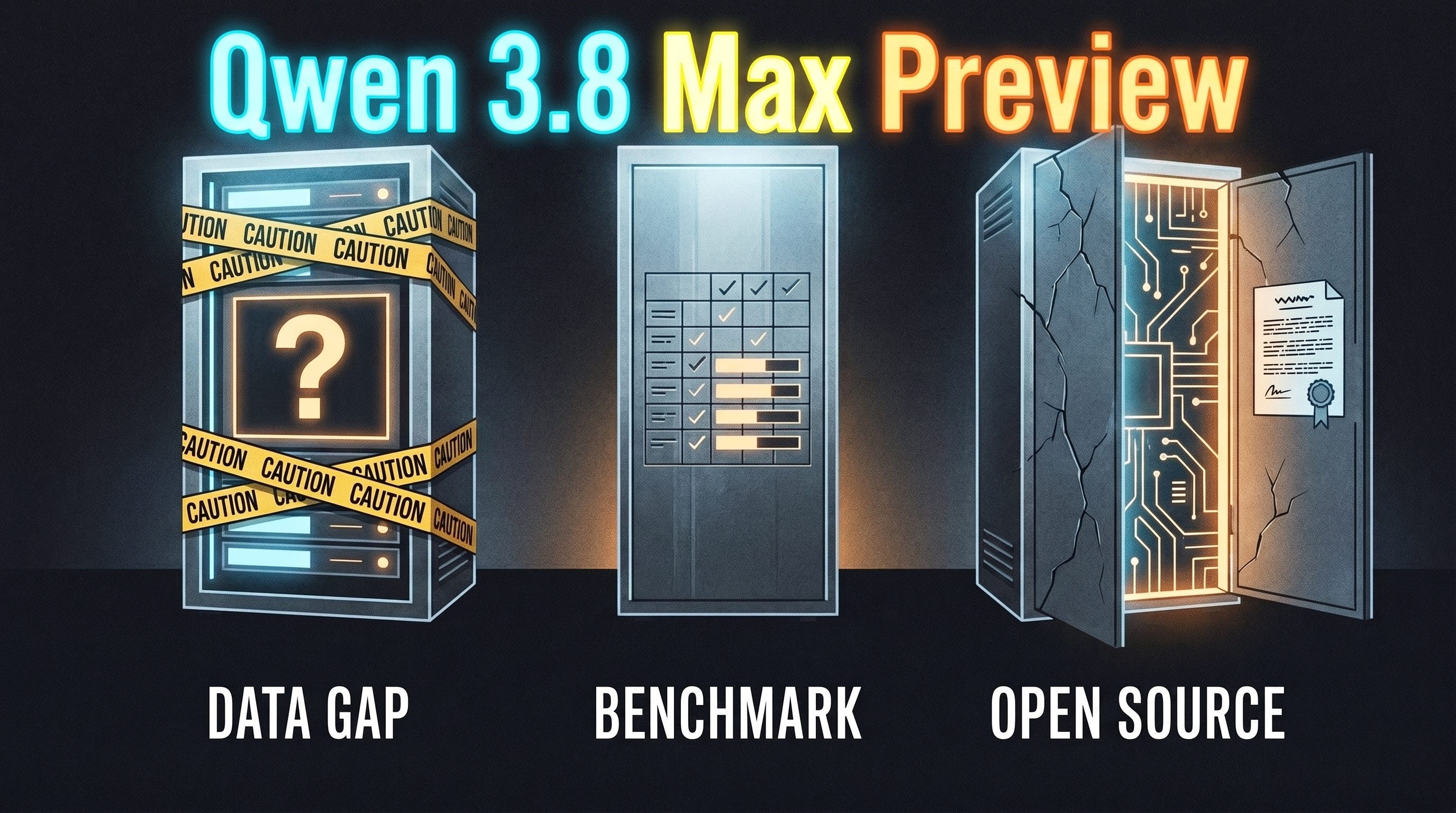
The gap between Moonshot dropping a 2.8 trillion parameter model on the world and Alibaba announcing its 2.4 trillion parameter answer was eight days. Neither lab waited for the other to finish talking.
So which one belongs in your stack?
Short version, so you can bail out whenever you want. Qwen 3.8 Max Preview is an evaluation target, not a dependency. Kimi K3 is the one with a neutral referee’s score attached. GLM 5.2 is the one you can download today with a license file you can actually read. The word doing all the heavy lifting in “Qwen 3.8 Max Preview” is Preview.
Now the receipts.
What Alibaba actually announced
On July 19, 2026, Alibaba’s Qwen team previewed Qwen3.8-Max-Preview at the World AI Conference in Shanghai, describing it as a 2.4 trillion parameter model and positioning it as second only to Claude Fable 5 among the systems it benchmarked. That positioning is Alibaba’s own framing. No benchmark results, model card, or active-parameter count were disclosed, so the ranking claim is not an independently verified result.
Here’s what is real and checkable. The model takes text, image, and video input, and it speaks both the OpenAI and Anthropic API protocols, which means existing coding agents can connect without anyone rebuilding a harness. Qwen Cloud metadata lists a 983,616 token context window and a 131,072 token maximum output, with thinking always on across low, high, and xhigh settings, and xhigh as the documented default. Qwen announced a new preview build on July 20 claiming broad gains including web frontend work, while describing the model as evolving daily. Also a vendor claim.
And the thing nobody puts in the headline: the active parameter count is the number nobody has. Without it, the 2.4T figure says very little about what serving this thing costs.
The pricing is a subscription, not a price
If your instinct when you read “2.4 trillion parameters” is “sounds expensive,” your instincts are fine. But you can’t actually check.
There is no standalone per-token API rate published for Qwen3.8-Max. Access is bundled into a credit-based Token Plan subscription, sold during preview at 10% of standard pricing across Token Plan, Qoder, and QoderWork, with an additional 80% off night discount that drops off-hours consumption to roughly 0.2% of the standard rate. Qoder’s own event page confirms the off-peak window runs 22:00 to 08:00 Singapore time, with an end date listed as TBD.
Token Plan Personal tiers run roughly $6 a month for Lite, about $20 for Standard, and about $70 for Pro, converted from CNY prices that move with the exchange rate. What separates those tiers isn’t model access, it’s how many agents you can run at once.
A promotional rate on an undefined unit for a model that changes under you is a trial, not a budget line. Third-party resellers have started listing per-token figures for the preview endpoint, but those are reseller rates, not Alibaba’s published price.
Kimi K3 is the one with a scorecard
Moonshot launched Kimi K3 on July 16, 2026, a 2.8 trillion parameter model with native multimodal support, a 1 million token context window, and always-on reasoning. Some outlets date the launch to July 17.
The difference from Qwen isn’t size. It’s that somebody outside the company checked the homework. Artificial Analysis put K3 at 57 on its Intelligence Index, comparable to Opus 4.8 and GPT-5.5, behind Fable 5 and GPT-5.6 Sol. It also took first place on Frontend Code Arena at 1679 Elo, a seventeen-place jump from K2.6.
The catch is the bill. K3 runs $3.00 per million input tokens and $15.00 per million output, with a $0.30 cache hit rate. During the Artificial Analysis evaluation, K3 generated 130 million output tokens against 70 million for GPT-5.6 Sol and 87 million for Fable 5. Developer Theo Browne’s widely shared read was blunt about the gap between per-token price and per-task price. Artificial Analysis put K3’s cost per task at $0.94, close to GPT-5.6 Sol at $1.04 and about half of Opus 4.8.
One thing to note on sourcing. Artificial Analysis reported K3’s GDPval-AA v2 Elo at 1668, while VentureBeat reported 1,687 for the same benchmark. Small gap, but it’s there, and I’d rather you know than not.
And the weights? As of July 20, no official K3 Hugging Face repository or license had been published, with Moonshot planning full weights by July 27. That date is three days out from this writing.
GLM 5.2 is the one you can hold
Z.ai released GLM 5.2 with weights on Hugging Face under an unrestricted MIT license, letting teams download it, fine-tune it, and self-host it for the cost of their own compute. It posts 62.1 on SWE-bench Pro and 81.0 on Terminal-Bench 2.1, and Z.ai’s list price is around $1.40 per million input tokens and $4.40 per million output.
Two caveats worth your attention. The parameter count is disputed. Both 744B and 753B appear across vendor and reseller pages, with Artificial Analysis using 744B total and roughly 40B active. And route pricing swings hard. OpenRouter has routed GLM 5.2 well below Z.ai direct, and its own listing currently shows $0.77 input and $2.42 output. Check your route before you model your costs.
It’s also verbose, burning around 43K output tokens per Index task against 16K for GPT-5.5, which pushes effective cost per task closer to the frontier than the sticker suggests.
So, What
Do this: If you need open weights on disk this week, GLM 5.2 is the only one of the three that qualifies. It’s cheaper, open today, and independently verified.
Wait on this: Kimi K3 for self-hosting. The API is live and the scores are real, but the weights and the license land July 27. Prep your vLLM or SGLang staging now and route production through the API in the meantime.
Skip this for now: Migrating anything to Qwen 3.8 Max Preview. Test it, absolutely. But treat it as an evaluation target, keep a known-good fallback, and expect outputs to shift without the model ID changing.
Stealable takeaway: A parameter count is a marketing number. The active parameter count, the license file, and the third-party score are the buying numbers. If a launch gives you the first and not the other three, you’re reading an announcement, not a release.