

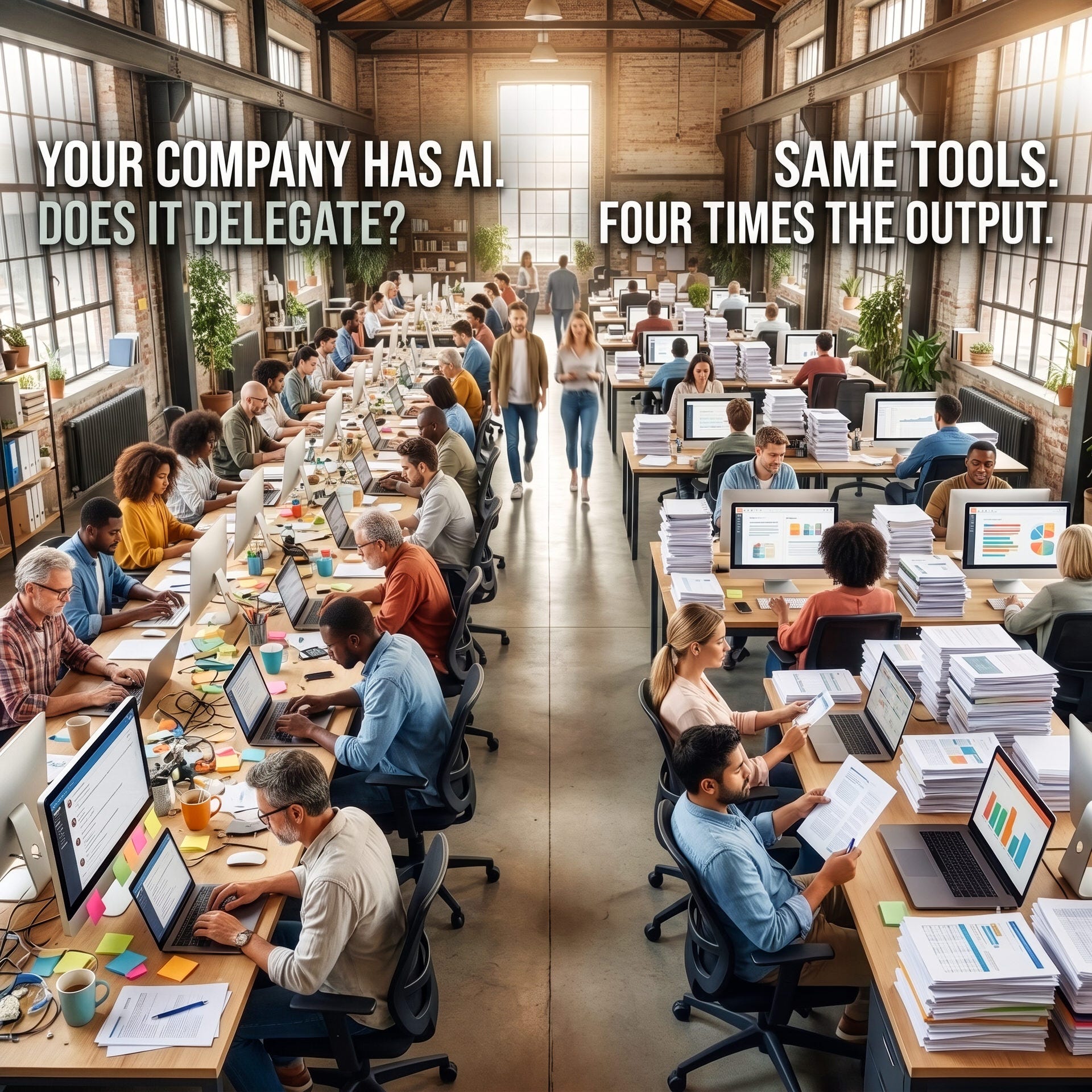
For three years, companies have bragged about one AI number: how many people have it. They counted seats, logins, and licenses handed out at the all-hands like free pizza. That number just got old.
On October 14, OpenAI published usage data from its business customers in the European Union. By September 30, agents wrote 55% of the text OpenAI’s AI produced for those companies over the previous four weeks, according to OpenAI’s own chart. Agents here means ChatGPT Work and Codex, the tools you hand a whole job to. ChatGPT Work only launched in July.
My verdict: at work, the number that matters now is how much of the job your people hand to AI. And the companies using AI the hardest are pulling away fast, a gap OpenAI says widened as agent use grew. In September, the heaviest-using 10% of EU companies produced more than four times as much AI output per person as a typical EU company. The heaviest users outside the EU produced more than twice as much. They all had the same tools in the same month, with wildly different habits.
The simplest way I can put the difference: chatting is asking a coworker how to build the quarterly report. Delegating is coming back from lunch to find the report on your desk, with a sticky note about the two numbers it couldn’t confirm.
We’ve all done the chatting version. Paste the error into the chat window, type “why,” copy the answer, paste it somewhere else, repeat forty times, then tell your boss you “use AI.” Congratulations, you’re the AI’s unpaid intern.
What you can hand off now that you couldn’t in May
None of these four existed in their current form back in May. Now they ship inside apps you may already pay for.
A whole job, start to finish, in ChatGPT. ChatGPT Work takes a goal, gathers context from your files and connected apps, makes a plan, and returns a finished doc, deck, spreadsheet, or site. One of OpenAI’s own examples: find the emails you need to answer, summarize each one, draft replies, and leave them unsent for you to review. Its Plan mode asks questions and shows you the steps before it starts.
A task that keeps going after you close the laptop. On October 13, Google added a chat-to-tasks toggle to the Gemini app for AI Pro and Ultra subscribers. Flip it, and Gemini keeps working while you’re away from your computer, across more than 40 connected apps. Google’s examples include ordering groceries through Instacart and booking a table on OpenTable.
An assistant that remembers and keeps pushing. Meta launched Muse Wonder on October 12. Meta’s two big claims are Active Memory, which carries details about you from one conversation to the next, and Active Focus, which tries another approach when a task stalls and checks in before important actions. Most of the proof so far is Meta’s own testing.
A coding job split across several top models at once. On October 14, GitHub added HydraFusion Max to Copilot. You don’t pick a model. It drafts, critiques, and revises using a pool that now includes Claude Opus 5.5, GPT-6 Astra, GPT-6.1 Sol, and GPT-6 Luna.
The quick rule: use chat when you want an answer you’ll act on yourself. Use a task or an agent when you can describe the finished thing and check it afterward.
Here’s what that looks like on an ordinary Monday. Chatting: “How should I summarize last week’s support tickets?” Delegating: “Pull last week’s tickets from the shared folder, write the status report in our usual format, flag anything overdue, and leave it as a draft for me.” You drink the same coffee and get a very different morning.
What they said vs. what the tests showed
Claim: OpenAI says agents produced more than half of the output tokens in its EU business sample by the end of September, 55% on its September 30 chart (published October 14, 2026).
The evidence: The data is real, and it comes with four big footnotes.
It counts text, and text isn’t finished work. An agent plans, drafts, checks, and rewrites, so one job can produce far more text than a quick chat answer. Read the 55% as “agents write most of the text,” which is a smaller claim than “agents do most of the work.”
It only covers OpenAI’s own paying business customers. OpenAI’s web page describes the main figure as its Enterprise sample, while the report’s chart note says Enterprise and Business accounts.
The wider economy is far behind. Eurostat found that 20% of EU companies with 10 or more employees used any kind of AI in 2025. In Poland, Eurostat put that figure at 8.4% of companies. Separately, inside OpenAI’s sample, agents wrote 76% of the AI text at Polish business accounts in September 2026. Different measures and different years, so don’t subtract one from the other. The point is that OpenAI’s numbers describe early movers.
Regular people are warier than the charts. In a June survey of 7,675 US adults, published by Channel V Media on October 8, 2026, two in five would hand at least one everyday task to an AI agent, and fewer than one in five called agents a good idea. It’s US data, so treat it as a mood check, not a match for Europe.
What delegation costs
Everything here is a paid, closed-source product. Nothing on this list is open source.
ChatGPT Work: limited access on the Free and Go plans (desktop app only). Plus unlocks it on desktop, web, and mobile at $20 a month in the US. Business seats are $20 per user per month billed yearly, or $25 billed monthly, with a two-seat minimum. Those prices come from independent pricing trackers checked in early October, because OpenAI’s own page loads prices separately. Re-check before you buy.
Gemini tasks: included with Google AI Pro at $19.99 a month in the US. Ultra starts at $99.99 and comes with higher limits. Google says tasks mode is limited to select countries for now.
Muse Wonder: available through Meta’s Model API and Muse Code. Wonder Full is limited to Muse Code subscribers. Check Meta’s rates before you budget.
HydraFusion and HydraFusion Max: research previews on Copilot Pro, Pro+, Business and Enterprise with preview features turned on. GitHub bills by the tokens each underlying model uses, at that model’s standard rate. More models and more thinking mean a bigger bill.
Agents run longer than chats and burn through plan limits faster, so count the cost per finished job. For example, if a $20 seat finishes four weekly reports a month for you, that’s $5 a report. If it finishes zero because nobody hands it anything, that $20 is a very expensive bookmark.
The Delegation Scorecard
Give your team one point for every yes.
In the last week, did someone hand AI a job with a finished output, like a doc, sheet, deck or code change, instead of a question?
Can you name at least two recurring tasks an agent now owns from start to finish, with a person checking the result?
Does someone check the agent’s work against the source before it goes out?
Do you know what one finished job costs, beyond the seat price?
If your heaviest AI user quit tomorrow, would their delegated tasks keep running?
Score 0 to 1: you’re chatting. Score 2 to 3: you’re dipping a toe in. Score 4 to 5: you’re delegating, and you’re probably on the right side of that 4x gap.
What gets me is how new this is. For most of history, handing off work was a privilege. You needed staff. Now a two-person shop can hand a weekly report to software the way a VP hands it to an analyst. The tools are already on most of our laptops, and the habit is what’s missing.
So what
Do this: Pick one recurring task this week. Write down what “finished” looks like, hand the whole thing to an agent, and check it the way you’d check a new hire’s first draft.
Skip this: Reporting seat counts as your AI progress. Bring the delegation number to your next meeting instead.
Wait on this: HydraFusion Max for anything with a tight budget. It’s a research preview billed by the token across several models.
Steal this line: “We stopped counting who AI has. We count what we’ve handed it.”
Thanks for reading. Go delegate something boring this week, and then tell me how it all turned out.
Sources
Intro
OpenAI, “Europe’s Agentic Opportunity” report PDF (October 2026). Backs the 55% agentic share on September 30, the July launch of ChatGPT Work, and the 4x and 2x frontier-firm gaps.
What you can hand off now that you couldn’t in May
OpenAI, “ChatGPT Work” product page (checked October 14, 2026). Backs what Work does, the email example, and Plan mode.
Google, “Gemini 4 Argon is now available in the Gemini app” (October 13, 2026). Backs the chat-to-tasks toggle and 40+ connected apps.
Meta, “Muse Wonder: A Frontier Model For Personal & Professional AI Agents” (October 12, 2026). Backs Active Memory and Active Focus.
GitHub Changelog, “HydraFusion updates and new Max option” (October 14, 2026). Backs HydraFusion Max, the model pool, and plan availability.
What they said vs. what the tests showed
OpenAI, “The EU’s next chapter in AI is agentic” (October 14, 2026). Backs the “more than half” claim and the Enterprise sample wording.
Eurostat, “20% of EU enterprises use AI technologies” (December 11, 2025). Backs the 20% EU figure and Poland’s 8.4%.
PPC Land, “40% of Americans would let AI agents act for them, Channel V Media finds” (October 2026). Backs the two-in-five and fewer-than-one-in-five survey figures.
What delegation costs
OpenAI, “ChatGPT Plans and Pricing” (checked October 14, 2026). Backs Work access by plan and the two-seat Business minimum.
Tech Jack Solutions, “ChatGPT Pricing 2026” (checked against OpenAI’s pages October 4, 2026). Backs the $20 Plus and $20/$25 Business seat prices.
SiliconANGLE, “Gemini 4 Argon reaches Gemini app Pro and Ultra subscribers alongside a new tasks mode” (October 13, 2026). Backs the $19.99 and $99.99 plan prices and the select-countries limit.
Android Authority, “Meta wants Muse to keep up with ChatGPT and Gemini, and Wonder is how” (October 2026). Backs Muse Wonder access through the Model API and Muse Code.
GitHub Community, “HydraFusion is live in GitHub Copilot CLI” (September 1, 2026). Backs token billing at each model’s standard rate.