

Picture hiring an assistant who texts you 40 times before lunch. “Should I send this?” “Which folder?” “Is this the right Dave?” By noon you’ve done none of your own work, and you’re weirdly invested in a Dave you’ve never met.
That’s where a lot of us are with AI agents. The agents got good, and we got promoted to full-time supervisor without a raise.
This week GitHub shipped its answer, and its own data shows why it couldn’t wait. In September, more than 40% of pull requests on GitHub (a pull request is a proposed change to a codebase) started with an agent’s first draft. In March, that share was 17%.
The verdict: If you write code, GitHub’s new agent tools are worth switching on this week, one small chore at a time. If you don’t write code, read on anyway. The same management layer is heading for your inbox, your docs, and the skill that pays next is deciding what deserves your attention.
What you can hand off now
Keep one number in mind: your interrupt count, meaning how many times a day your AI needs you to make a call. Every launch this week is trying to push it down.
At its October 28 Universe conference, GitHub turned Copilot from a helper you chat with into something closer to a shift manager for agents. What changed for you:
You can hand an agent a whole task and walk away. Copilot’s cloud agent, where you assign a task and it works on its own, grew 230% in a year. Agent chat grew 85% over the same stretch.
You can run agents across several projects at once. Copilot projects, in preview, lets you give one goal and have agents work in parallel sessions across multiple repositories, with one place to track progress and make decisions.
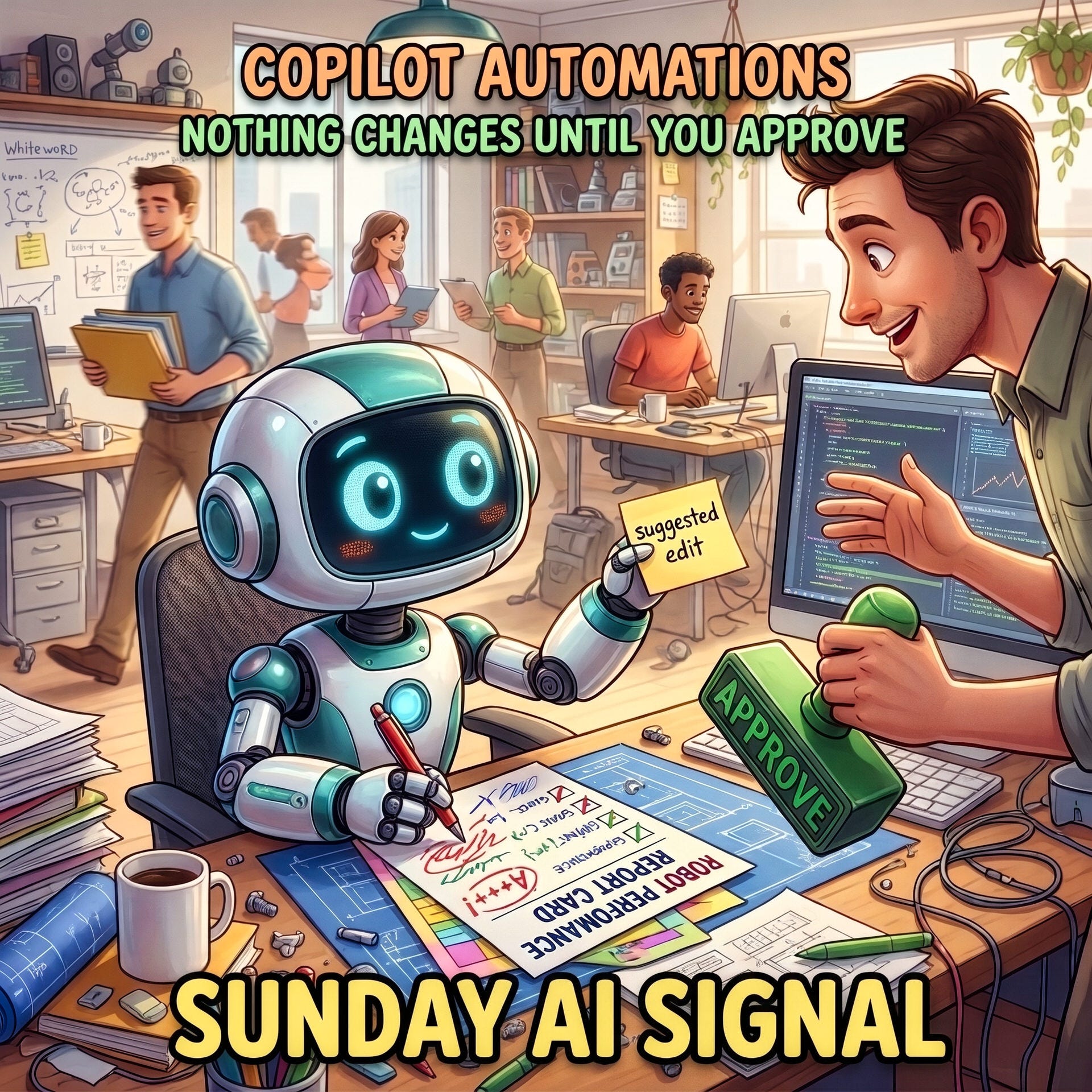
You can schedule repeat chores. Copilot automations run in the cloud on a timer, on an event like a new bug report, or when you click. They use only the tools you allow. The new trick: they review how earlier runs went and propose edits to their own instructions, and nothing changes until you approve.
You can start on your phone and steer from your laptop. One cloud session follows you across the GitHub app, VS Code, the command line, and the web.
You can let Copilot pick the model for you. Copilot Fusion decides which AI model handles each step. Sometimes a cheap model drafts and a stronger one checks the work.
Here’s the same Monday, twice.
The old Monday: you prompt, wait, read, fix, and prompt again until your coffee is cold and your will to live is room temperature.
The new Monday: you set three goals at 9 a.m., agents work in parallel, and a panel shows you the two things that need a human.
DeepSeek landed in the same spot from the other side of the world. On October 31, its Harness team open-sourced a research prototype called dsh-superagent. One “router” agent takes requests and hands them to separate “worker” agents that do the job in their own sessions and report back. A web panel shows what needs a person. The README states the design goal plainly: “take as little human attention as possible, and give as much value as possible.”
What one heavy agent task really costs
License call: freemium, paid for anything serious. Copilot Free costs $0 with a limited allowance. Pro is $10 a month with 1,500 AI credits, Pro+ is $39 with 7,000, and Max is $100 with 20,000. For teams, Business is $19 per seat, and Enterprise is $39. GitHub’s docs price extra organization usage at one cent per credit.
What drives the bill: Fusion charges for each model it uses, at that model’s standard rate, and paid plans get 30% off those model costs for a limited time. The effort level you choose (Standard, High, or Max) decides how much horsepower, and how much money, goes into each task.
The independent number: Artificial Analysis, an independent benchmarking firm, measured Fusion Max at $5.59 in average API cost per task on its Coding Agent Index on October 28. Claude Code with Opus 5.5 Max cost $11.42 per task in the same test. At one cent per credit, a task like that works out to roughly 559 credits, so Pro+ covers about a dozen of them a month before the discount. That’s my rough estimate, and GitHub hasn’t published a per-task figure. Those benchmark tasks are hard on purpose, and GitHub positions Fusion Standard for everyday coding.
One more line item: shared automations bill to whoever owns the repository, not the person who built the automation. That’s great news for whoever builds them and mildly terrifying news for whoever pays.
What they said vs. what the tests showed
Copilot Fusion vs. Claude Code
Claim: A New Stack headline on October 28 said Fusion “beats Claude Code” at half the API cost. GitHub’s own changelog that day was more careful and said Fusion Max landed within two points.
The evidence: Artificial Analysis scored Fusion Max at 60 and Claude Code with Opus 5.5 Max at 62 on October 28. Fusion was about half the API cost per task, at $5.59 vs. $11.42, and it finished second. That cost is pay-per-token API pricing, which isn’t what a Copilot subscriber pays.
“Nobody can review all this code”
Claim: GitGuardian’s write-up of the Octoverse report on October 29 said code is being written faster than anyone can review it.
The evidence: GitHub’s Octoverse report, published October 28, shows commits nearly tripled to 34.3 billion in a year. It also shows agent-started pull requests merged within two weeks 90% of the time in September, vs. about 86% for pull requests without detected agents, and use of AI-assisted code review grew more than 90% year over year. By GitHub’s measures, review is keeping pace so far. Fast merging can’t tell you whether anyone read carefully, which is exactly why your attention is the thing to manage.
DeepSeek’s “super agent”
Claim: A Pandaily post this weekend described DeepSeek’s prototype as an agent that “finds and fixes bugs on its own.”
The evidence: The project’s README, published October 31, calls it a research prototype that isn’t an official DeepSeek product and may still contain bugs. It works on one GitHub repository and takes work when an allowed person asks. Some designs in DeepSeek’s write-up aren’t built yet.
The Babysitting Audit
Run any chore through these five yes-or-no questions before you hand it to an agent.
Can you describe “done” in one sentence?
Can you check the result in under five minutes?
If it goes wrong, can you undo it easily?
Can it run without touching passwords, payments, or messages to real people?
Does it come up at least once a week?
Score it: Four or five yeses, put it on a schedule. Two or three, let the agent draft and you approve. Zero or one, keep it yourself for now.
A Friday sales summary usually scores five. Replying to your biggest client usually scores one, and that’s where your attention belongs.
Skip, wait, steal
Do this: Pick one chore you do every week, run it through the Babysitting Audit, and if it scores four or five, schedule it. On Copilot, that’s an automation. Most agent tools now have their own version.
Skip this: Fusion Max for everyday edits. Max is for the gnarly work, and it bills like it.
Wait on this: DeepSeek’s dsh-superagent, unless you want to tinker in a sandbox. It’s an MIT-licensed research prototype. Also wait on self-hosting Mistral’s newly open Large 4, nicknamed Le Chonk. Its weights went public October 29, and it scores 48 on the same coding-agent index where Claude Code scores 62. It’s also a 1-trillion-parameter model, so plan on data-center hardware to run it.
Steal this line: “I judge my AI setup by how rarely it needs me.”
For two years the question was whether AI could do the work. This week the companies building it started asking how little of your day it can take while it does. Keep an eye on your interrupt count this week. I’m betting mine is embarrassing.
See you next Sunday.
Sources
What you can hand off now
GitHub Blog: Octoverse: Commits, pushes, reach new highs in 2026 as developers build with agents (Oct 28, 2026). Backs the 40% and 17% pull request shares, the 230% cloud agent and 85% agent chat growth.
GitHub Blog: GitHub Universe 2026: Evolving every layer of the stack (Oct 28, 2026). Backs Copilot projects, session continuity, automations that propose their own improvements, and Copilot Fusion.
GitHub Changelog: Build shared workflows for your team with Copilot Automations (Oct 28, 2026). Backs triggers, allowed tools only, repository-owner billing, and plan rollout.
DeepSeek on GitHub: dsh-superagent-prototype README (Oct 31, 2026). Backs the router and worker design, the web panel, the attention quote, and research-prototype status.
What one heavy agent task really costs
GitHub Docs: Plans for GitHub Copilot (checked Nov 1, 2026). Backs plan prices, AI credit allowances, and one cent per extra organization credit.
GitHub Changelog: Route and orchestrate models with GitHub Copilot Fusion (Oct 28, 2026). Backs per-model billing, the limited-time 30% discount, and effort levels.
Artificial Analysis: GitHub Copilot Fusion orchestrates Anthropic and OpenAI models to balance performance and cost (Oct 28, 2026). Backs $5.59 vs. $11.42 per task.
What they said vs. what the tests showed
The New Stack: GitHub debuts Copilot Fusion, a new model selection & orchestration system that beats Claude Code for half the API cost (Oct 28, 2026). The headline claim.
Artificial Analysis: Claude Code vs. GitHub Copilot (checked Nov 1, 2026). Backs the 62 vs. 60 index scores.
GitGuardian: GitHub Octoverse 2026: Five Takeaways for Security Teams (Oct 29, 2026). The review-speed claim.
GitHub Blog: Octoverse 2026 report (Oct 28, 2026). Backs 34.3 billion commits, the 90% vs. 86% merge rates, and 90%+ growth in AI-assisted review.
Pandaily on X: DeepSeek Harness Team Open-Sources a Super-agent Prototype That Finds and Fixes Bugs on Its Own (Nov 1, 2026). The “on its own” claim.
Skip, wait, steal
Mistral AI: Mistral Large 4 (Le Chonk) open weights (Oct 29, 2026). Backs the open-weight release and 1-trillion-parameter size.
Artificial Analysis: GitHub Copilot vs. Mistral Vibe (checked Nov 1, 2026). Backs Mistral Large 4’s index score of 48.