


Sunday AI Signal: one pick worth your attention, what the week’s coverage oversold, and what to do about it on Monday.
By the end of this, you’ll have one question that tells you whether any AI product is worth your money.
For two years I’ve graded chatbots like a talent show judge. I wanted to know which one was smartest and which one wrote the best emails. Meanwhile, the smartest one in the room couldn’t turn off my kitchen light. It could write a sonnet about my kitchen light. It was a lovely sonnet, and the light stayed on.
That changed between September 15 and 18. Google, Meta, and Vercel each shipped a way for AI assistants to press real buttons inside real products. So here’s the verdict up front: stop asking which AI is smartest and start asking what it can reach. One of these is usable by a regular person this week, and it sits behind a $20-a-month plan. The other two matter mostly if you build things.
Quick definition, because the name helps nobody. MCP stands for Model Context Protocol. Think of it as a standard plug. A company builds the plug once, and any AI assistant that fits it can use that company’s product. An assistant that acts for you this way gets called an agent.
Examples that help me tell the two apart: a chatbot is the friend who gives great directions. An agent is the friend who has your car keys.
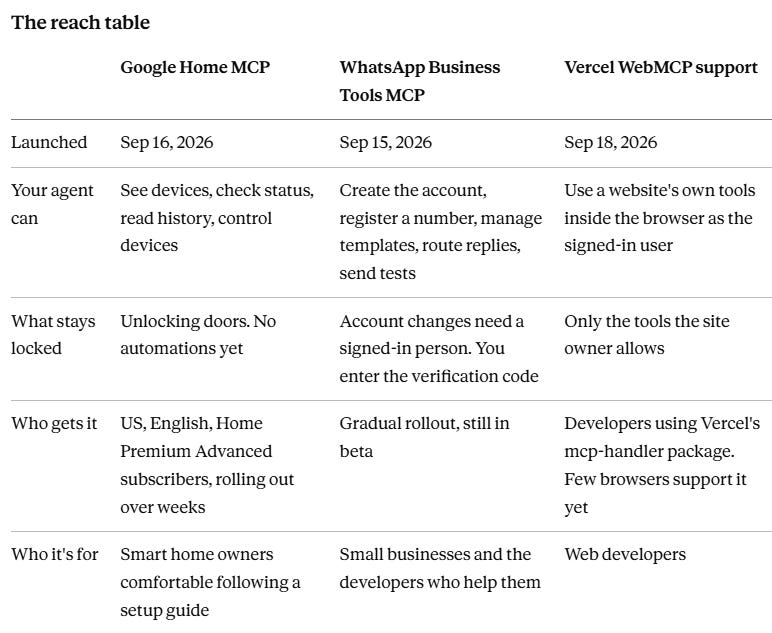
What your agent can reach now, and what stays locked
Google Home (September 16). You can ask your house what happened while you were out, and the answer comes from your devices’ real history. You can say “turn off all the outside lights,” and they go off. Google’s setup guide lists five tools the agent gets: find your homes, list your devices, check their status, read their history, and run actions. Google says early testers asked what the kids did after school and got a summary pulled from every camera. Another counted a week of laundry loads. I don’t want that number for my house.
What stays locked: unlocking doors is a blocked action. Creating automations isn’t supported yet, and Google lists slow responses as a known issue.
WhatsApp Business (September 15). You can set up WhatsApp for your shop by asking. Tell a coding assistant such as Claude, Cursor, Codex, or ChatGPT what you need, and it creates the business account, adds and registers your phone number, drafts your message templates, points customer replies at the right system, and sends a test. Meta says that job used to mean bouncing between four places: its Developer Console, Business Manager, the technical manual, and your code editor. You still type in the verification code Meta texts you, and Meta says anything that changes the account needs a signed-in person.
Vercel (September 18). This one is for people who build websites. WebMCP is the same plug, built into a web page, so an assistant living in your browser can use the site’s tools while you’re logged in. Vercel says a site that already has MCP tools can switch them on with a single script tag, which is one line of code on the page, plus a short list of which tools to allow. Nobody builds a second login system. It’s labeled experimental; WebMCP is still a proposed web standard, and the developers behind the change note that browser support is limited.
What it costs to get in
Google Home MCP: paid. Access requires Google Home Premium Advanced, which TechCrunch reported at $20 a month on September 16. You also need a Google Cloud project and an AI assistant that supports MCP, which for most people is another subscription.
WhatsApp Business Tools MCP: free to use. Meta hasn’t announced a charge for the tool. WhatsApp’s normal fees for paid business messages still apply once you go live.
Vercel’s WebMCP support: free and open source, experimental.
None of the three bills you per action. What you pay for is the subscription that gets you through the door, plus setup time. Google’s instructions have you create a cloud project, switch on the Home API, and generate login credentials. That reads like a weekend project for a tinkerer and a hard no for my mother.
Claims vs. Receipts
The week’s other big story was Jev, from a startup called TypeSafe AI, launched September 15. Jev doesn’t chat. You hand it messy information and a question with fixed answers, and it hands your software numbers back, such as fraud 0.96 and legitimate 0.04. A chatbot writes you a paragraph. Jev hands your software a number. Use a chatbot when you need an explanation. Use something like Jev when software has to make the same small call ten thousand times a day.
TypeSafe prices it at $0.042 per million input tokens with output free. A token is a chunk of text about three-quarters of a word long, so that’s roughly four cents to read 750,000 words. It’s a paid online service with a waitlist, and MarkTechPost reported on September 19 that TypeSafe hasn’t released a version you can download or run yourself. Tiny prices still add up: TypeSafe’s own demo of Jev playing the video game Doom made 10 decisions a second and cost about $7 an hour, by the company’s count.
Claim: “193.6x faster, 444.6x cheaper.” (TypeSafe, September 15) Receipt: the same TypeSafe post says it expects those figures to sit at the higher end of real-world gains. It also says TypeSafe’s own team built the four test jobs, and that Jev was graded against the averaged answers of two large chatbots instead of an answer key. Independent numbers are smaller. TechCrunch reported on September 18 that a Vercel engineer saw a safety check run 5 to 18 times faster after switching to Jev. In the same article, another developer found Jev 10 to 20 times cheaper than Gemini at sorting business email, with Gemini slightly more accurate. One independent GitHub test dated September 18 measured 0.43 seconds for Jev against 0.92 seconds for a small, cheap chatbot model.
Claim: Jev “can’t hallucinate.” (TypeSafe, September 15) Receipt: TypeSafe’s own footnote says its 0% figure “is not empirical.” The guarantee is that Jev can only pick from the answers you gave it. It can still pick the wrong one with a straight face. An independent evaluation called PriorBench, dated September 20, scored Jev at 95.9% on a 400-item test. The same evaluation watched it file a cake recipe as a “technical issue” at 0.94 confidence, and saw 0 of 30 off-topic messages get flagged when the answer list had no “none of these” option. We’ve all worked with this guy. He has never said “I don’t know” in a meeting. One caution on the receipt itself: PriorBench is a single anonymous author’s one-evening test, run through a middleman service.
Claim: AI agents can now control your locks. (A DEV Community write-up from this past weekend listed lights, locks, and thermostats.) Receipt: Google’s setup guide, last updated September 15, says unlocking doors is a blocked action and that the service enforces rate limits. Google also suggests telling your household before you connect an agent.
Skip / Wait / Steal
Do this: If you already pay for Home Premium Advanced and you’re comfortable following a setup guide, check whether access has reached your account. Google says it’s rolling out over the coming weeks.
Skip this: Upgrading to the $20 plan only for this. Slow responses are a listed known issue, and automations aren’t there yet.
Wait on this: Jev for any decision where a wrong answer costs money. The independent tests are days old. If you build software and try it anyway, PriorBench’s most useful tip is to always give it a “none of these” option.
Steal this line: “I stopped asking which AI is smartest. I ask what it can reach.”
The web spent decades building doors for software. Last week three big companies started building doors for AI assistants, in four days, without coordinating a press release.
Your one next step: open the AI tool you pay the most for and find its list of connections, sometimes called connectors or integrations. That list is what you’re really paying for.
Talk soon.
Sources:
What your agent can reach now, and what stays locked
Google Home Developers: Google Home MCP Server setup guide (last updated Sep 15, 2026). The five tools, the blocked unlock action, rate limits, prerequisites, known issues, and the missing automations.
TechCrunch: Your AI agents can now control your Google Home devices (Sep 16, 2026). Launch date, US rollout over the coming weeks, and the $20-a-month Premium Advanced requirement.
Unite.AI: Google Opens Home MCP Early Access to AI Agents for Smart Home Control (week of Sep 16, 2026). Google’s early-tester examples, including the after-school camera summary and the laundry count.
TechCrunch: Meta now lets AI agents handle the boring parts of WhatsApp Business setup (Sep 15, 2026). The supported coding assistants, the setup tasks, and the four places the job used to live.
The New Stack: Meta lets Claude and Codex configure WhatsApp Business via MCP (Sep 15, 2026). The verification code step, the signed-in-person rule, the gradual rollout, and beta status.
Vercel Changelog: WebMCP support now available in mcp-handler (Sep 18, 2026). The single script tag, the opt-in tool list, and no separate browser login flow.
GitHub: vercel/mcp-handler pull request 183, experimental WebMCP bridge (Sep 18, 2026). Experimental status, WebMCP as a proposal, and limited browser availability.
What it costs to get in
Cost figures in this section come from the TechCrunch Google Home entry and the Google setup guide above.
Claims vs. Receipts
TypeSafe AI: Introducing System One Models and Jev (Sep 15, 2026). Pricing, the 193.6x and 444.6x figures with TypeSafe’s own caveats, the “not empirical” footnote, and the $7-an-hour Doom demo.
MarkTechPost: TypeSafe AI Releases Jev (Sep 19, 2026). Hosted service behind a waitlist, no downloadable or self-hosted version.
TechCrunch: A new kind of AI model from a ChatGPT inventor is thrilling developers (Sep 18, 2026). The Vercel 5 to 18 times result and the Gemini email comparison.
GitHub: ickma2311/jev-baselines-eval (Sep 18, 2026). The 0.43-second versus 0.92-second measurement against a small chatbot model.
GitHub: priorbench/jev (Sep 20, 2026). The 95.9% score, the cake recipe at 0.94 confidence, the 0 of 30 result, and the “none of these” tip.
DEV Community: Google Home adds an MCP server, gated at $20 a month (weekend of Sep 19, 2026). The “lights, locks, and thermostats” wording.