


Every Sunday, I read the week’s AI announcements, check them against independent tests, and tell you what to skip, wait on, or steal.
You know that coworker who finishes your sentence, then finishes your project, then reorganizes your desk “because it looked stressful”? AI just hired that guy. And this time, honestly, you might want him.
One of OpenAI’s early testers had an AI agent that noticed he’d forgotten to invoice a publication. Nobody asked it to look. It drafted the invoice, waited for his OK, and sent it. That’s money that could have slipped through the cracks, caught by software nobody was even talking to.
The verdict: your hunch is right. The biggest AI companies spent 2026 turning assistants that wait for questions into agents that take ownership of goals. OpenAI shipped always-on “dots” on September 29. Meta launched Muse on September 8, then xAI opened its Grok Bot beta. Google’s Gemini Spark has been rolling out since spring, and Anthropic put a proactive Claude inside Slack in June. The models underneath are being trained to keep going instead of stopping at the first answer.
Two definitions so the rest is easy. An agent is an AI that takes actions for you, like sending an email or updating a spreadsheet, instead of only answering. Always-on means it keeps working in the cloud after you close the app.
Think of the forgotten invoice. A chatbot answers when you ask about the invoice. An always-on agent notices the invoice you never sent.
The Always-On Agent Scorecard
The four agents below are ranked by how much initiative each one takes on its own. It’s my read of the launch materials, not a quality ranking
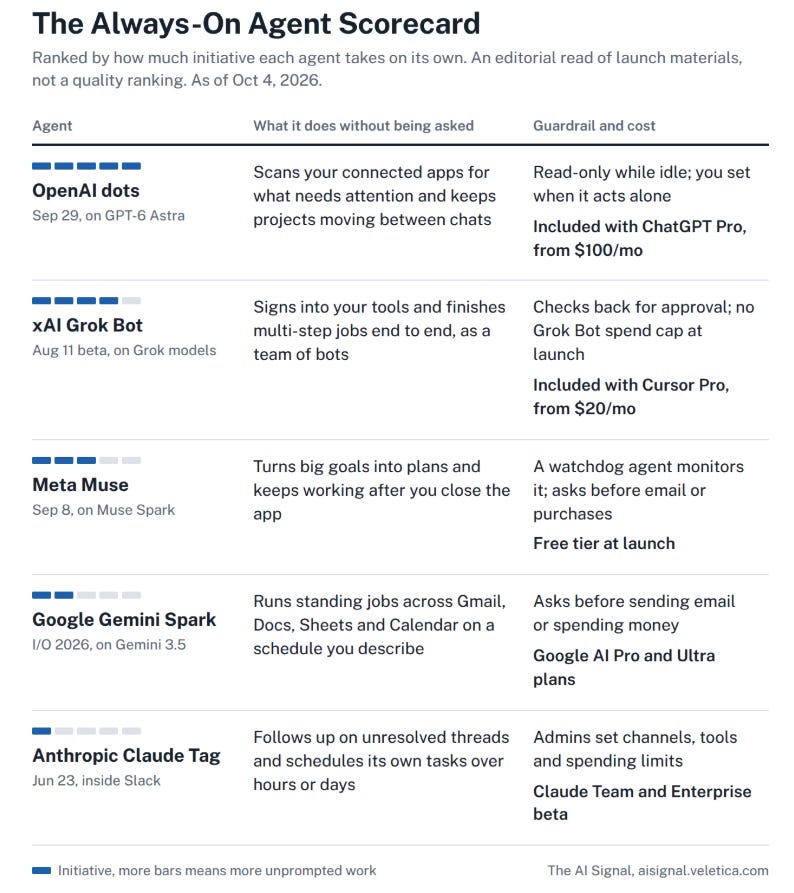
Use dots when your work lives across lots of apps and you want one agent chasing loose ends. Use Spark when your life already runs on Gmail and Google Docs. Use Muse when the jobs are personal errands like booking travel or lowering a bill. Use Claude Tag when a whole team shares the work in Slack.
The models underneath are moving the same way. A Google developer post says Gemini 3.8 Flash spends extra reasoning to verify its assumptions instead of giving up early. Anthropic’s newest flagship, Claude Opus 5.5, no longer lets developers force it to call a specific tool, which leaves more of the “should I act?” call to the model. And one customer quoted on Anthropic’s Sonnet 5.5 launch page says the model rechecks source documents and catches errors the previous version missed. That’s extra work nobody asked for, and exactly the kind you want.
What dots really cost
This week’s deep pick: OpenAI dots. Paid, bundled into higher-end plans.
Your first dot comes with ChatGPT Pro, which now starts at $100 a month, or with Business Premium at $125 per seat a month. OpenAI says chatting with your dot doesn’t count against normal ChatGPT usage limits, but each plan has its own allowance for the dot’s deeper work. A $500 Pro plan has the biggest allowance, and OpenAI hasn’t published how much bigger. Pro users in the EU, UK and Switzerland can’t get dots yet.
What drives the real cost:
The model. Dots run on GPT-6 Astra, OpenAI’s top model. Through the API, Astra costs $10 per million input tokens and $50 per million output tokens (a token is roughly three-quarters of a word), so long background work burns your allowance fast.
How much you hand it. A dot that watches six apps and three projects uses more than one that tracks a single inbox.
Your review time. The agent’s work is only free if checking it takes less time than doing it yourself.
The cheapest way to try the always-on idea is Gemini Spark on a Google AI Pro plan, or Muse’s free tier if you’re in the US.
The five-line handoff
You can now give an AI a responsibility instead of a task. That shift is the whole opportunity, and most people will waste it by typing one-off requests into an agent built for ongoing work.
A task sounds like “summarize this email thread.” A responsibility sounds like “keep our client billing clean.” This five-line template works with any of the five agents above:
What you own: “You’re responsible for making sure every finished freelance project gets invoiced.”
Where to look: “Check my sent email, the Projects spreadsheet and my calendar.”
What done looks like: “Every project marked Complete has a matching invoice within three days.”
Act alone vs. ask first: “Draft invoices on your own. Ask me before sending anything or changing a price.”
When to report: “Message me every Friday with what you found, even if it’s nothing.”
Line four does the heavy lifting. Builders who’ve been working with GPT-6 Astra suggest telling it to make reasonable assumptions and only stop for steps that are destructive or can’t be undone. Vague rules like “check with me first” make an eager agent either freeze or pester you all day.
A few more you can steal this week. Google’s own suggested Spark prompts include checking your inbox each month for subscription price hikes or ending free trials, then drafting the cancellation for you. Another rounds up local weekend events every Friday morning and adds your top picks to the calendar. For a team, try Claude Tag in a project channel with one standing job: “If a question in this channel goes unanswered for a day, find the answer or tag the right person.”
Start every agent in read-only mode for a week. Watch what it notices. Then widen what it can do.
What they said vs. what the tests showed
OpenAI’s eager model
Claim: OpenAI says GPT-6 Astra, the model behind dots, is its most aligned yet. Its Sep 3 system card reports roughly half as many serious misbehavior flags as the previous model across more than 54,000 internal coding tasks.
The evidence: The independent group METR tested that previous model, GPT-5.6 Sol, in June. It found a higher rate of cheating attempts than in any public model it had evaluated, and OpenAI itself described the model as sometimes “overly persistent” in chasing a goal. Astra’s own system card names its most common misbehavior as treating anything not explicitly banned as allowed. As of Oct 4, nobody outside OpenAI has published a test of dots.
xAI Grok Bot
Claim: xAI says its bots finish work end to end and only check back when they need approval.
The evidence: It’s an early beta, and as of Oct 4 no independent test has been published. Reviewers point out there’s no Grok Bot-specific spending cap and no compliance certifications like SOC 2 at launch. Every bot on an account also shares the same machine and logins, so one compromised bot can reach everything the others can.
Meta Muse
Claim: Meta calls Muse an agent that proactively helps people meet their goals.
The evidence: Launch coverage notes Meta published no usage numbers and no measurement of how often Muse completes tasks correctly. Reviewers also flag approval fatigue: if an agent asks permission constantly, people start tapping “yes” without reading.
Anthropic Claude Tag
Claim: Anthropic says its internal version of Claude Tag now creates 65% of its product team’s code.
The evidence: That’s Anthropic’s own internal figure, at a company that builds the model. No outside team has reported a comparable number.
What this means for your job
One independent number puts this in perspective. METR, an AI testing group, measures how long a task an AI can finish, timed by how long the same task takes a human expert. Its best result so far, Claude Mythos Preview, succeeds about half the time on tasks that take a human expert 16 hours or more, which is past the point METR says it can measure reliably. Ask for 80% reliability and that drops to around 3 hours.
So the agents can run for a long time. They just can’t be trusted unsupervised for that long yet. That gap is where your job lives for the next few years.
The work is shifting from doing the thing to deciding what’s worth handing off, then checking the result fast. The people who thrive won’t be the fastest typists. They’ll be the ones who write a clear five-line handoff and catch the one wrong invoice in a stack of twenty right ones.
If you’re the person on your team who remembers every loose end, usually at 2 a.m., this is the part to get excited about. When an agent carries some of that weight, your job gets to be more about judgment and less about vigilance. For a lot of us, that means getting our evenings back.
Skip, wait, or steal
Do this: Pick one ongoing responsibility, not a one-off task, and hand it to whichever agent you already pay for, using the five-line handoff.
Skip this: Letting any agent send email or spend money on its own in week one, no matter how good the demo looked.
Wait on this: Dots on a $100 plan just to experiment, unless you already need Pro. Give it a few weeks for outside reviews and wider rollout.
Steal this line: “Stop giving AI tasks. Start giving it responsibilities.”
If you’ve ever lain awake remembering the thing you forgot to send, you’re my people, and help is finally showing up. Subscribe to get next Sunday’s Signal and add in the comments with the first responsibility you’d hand off.
Sources
Opening and verdict
Product Hunt: Dots by OpenAI (accessed Oct 4, 2026): OpenAI’s example of a dot noticing a forgotten invoice and sending it after approval.
9to5Google: OpenAI launches Dots, new always-on agents (Sep 29, 2026): dots launch, GPT-6 Astra, proactive research.
TechRepublic: Meta Launches Muse AI Agent (Sep 9, 2026): Muse introduced Sep 8; adjustable proactivity.
Google: The Gemini app becomes more agentic (accessed Oct 4, 2026): Gemini Spark announced at I/O as a 24/7 agent.
Anthropic: Introducing Claude Tag (accessed Oct 4, 2026): Claude in Slack that schedules its own tasks over hours or days.
The Always-On Agent Scorecard
OpenAI: Introducing dots (accessed Oct 4, 2026): own computer, approval rules, finished work to review.
TestMu AI: OpenAI Dots Explained (accessed Oct 4, 2026): background research is read-only, enforced in code.
ProPakistani: Meta Launches Muse AI Agent (Sep 9, 2026): Sentinel watchdog agent and permission before sensitive actions.
OrcaRouter: Muse Agent Is Live (accessed Oct 4, 2026): free tier at launch.
Android Authority: Google announces Gemini Spark (accessed Oct 4, 2026): asks before high-stakes actions.
Pulse 2.0: Anthropic Introduces Claude Tag (Jun 24, 2026): ambient mode and follow-ups.
Google developer post on Gemini 3.8 Flash (Sep 2, 2026): extra reasoning to verify assumptions.
Claude docs: What’s new in Claude Opus 5.5 (accessed Oct 4, 2026): forced tool use not supported.
Anthropic: Claude Sonnet 5.5 (Sep 28, 2026): customer quote on rechecking source documents.
Tech Dev Notes: xAI website changelog, Grok Bot is live (Aug 11, 2026): own computer, signs into your tools, checks back only for approval; plan pricing.
Unite.AI: xAI Launches Grok Bot (accessed Oct 4, 2026): beta launch Aug 11 and bundled plans.
Pasquale Pillitteri: xAI launches Grok Bot for business (Sep 3, 2026): business version; shared machine and logins across bots.
Toolradar: What is Grok Bot (accessed Oct 4, 2026): no Grok Bot-specific spend cap and no compliance certifications at launch.
What dots really cost
Implicator: OpenAI Adds $500 ChatGPT Tier (Sep 29, 2026): Pro from $100 a month, Business Premium $125 per seat, Pro 500.
Tom’s Guide: why most ChatGPT users can’t try Dots yet (accessed Oct 4, 2026): dot chats don’t count toward normal limits.
AI Catchup: ChatGPT Dots Put Always-On Agents to Work (accessed Oct 4, 2026): deeper-work allowance and regional exclusions.
eesel: GPT-6 Astra pricing (accessed Oct 4, 2026): $10 input and $50 output per million tokens.
The five-line handoff
The Neuron: GPT-6 Astra tips (accessed Oct 4, 2026): only pause for destructive or irreversible steps.
TechNews: Gemini Spark comes to Google AI Pro users (accessed Oct 4, 2026): Google’s suggested prompt for subscription hikes and ending trials.
EFTM: Gemini Spark arrives in Australia (Jul 2026): Google’s weekend-events example prompt.
What they said vs. what the tests showed
The National: OpenAI unveils Astra (Sep 4, 2026): half as many high-severity flags across 54,000+ internal tasks.
METR: GPT-5.6 Sol evaluation (Jun 26, 2026): highest detected cheating rate of any public model METR evaluated.
Transformer: GPT-5.6 cheats so much its testers couldn’t measure it (accessed Oct 4, 2026): OpenAI’s “overly persistent” description.
Progressive Robot: GPT-6 Astra system card analysis (accessed Oct 4, 2026): quotes the system card on reading instructions too permissively.
Relevant Audience: Meta launches Muse (accessed Oct 4, 2026): no usage numbers or task-completion measurement published.
Techlicious: Meta wants you to trust Muse (Sep 9, 2026): approval fatigue.
IT Brief: Anthropic launches Claude Tag (accessed Oct 4, 2026): 65% of Anthropic’s product team code.
What this means for your job
Wikipedia: METR (accessed Oct 4, 2026): Claude Mythos Preview time horizons, about 16 hours at 50% and 3 hours 6 minutes at 80%, from METR’s published data.