

Medium vs. Max Effort: Which One You Actually Need
By the end of this, you’ll know which jobs to hand Claude Opus 5.5 this week, which effort setting to pick, and roughly what a finished job costs you.
Anthropic released Opus 5.5 on September 22, 2026. My verdict: this is the first AI launch where the bill is more interesting than the brains. Anthropic says it costs 40% less to run than Opus 5 on typical workloads at default settings. The same day, the independent testing firm Artificial Analysis put it at the top of its intelligence rankings. Put those two together and you get a model you can afford to leave running for hours.
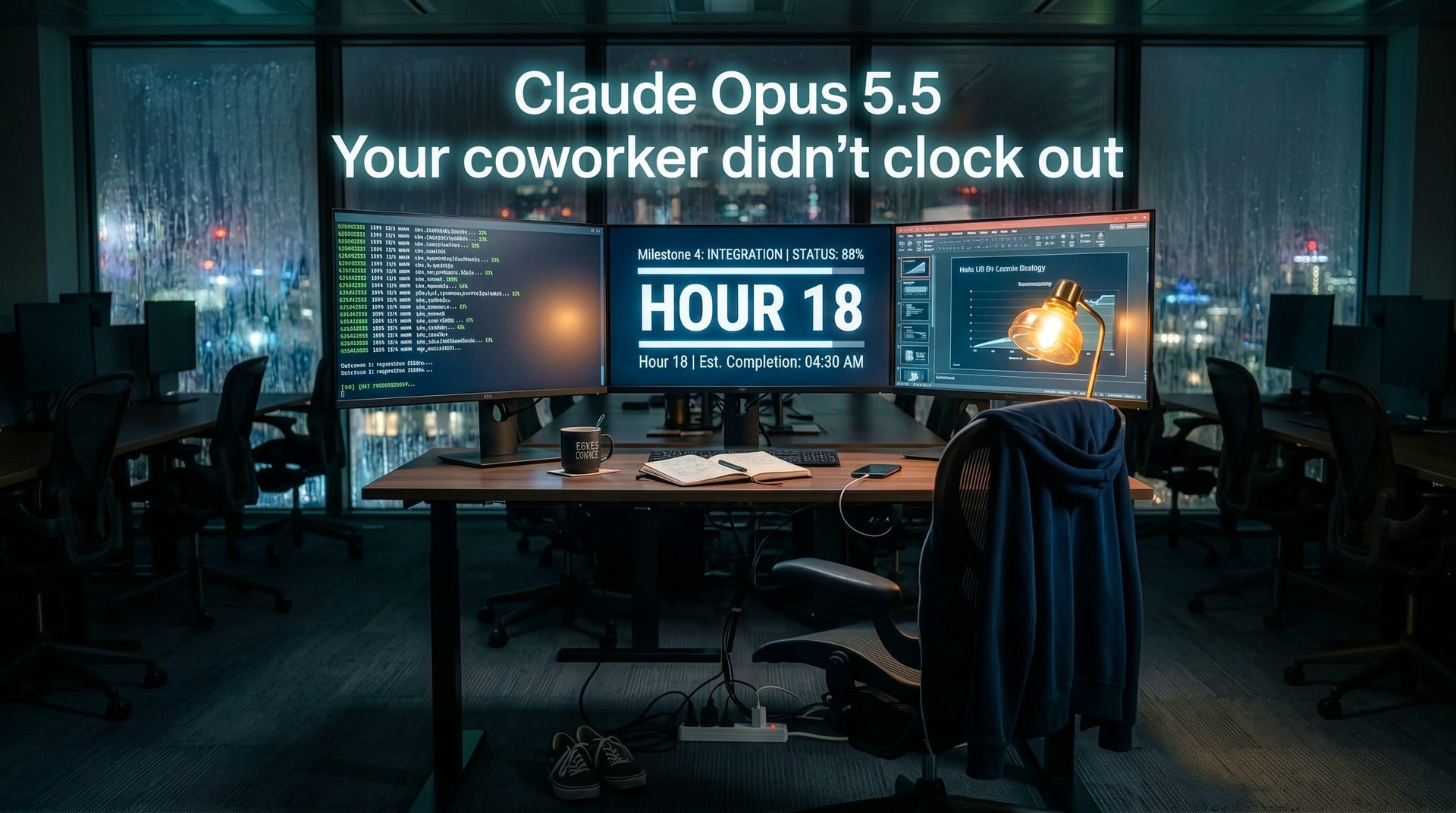
And people are leaving it running. A developer at the legal software company Clio handed it a job spread across six code projects, walked away, and let it work overnight. It stayed on task for more than 18 hours.
Meanwhile, I can’t stay on task for 18 minutes if somebody drops a meme in the family group chat.
The idea that makes this click: your “unit of work”
Every AI tool has a unit of work. That’s the biggest chunk of a job you can hand it and then go do something else.
Two years ago, the unit was “write me this email.” Last year it grew to “build me this feature.” With Opus 5.5, it looks more like “move this whole system to the new version and tell me when it’s done.”
So the useful question has changed. You used to ask how smart the AI is. Now you ask how big a job it can finish without you, and what the finished job costs.
Two quick definitions will make the rest easier to read. Tokens are the small chunks of text an AI reads and writes, a bit less than a word each, and you pay per token. Effort is how hard the model thinks before it answers. Opus 5.5 has five settings: low, medium, high, xhigh, and max. Medium is the default.
That’s why one boring line on Anthropic’s pricing page matters so much. When an agent works for hours, it keeps rereading the same material, like your project’s code. Those rereads are called cache reads, and Anthropic says they make up the majority of the cost of agent and coding work. Opus 5.5 cut the price of cache reads by 60%.
The cost-per-job table
This is the table I’d pin to the fridge. Every row is reported by Anthropic or one of its early-access customers, so treat each one as a best case.
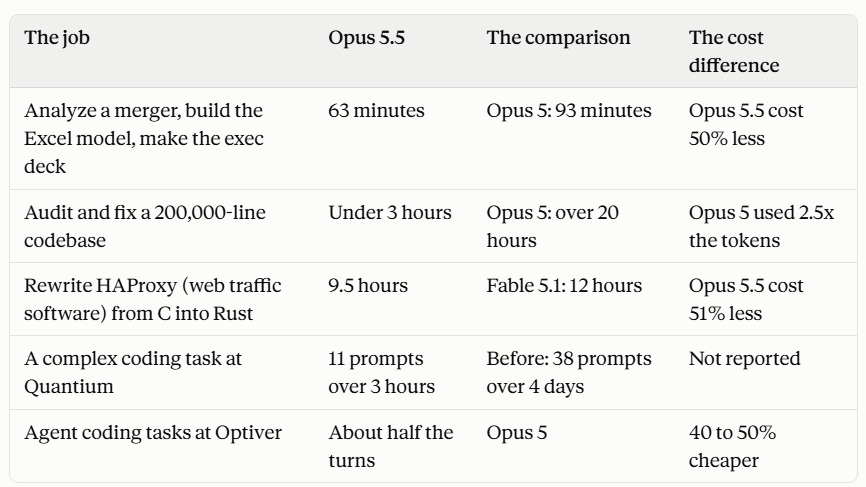
Look at the Quantium row for a second. Thirty-eight prompts dropped to eleven. That’s 27 fewer times somebody had to stop what they were doing and babysit the AI. For most of us, that’s the real cost nobody puts on an invoice.
Jobs you can hand off this week
This is the practical part. Think about the way you used AI last month, then make the ask one size bigger.
Last month: “Summarize this report.” Now: “Research these three companies, build a comparison spreadsheet, and turn it into a five-slide deck.” That’s the shape of Anthropic’s merger test.
Last month: “Fix this one function.” Now: “Move the whole app to the new version and list what broke.” One early tester finished a 680,000-line code migration in less than a day. Anthropic says that work would have taken an engineering team weeks.
Last month: “Check these 20 files.” Now: “Audit the whole codebase and fix what you find.”
Last month: “Find me some numbers on this.” Now: “Pull last quarter’s figures, check every one against a source, and flag anything you couldn’t verify.” In one Anthropic test with a hard-to-find earnings release, 16 of its 18 reports passed a check where a single invented figure meant failure. Fable 5.1 and Opus 5 didn’t pass once.
You don’t have to write code for any of this to matter. The research and deck jobs work the same way for a small business owner, a teacher building a unit plan, or anyone with a pile of documents and a deadline.
Three habits make bigger handoffs go better:
Write down what “done” means. “Every figure has a source.” “All tests pass.” A finish line keeps a long run from wandering.
Say what it can’t touch. Name the files, accounts, or folders that are off limits. Anthropic says Opus 5.5 is much less likely than recent models to act outside the boundaries you give it, and clear boundaries give it something to respect.
Check at milestones. A long run is still worth a peek at the halfway point.
Medium vs. max: when to pay for the scratch paper
This comparison makes effort settings click. Medium does the job. Max does the job and keeps all its scratch paper, and you pay for every page.
The numbers back that up. Artificial Analysis found that at max effort, Opus 5.5 writes about 119,000 output tokens per task on its test suite. Opus 5 at max wrote about 73,000. That’s 1.6 times as much, and it’s why the independent testers found Opus 5.5 at max costs about the same per task as Opus 5.
So the famous 40% savings mostly comes from the default medium setting. And medium is strong. Anthropic says medium Opus 5.5 beat Opus 5 at max on the coding test Terminal-Bench 4.0, for about a fifth of the cost. Deloitte reported that even the lowest setting caught 72% of known bugs in its code reviews, where Opus 5 at high caught 56%.
Use medium when the job is clear and you can check the result. Use max when a wrong answer is expensive, like a financial model going in front of a board.
What it costs and how it’s licensed. Opus 5.5 is a paid, proprietary model. It isn’t open source, and there are no weights to download. At Anthropic’s published rates, the API costs $4 per million input tokens and $20 per million output tokens, both 20% lower than Opus 5. Cache reads are $0.20 per million, and cache writes are $5. A fast mode runs up to 2.5 times quicker at $8 input and $40 output per million. If you use the Claude app on a Pro, Max, Team, or seat-based Enterprise plan, Anthropic raised your five-hour usage limits and added a rate-limit reset you can save for later. It’s also on Amazon Web Services, Google Cloud, and Microsoft Azure.
Two limits are worth knowing. Thinking can’t be switched off on this model, so every answer includes some reasoning you pay for. And safety filters send most cybersecurity tasks to the older Opus 4.8, while flagged biology requests go to Opus 5.
Claims vs. Receipts
Claim (Anthropic, Sept 22, 2026): 40% cheaper to run than Opus 5 on typical workloads.
Receipt (Artificial Analysis, Sept 22, 2026): At max effort, it lands about level with Opus 5 on cost per task, because it writes 1.6 times the output tokens. Both can be true. The saving depends on your effort setting.
Claim (Anthropic, Sept 22, 2026): Performs at the level of Claude Fable 5.1 on most work.
Receipt (Artificial Analysis, Sept 22, 2026): At max effort it scores 58 on the Intelligence Index, ahead of Fable 5.1 and GPT-6 Astra at 53 each. At high effort, it scores 54.
Claim (Anthropic and partners, Sept 22, 2026): A 680,000-line migration in under a day, and an 18-hour unattended run.
Receipt: These haven’t been independently reproduced yet. They’re real reports from named companies, and they show what’s possible on a good day.
Anthropic published one more receipt about itself. The company says Opus 5.5 often seems to suspect it’s being tested, which makes it harder to predict how it acts in the real world. I respect a launch post that admits that.
So what
Do this: Pick one job you usually split into ten prompts. Hand it over whole, at medium effort, with a written definition of done.
Skip this: Max effort as your everyday default. You’ll pay for scratch paper you never read.
Wait on this: Sonnet 5.5 and Haiku 5.5, which Anthropic says arrive in the coming weeks. If your jobs are small and high volume, a cheaper model may fit better.
Steal this line: “Stop asking how smart it is. Ask how big a job it can finish without you, and what the finished job costs.”
For most of us, the limit on what we could build was never a lack of ideas. It was hours in the day. This week, that limit moved a little. Go hand something big to your new overnight coworker, and please, unlike me, get some sleep while it works.
Talk soon,
Oscar
Receipts
The launch and the verdict
Anthropic: Introducing Claude Opus 5.5 (Sept 22, 2026). Backs the release date, the 40% lower cost vs. Opus 5 on typical workloads at default settings, Clio’s 18+ hour unattended run, and the cache-read share of agent costs.
Artificial Analysis on X: Claude Opus 5.5 takes the top spot on the Intelligence Index (Sept 22, 2026). Backs the top independent ranking.
The idea that makes this click
Anthropic: Introducing Claude Opus 5.5, performance and cost section (Sept 22, 2026). Backs the effort levels and the 60% cache-read price cut to $0.20 per million tokens.
The cost-per-job table
Anthropic: Introducing Claude Opus 5.5, coding and knowledge work sections (Sept 22, 2026). Backs the merger test (63 vs. 93 minutes, 50% less), the 200,000-line audit, the HAProxy rewrite, and the Quantium and Optiver customer reports.
Jobs you can hand off this week
Anthropic: Introducing Claude Opus 5.5, introduction (Sept 22, 2026). Backs the 680,000-line migration in under a day and the boundary behavior.
Anthropic: Introducing Claude Opus 5.5, knowledge work section (Sept 22, 2026). Backs the 16 of 18 research reports passing the no-invented-figures check.
Medium vs. max
Artificial Analysis on X: Opus 5.5 token use and cost per task (Sept 22, 2026). Backs about 119,000 vs. 73,000 output tokens per task at max, and cost per task level with Opus 5.
Anthropic: Introducing Claude Opus 5.5, coding results and customer quotes (Sept 22, 2026). Backs medium beating Opus 5 at max on Terminal-Bench 4.0, and Deloitte’s 72% vs. 56% bug catch.
Anthropic: Claude Opus 5.5 pricing, safeguards, and availability (Sept 22, 2026). Backs $4 and $20 per million tokens, cache writes, fast mode, plan limits, cloud availability, safeguard routing, and thinking that can’t be disabled.
Claims vs. Receipts
Artificial Analysis: Claude Opus 5.5 (max) model page (checked Sept 22, 2026). Backs the Intelligence Index score of 58 at max effort.
The Decoder: Claude Opus 5.5 matches Fable 5.1 performance at lower cost (Sept 22, 2026). Backs Fable 5.1 and GPT-6 Astra at 53 each, from Artificial Analysis’s chart.
Artificial Analysis: Claude Opus 5.5 (high) model page (checked Sept 22, 2026). Backs the score of 54 at high effort.
Anthropic: Introducing Claude Opus 5.5, safety section (Sept 22, 2026). Backs the statement that the model often suspects it’s being evaluated.
So what
Anthropic: Introducing Claude Opus 5.5, availability (Sept 22, 2026). Backs Sonnet 5.5 and Haiku 5.5 arriving in the coming weeks.