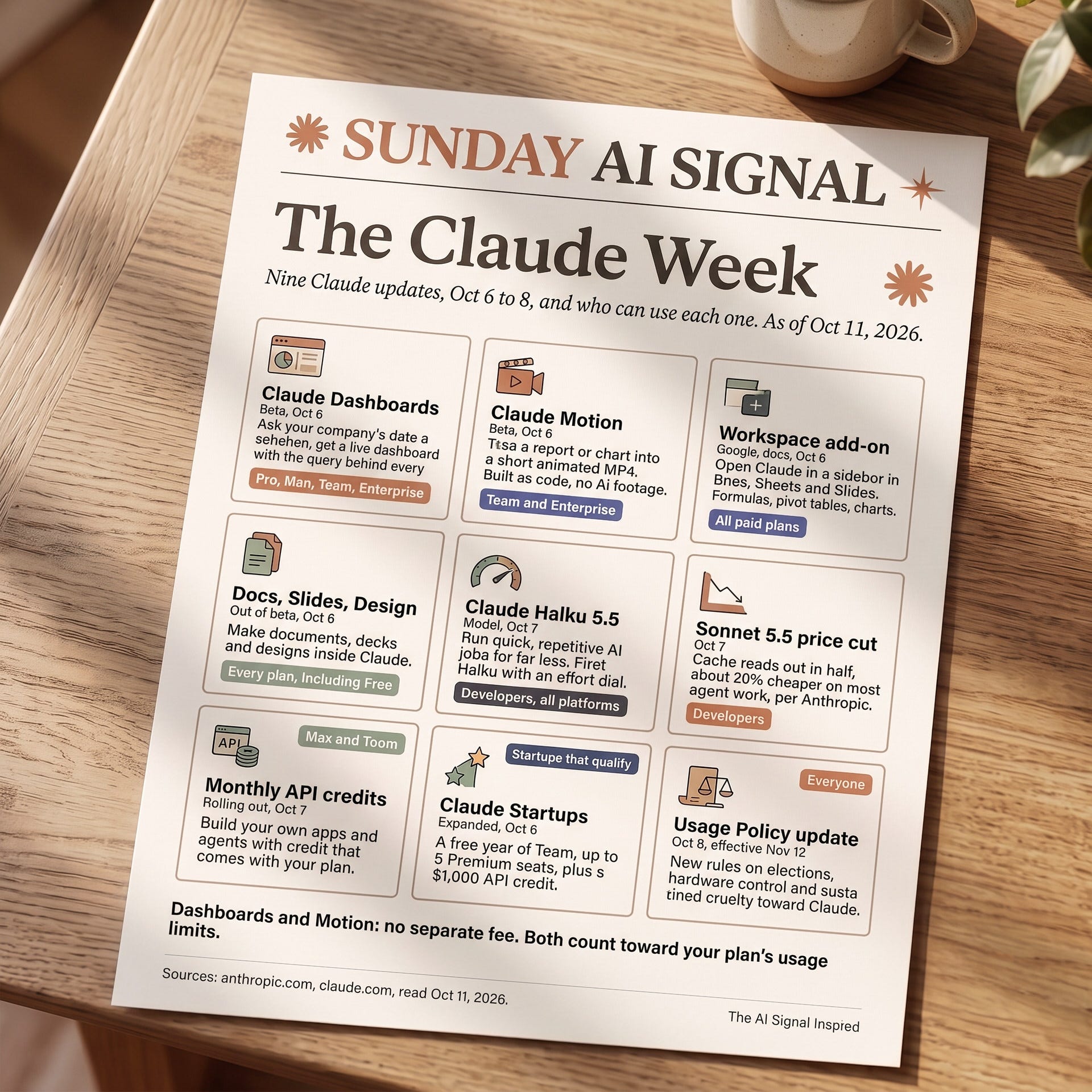
The Sunday AI Signal: the claims that made headlines this week, and the ones that survived testing.
Anthropic shipped nine Claude updates between Tuesday and Thursday. Nine. In three days. I can’t send three emails in three days without one of them going to the wrong Mike.
So let me save you the scrolling.
My verdict: Claude Dashboards got the headlines, and it’s genuinely useful, but only if your company’s numbers already live in a data warehouse. The quiet winner is Haiku 5.5. Independent testers confirmed it’s the best small model you can buy right now, with one catch the launch page doesn’t lead with: it talks a lot, and talking costs money. And if you just want something useful by Monday morning, install the Claude add-on in Google Sheets.
Easy way to keep the two big ones straight: Dashboards answers the question. Motion tells the room the answer.
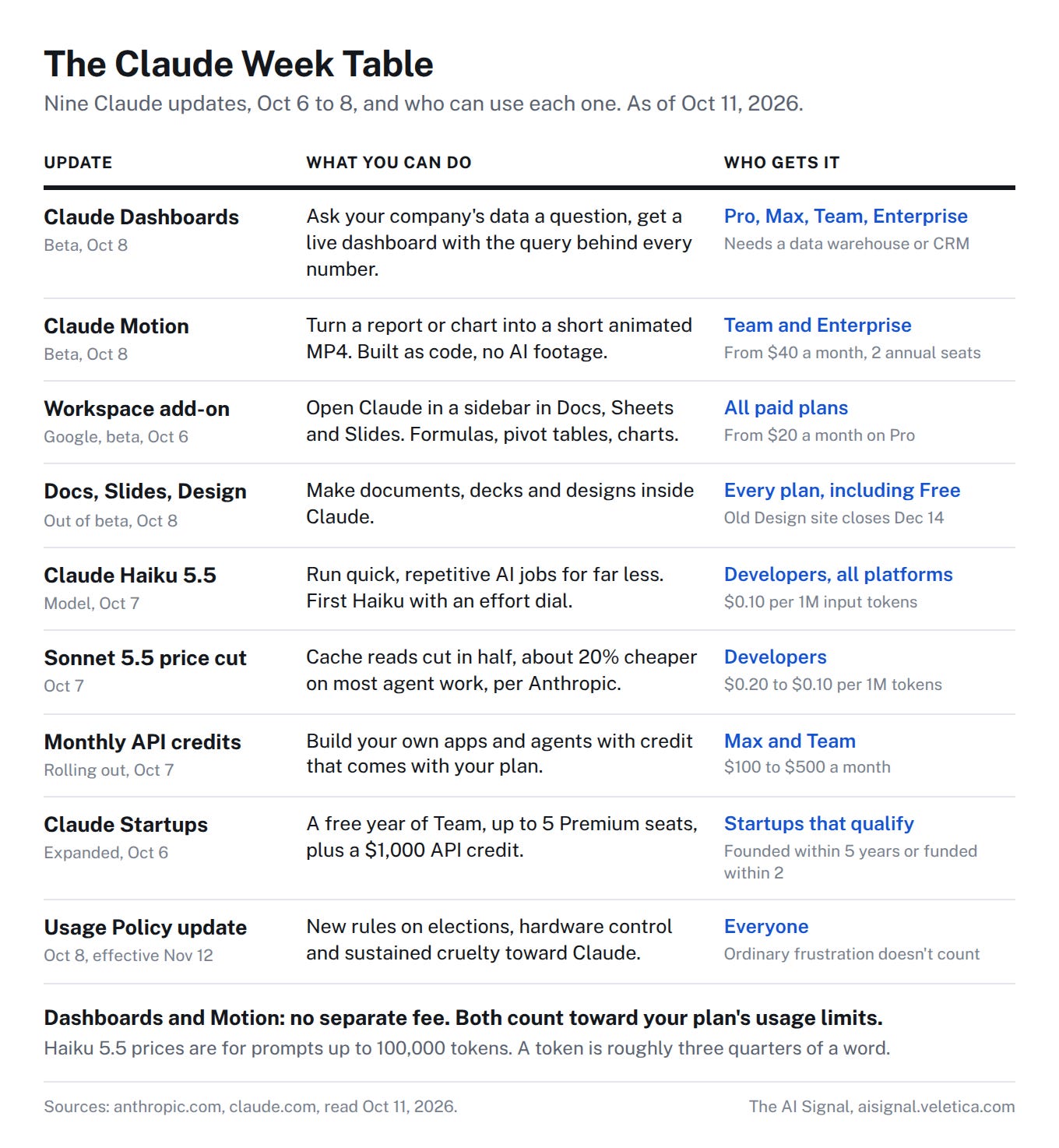
The Claude Week in One Table
Every update, the date Anthropic announced it, and who can use it.
This Week’s Deep Pick: Claude Dashboards
You know the drill. You need one number for Monday’s meeting. You ask the data person. The data person is on vacation, or quietly pretending your message went to spam. Two days later you get a chart. It answers a slightly different question.
Dashboards tries to kill that whole loop.
First, one quick definition. A data warehouse is the big central database where a company keeps its numbers, like sales and signups. If your company has one, here’s what you can do as of October 8:
1. You can ask your company’s data a question in plain English and get a live dashboard back. It works with five warehouses: Amazon Redshift, BigQuery, ClickHouse, Databricks, and Snowflake, plus CRM tools like Salesforce.
2. You can click any number and see the database query behind it. A query is the exact instruction Claude sent to your database. This is the part I like most, because you can check the work instead of trusting a pretty chart.
3. You can hand a dashboard off to eight analytics tools when you need to dig deeper, including Grafana, Hex, Mixpanel, and PostHog.
4. You can come back next week and find it updated, with a “last refreshed” stamp on each chart.
Use Dashboards when the question repeats every week. Use a plain Claude chat when you need the answer once.
Free or paid? Paid. Dashboards is in beta on Pro, Max, Team, and Enterprise, with no separate fee.
What drives the cost:
Your plan. Pro is $20 a month, or $17 a month if you pay for the year up front. Team is $25 a seat, or $20 billed annually.
Your usage limits. Every dashboard draws from the same pool as your regular chats. Build a lot of them, and you’ll hit your limit sooner.
Your warehouse bill. This is the one nobody mentioned. Every chart runs a query on your warehouse, and warehouses charge for that. BigQuery, for example, bills on-demand queries by how much data they scan, with the first 1 TiB each month free. A TiB is roughly a thousand gigabytes.
Who should skip it: anyone whose numbers live in spreadsheets. Dashboards has nothing to connect to. Use the Google Sheets add-on below instead.
Everything Else Claude Shipped This Week
Here’s what you can do now that you couldn’t do last Sunday, in order of how many people can use it.
Docs, Slides, and Design are out of beta (Oct 8). They’re now on every Claude plan, including Free. If you used the standalone Claude Design site, it closes December 14, and your chats and comments there won’t carry over. Save what matters before then.
Claude for Google Workspace (Oct 6, beta). Claude now opens in a sidebar inside Google Docs, Sheets, and Slides on all paid plans. In Sheets, it can write formulas, build pivot tables, and make charts. By default, it asks before every edit, which I’d keep on until you trust it. Install it from the Google Workspace Marketplace, then open a file and go to Extensions, then Claude, then Open Claude. On Team and Enterprise, an owner has to switch on the connectors first.
Claude Motion (Oct 8, beta). Motion turns a report or a chart into a short animated explainer you download as an MP4. Type /motion to start. It doesn’t use a video generation model, so there’s no AI footage and no AI people. Your CFO will not show up as a slightly melted avatar. Because each animation is built as code, you can change one number without rebuilding the whole thing, then open it in seven video tools, including Adobe, Descript, and Runway. The catch: it’s Team and Enterprise only. The cheapest way in is two Team seats billed annually, which is $40 a month.
Claude Haiku 5.5 (Oct 7). This is Anthropic’s cheapest, fastest small model. A small model is a lighter version built for quick, repetitive jobs, like summarizing emails or pulling one number out of a long report. Prices are per million tokens, and a token is roughly three-quarters of a word. For prompts up to 100,000 tokens, Haiku 5.5 costs $0.10 for input and $0.50 for output, down from $1.00 and $5.00 on Haiku 4.5. Above 100,000 tokens, it’s $0.50 and $2.50. It’s also the first Haiku with an effort setting. Low effort is faster and cheaper. Max effort is smarter but burns more tokens. Use Haiku when the job is simple and repeats thousands of times. Use Sonnet when the job needs judgment.
A cheaper Sonnet 5.5 (Oct 7). Anthropic cut the price of cache reads in half, from $0.20 to $0.10 per million tokens. A cache read is when Claude rereads instructions it has already seen, like a long setup prompt. Anthropic says that makes Sonnet 5.5 about 20% cheaper on most agent work.
Monthly API credits for Max and Team (rolling out from Oct 7). The API is how your own apps and tools talk to Claude directly, outside the chat window. Max 5x subscribers get $100 a month in credit, Max 20x gets $200, and Team plans get up to $500 shared across the team. You claim it by linking a Claude Console account in your billing settings. If you pay for Max and never build anything, fine. But if you’ve been meaning to try building a small tool, this month it’s already paid for.
Claude Startups, expanded (Oct 6). Qualifying startups get a free year of Claude Team, with up to five Premium seats for companies new to Team, plus a one-time $1,000 API credit. You qualify if your company was founded in the last five years or raised money in the last two.
The 2026 Usage Policy (announced Oct 8, effective Nov 12). The rule that made headlines bans sustained, needless cruelty toward Claude. Anthropic says it only covers extreme, repeated abuse with no purpose. Ordinary frustration doesn’t count. So yelling “WHY” at a broken spreadsheet formula is still legal. Probably healthy, even. The update also narrows the election rules and adds a requirement that a person can watch and stop any physical equipment Claude controls in risky settings.
What They Said vs. What the Tests Showed
For once, the testers showed up fast. Here’s what held up and what didn’t.
Claim: Anthropic called Haiku 5.5 “the most capable small model” it has released (Oct 7).
The evidence: Artificial Analysis, an independent testing group, scored Haiku 5.5 at 43 on its Intelligence Index at max effort, the top score among small models, ahead of GPT-6 Luna at 38. A year ago, Haiku 4.5 scored 17 on the same index. It still trails Claude Sonnet 5.5, which scores 56. Verdict: holds up.
Claim: Anthropic says Haiku 5.5 costs about 75% less to run than Haiku 4.5 (Oct 7).
The evidence: The price per token really did drop. But Artificial Analysis found that at max effort, Haiku 5.5 produced 440 million output tokens to finish its test set, while the typical model in its price range produced 100 million. More words means a bigger bill. Artificial Analysis measured about $0.21 per test task at max effort and about $0.08 at high effort, and its cost figures don’t yet include the higher price above 100,000 tokens. Verdict: the savings are real, but the effort setting decides how big they are.
Claim: Anthropic reported Haiku 5.5 scored 39.2% on Terminal-Bench 4.0, a test of multi-step tasks on a command line (Oct 7).
The evidence: Artificial Analysis’s own run of the same test scored it 33%. Artificial Analysis says its score is probably low because of an over-refusal problem, meaning the model turned down tasks it should have done, and Anthropic is working on a fix. Verdict: disputed until the re-run.
Claim: Anthropic says Dashboards shows the query behind every number (Oct 8).
The evidence: True, and it’s a real feature. But a hands-on review from eesel.ai this week found no published refresh schedule, row limits, or chart limits anywhere in Anthropic’s help center. Anthropic also hasn’t published any accuracy data for Dashboards. Seeing the query helps, but it doesn’t tell you whether the query asked the right question. Verdict: useful, and still your job to check.
Skip, Wait, Steal
Here’s what I keep coming back to this week. Anthropic didn’t ship nine reasons to buy something. It shipped a bunch of ways to stop waiting on other people for answers. That’s the part that matters if you’re the one stuck waiting.
Do this: Install the Claude add-on in Google Sheets this week, leave “Ask before edits” on, and ask it to build one chart you normally build by hand. Ten minutes. Zero risk.
Skip this: Upgrading to Team just to try Motion. Unless you present numbers to a room every week, $40 a month for animated charts is a fancy hat, not a tool.
Wait on this: Pointing Dashboards at your real company numbers before you’ve checked three of its queries against a report you already trust. Also wait on Motion’s Canva and Captions handoffs, which are still marked coming soon.
Steal this line: “Cheap per word isn’t cheap per job.”
Your next step: open one Google Sheet you dread and let Claude take the first pass. Then hit reply and tell me what it built.
Sources
The Claude Week in One Table
Claude, “Build live dashboards and animate explainers with Claude” (Oct 8, 2026): Dashboards and Motion launch, plan access, Docs, Slides, and Design out of beta.
This Week’s Deep Pick: Claude Dashboards
Claude Help Center, “Get started with Claude Dashboards” (Oct 8, 2026): warehouses, query visibility, handoff tools, plans.
Claude, “Pricing” (read Oct 11, 2026): Pro and Team prices.
Google Cloud, “BigQuery pricing” (read Oct 8, 2026): on-demand queries billed by data scanned, first 1 TiB a month free.
Everything Else Claude Shipped This Week
Claude Help Center, “Migrate from standalone Claude Design to Claude” (Oct 8, 2026): December 14 closure.
Claude, “Claude now works with Google Docs, Sheets, and Slides” (Oct 6, 2026): add-on, plans, edit modes, setup.
Claude Help Center, “Get started with Claude Motion” (Oct 8, 2026): /motion, MP4 export, video tools, plan access.
Anthropic, “Claude Haiku 5.5” (Oct 7, 2026): Haiku pricing, effort setting, Sonnet cache price cut, monthly API credits.
Claude, “We’re expanding the Claude Startups program” (Oct 6, 2026): free year of Team, $1,000 credit, eligibility.
Anthropic, “2026 Usage Policy update” (Oct 8, 2026): cruelty rule, election and hardware changes, Nov 12 effective date.
What They Said vs. What the Tests Showed
Artificial Analysis, “Claude Haiku 5.5 (Max)” (Oct 2026): Intelligence Index score of 43, 440 million output tokens versus a 100 million median.
The Decoder, “Claude Haiku 5.5 arrives with massive price cuts” (Oct 2026): GPT-6 Luna at 38, $0.21 per task at max effort.
The GenAI Magazine, “Claude Haiku 5.5 Review” (Oct 2026): $0.08 per task at high effort, per Artificial Analysis.
Latent Space, “AINews: Claude Haiku 5.5” (Oct 2026): Terminal-Bench 4.0 at 33%, over-refusal fix, cost figures provisional.
Fello AI, “Claude Haiku 5.5: Price, Benchmarks and Who Can Use It” (Oct 2026): Haiku 4.5 at 17 a year ago, Sonnet 5.5 at 56.
eesel.ai, “Claude Dashboards review” (Oct 2026): no published refresh schedule or limits
.