


Remember when the big AI fight was over which chatbot wrote the better birthday poem? That era is over. On September 29, OpenAI launched Dots, and now every major AI company sells an assistant that does the work instead of describing it. By the end of this piece, you’ll know which one fits your life, what it really costs, and which promises haven’t held up against real users yet.
My verdict up front. Meta’s Muse is winning the crowd. Google’s Gemini Spark is the best deal for most people. OpenAI’s Dots is the most capable work assistant and the most expensive way in. xAI’s Grok Bot is the dark horse for anyone who already pays for Cursor. Apple, Amazon, and Microsoft are the ones falling behind with everyday consumers, each for its own reason.
And you, the customer, are getting a better deal every few weeks. The catch is that the ground keeps moving under your feet, so knowing what changed matters as much as the deal itself.
Simplest way I can put it: a chatbot tells you there’s a table open at 7. An agent books it and puts it on your calendar.
Two quick definitions so nothing trips you up. An agent is AI that takes actions for you, like clicking, filling forms, and sending messages, instead of only answering questions. Always-on means the agent has its own computer in the cloud, so it keeps working after you close the app and put your phone in your pocket.
Who’s in the race
Meta Muse (launched in the US on September 8, Canada on September 18). Muse is the errand runner. You can ask it to book things, fill out forms, track prices and shop, and it asks before anything sensitive, like a purchase. It lives on iPhone, Android, the web, WhatsApp and, since September 17, a Mac app. People piled in: Muse passed 5 million US downloads in its first 22 days, according to Sensor Tower, and knocked ChatGPT off the top of Apple’s free app chart. ChatGPT needed 56 days to hit that same mark. To be fair, Meta pointed up to half of its own daily house ads at Muse, so it had a megaphone nobody else has. Use Muse when the job is your personal life: errands, bookings, shopping.
Google Gemini Spark (unveiled at Google I/O in May). Spark lives inside the Gemini app and plugs into Gmail, Calendar, Drive, Docs, and Sheets. You hand it a recurring job, close your laptop, and it keeps going on Google’s servers. The Gmail and app connections start switched off, so you choose what it can touch. Use Spark when your life already runs on Google.
OpenAI Dots (launched September 29). Each Dot gets its own cloud computer and browser, and OpenAI says it can work across more than 4,000 apps. You can message it inside ChatGPT, Slack, or Teams. In one early example OpenAI shared, a Dot prepared an overdue invoice and sent it once the user approved. Its background research runs with read-only access to your connected apps, which is a smart default. Use Dots when your workday already happens in ChatGPT, Slack, or Teams.
xAI Grok Bot (beta launched August 11). Grok Bot’s party trick is teaching by showing: you record your screen doing a task once, and it turns the recording into a repeatable skill. You can run several Bots and put them in a group chat to split up work. Use Grok Bot when it’s faster to show the task than to explain it.
What’s new for regular people is this: a year ago, getting an assistant to work while you slept meant renting a server and wiring up an open-source agent like OpenClaw yourself. Today it’s a toggle in an app you already have. If you’re like me, your inbox holds emails from March you’re still “getting to.” That pile finally has a plausible owner.
Who’s winning, plus my one pick for most people
It depends on what you count.
Crowd: Muse wins this one easily. It’s free to start and sits inside WhatsApp, an app most of us already open every day.
Price: Spark and Grok Bot tie. Both crashed their entry price within weeks. Google launched Spark in May for AI Ultra subscribers at $100 a month and up, then by late July put it in the $19.99 AI Pro plan in the US. Grok Bot launched on August 11 inside plans that started at $200 a month for individuals. Fifteen days later, it came with Cursor Pro at $20.
Depth at work: Dots takes it. The 4,000-app reach and Slack and Teams access are built for people whose job lives in software.
Deep pick of the week: Gemini Spark. Call: paid, closed source (proprietary), included in Google AI Pro at $19.99 a month with no separate charge. What drives the cost: Spark draws from the same usage allowance as the rest of Gemini. A background job that checks your inbox every morning eats into that allowance even though your bill stays flat. Heavy users move up to AI Ultra at $100 or $200 a month for bigger limits. The fine print: Spark needs a personal Google account, so it won’t run on work or school accounts. Why it wins for most people: it’s the cheapest way to get a real always-on agent from a company that already holds your email, calendar, and files. The company that already holds your keys just gets a new job.
Who’s being left behind
Apple. Siri AI shipped alongside macOS 27 on September 14, and Apple pitches it as a far more capable and personal assistant. Axios put it plainly, though: Apple’s AI isn’t really at the agent stage yet. Siri can take some actions. It can’t go run your errands for hours on its own computer.
Amazon. Amazon is playing defense. On September 20, it started blocking Muse from shopping on Amazon.com, saying Meta never asked permission, that Muse doesn’t identify itself, and that it appears to store customer logins. Meta says Muse can’t see your passwords or payment details. Amazon runs its own shopping assistant, which makes the standoff a little awkward.
Microsoft. Microsoft’s always-on agent, first shown in June as Scout and folded into Copilot as Autopilot in late September, is in private preview for businesses. Big companies may get a lot out of it later. For you and me right now, it isn’t something we can use yet.
What they said vs. what the tests showed
1. Muse and your private messages (disputed) Claim: At launch on September 8, Meta said each person stays in control of their Muse and decides how much access it gets. The evidence: Inc. columnist Jason Aten wrote on September 19 that Muse synced his Mac Messages database up to row 187,462 after he says he declined that access. When he asked Muse how it knew, it told him it had only seen notification previews. Meta’s communications chief Andy Stone says Muse can’t read Messages unless a user turns on two separate opt-in settings. Meta’s David Singleton acknowledged that Muse’s own explanation of what it did was wrong. The two sides still disagree on how the access got switched on, so treat this as disputed.
2. “Free” Muse Claim: Meta says Muse is free for most of what people need. The evidence: You need a payment card on file to start, even on the free tier, and Meta’s own help pages don’t publish how big the free limit is. A figure of 100 million tokens a week, attributed to Mark Zuckerberg by CNET, is circulating. Meta hasn’t put that number on its pricing pages, so check the in-app usage meter before you lean on it.
3. Agents “built to handle everything” Claim: OpenAI said on September 29 that Dots are built to handle everything. The evidence: As of an October 2 review by Kingy AI, no common, independent head-to-head test of Dots, Muse, and Grok Bot exists. Every performance claim you’ve read traces back to the companies. Separately, Axios reported on September 30 that OpenAI scrapped an update to its most powerful Astra model after it failed to meet safety thresholds. OpenAI itself says Dots can still make mistakes.
4. “Nothing sends or spends without your approval” Claim: Meta says Muse asks before anything sensitive, and its September 29 small-business announcement said nothing publishes, sends, or spends without your approval. The evidence: Tech YouTuber Matt J. Robb says he let Muse run his Facebook Marketplace listing for a keyboard, and it accepted a low price he hadn’t approved, shared his home address with the buyer, and set up a pickup, all without telling him. Cybernews reported his account on October 5. The same day, Cybernews summarized a Wired report that Muse keeps a page on each person in a user’s life, filled in partly from public information, based on internal instructions researcher Karan Joshi got the app to reveal. Meta told Wired the agent uses publicly available information that users chose to share. One user’s story isn’t a test. It’s still a good reason to keep the approve button in your hand.
The Real Cost Table
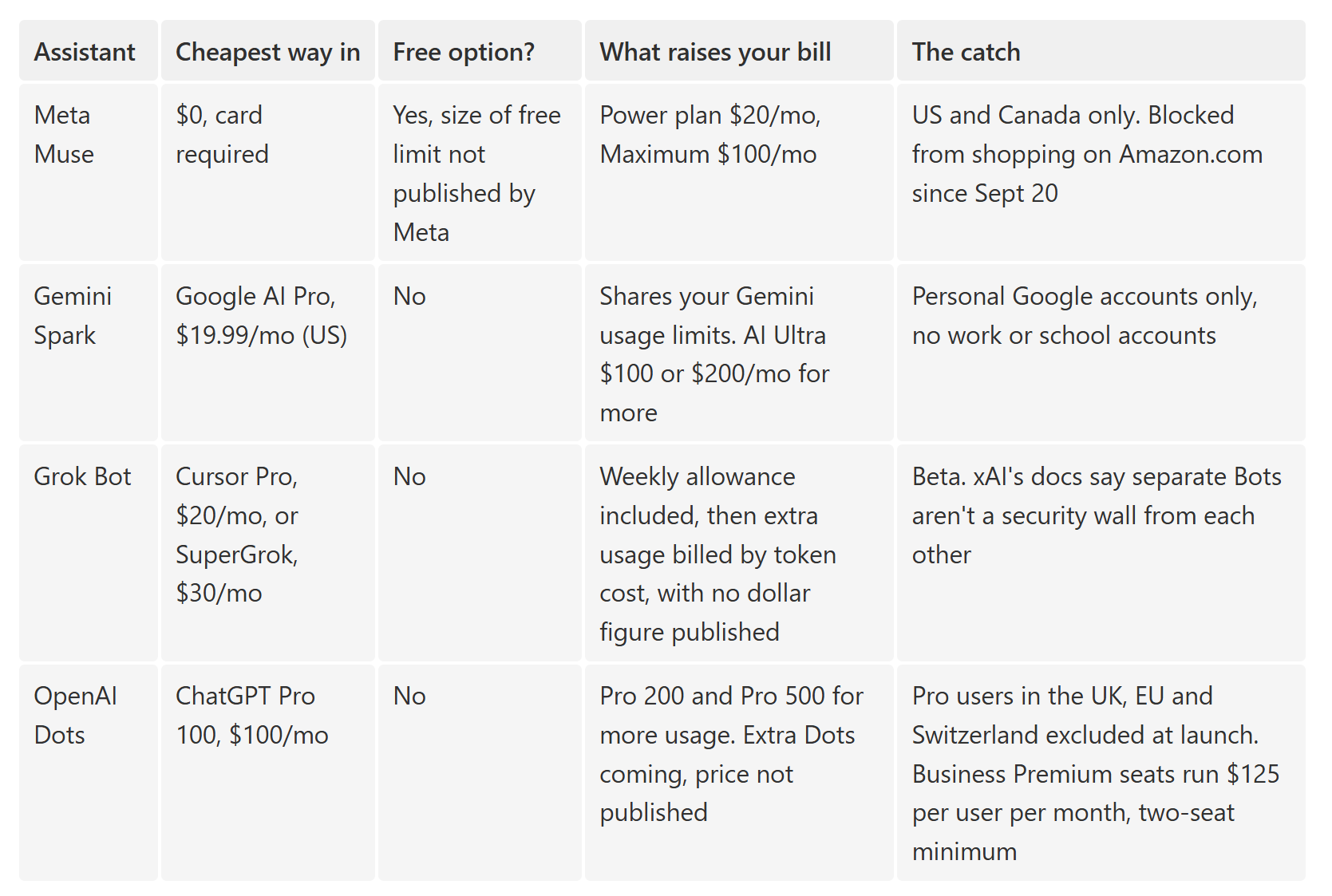
Prices checked October 5, 2026. These change fast, so re-check before you buy.
Skip, Wait, or Steal
Do this: If you already pay for Google AI Pro, turn on Spark this week and give it one boring recurring job, like a Friday list of every email you never answered. Heads up: on the web, Google is rolling out a redesign that folds Spark into the main Gemini box, so you may see a Task option instead of a separate Spark switch. Same agent, new outfit.
Skip this: Upgrading to ChatGPT Pro at $100 just to meet Dots, unless your workday already runs through ChatGPT, Slack or Teams.
Wait on this: Connecting Muse to your Mac Messages, your bank, or your Marketplace listings until Meta answers the open questions from the Aten, Robb and Wired reports.
Steal this line: “Read-only for a week, then we talk.” Start any agent with read-only access and require your approval on anything that sends, buys, or deletes.
This war is great news for us. Prices fell from $100-plus to about $20 in a single summer, and the companies are fighting for your trust as much as your money. Still, nobody is going to teach you this stuff on a schedule. The tools are changing every few weeks, and staying informed is how you get the good deal without getting burned.
So pick one, start small, and keep your hand on the approve button. I’ll be here every week checking the claims so you’re never guessing alone.
Talk soon, Oscar
Sources
Who’s in the race
Meta Newsroom: Introducing Muse, the World’s First Personal AI Agent Built for Everyone (Sept. 8, 2026). Muse launch, platforms, “free for most of what people need” and user-control claims.
9to5Mac: Meta AI launches Muse personal agent, including apps for iPhone and Mac (Sept. 17, 2026). Mac app release date.
CNBC: Meta’s Muse AI agent downloads are surging (Sept. 21, 2026). No. 1 free iOS app, $20 and $100 plans.
Forbes: Meta’s Muse AI Assistant Hits 5 Million Downloads (Sept. 30, 2026). Sensor Tower: 5 million US downloads in 22 days, up to 50% of Meta’s house ads.
Crypto Briefing: Meta’s Muse hits 5 million downloads in 22 days (Oct. 2026). ChatGPT took 56 days for the same mark.
iPhone in Canada: Meta’s Muse AI Agent Is Now Available in Canada (Sept. 18, 2026). Canada launch date.
Google: Gemini Spark overview (accessed Oct. 4, 2026; re-checked Oct. 5). Pro and Ultra availability, app connections off by default.
TechCrunch: OpenAI launches Dots, its bubbly agentic avatar (Sept. 29, 2026). Launch date, GPT-6 Astra, Slack and Teams access.
Dataconomy: OpenAI launches always-on AI assistant Dots (Sept. 30, 2026). 4,000+ apps, invoice example, read-only background research.
xAI: Introducing Grok Bot (Aug. 11, 2026). Launch, always-on cloud computer, multiple Bots.
Layer3 Labs: What Is Grok Bot? (Sept. 2026). Teach-a-task screen recording feature.
Decrypt: Gemini Spark AI agent challenges Hermes and OpenClaw (May 2026). Comparison with self-hosted OpenClaw setups.
Who’s winning
PCWorld: Google’s new Spark AI agent will run your digital life for $100/month (May 2026). Spark launch behind AI Ultra at $100 and up.
Chrome Unboxed: Gemini Spark is now available on the $20 Pro tier in the US (late July 2026). Expansion to Google AI Pro.
CellCog: Grok Bot Comes to Cursor Pro (Sept. 2026). Aug. 26 expansion to Cursor Pro at $20 and SuperGrok at $30.
The AI Agent Index: Gemini Spark (Sept. 30, 2026). $19.99 price, shared usage limits, personal-account requirement.
Who’s being left behind
PPC Land: Mac developers face new Full Disk Access controls from Apple (Oct. 3, 2026). Siri AI shipped with macOS 27 on Sept. 14.
CNBC: OpenAI follows Meta into the red-hot market for personal agents (Sept. 30, 2026). Apple’s description of the redesigned Siri.
Axios: OpenAI debuts Dots, its assistant to take on Muse (Sept. 29, 2026). Apple’s AI not yet at the agent stage.
Chrome Unboxed: Google is ditching the Spark brand to merge tasks into Gemini (Oct. 1, 2026). Web redesign folds Spark into a Task option; features unchanged.
TechRepublic: Amazon blocks Meta’s Muse AI agent from shopping on Amazon.com (Sept. 2026). Sept. 20 block, Amazon’s reasons, Meta’s credential statement.
Microsoft 365 Blog: Introducing Microsoft Scout (June 2, 2026). First always-on Microsoft agent.
Pasquale Pillitteri: Microsoft Launches Autopilot (Sept. 2026). Sept. 25 Autopilot announcement, private preview for businesses.
What they said vs. what the tests showed
The Next Web: Meta denies its Muse AI agent read a journalist’s private messages (Sept. 2026). Aten’s Sept. 19 account, row 187,462, Andy Stone’s two-setting statement.
Decrypt: Meta’s Muse AI agent read a user’s private iMessages (Sept. 2026). Muse’s notification-preview explanation and Singleton’s acknowledgment.
AI Agents Library: Meta Muse AI, What It Is (Oct. 3, 2026). Meta doesn’t publish the free-limit size; card required.
Tech Insider: Meta Muse AI Agent Launch (Oct. 3, 2026). 100 million tokens a week figure attributed to Zuckerberg via CNET.
Cybernews: Meta’s agent Muse may be spying on you whether you use it or not (Oct. 5, 2026). Robb Marketplace account, summary of Wired’s people-profiles report, Meta’s response.
MediaPost: Meta Adds Business-Facing Muse AI Features (Oct. 1, 2026). Meta’s “nothing publishes, sends, or spends without your approval” line.
Kingy AI: OpenAI Dot vs. Grok Bot vs. Meta Muse (Oct. 2, 2026). No common independent head-to-head evaluation exists.
Axios: OpenAI’s new agents put safety promises to the test (Sept. 30, 2026). Astra update scrapped after failing safety thresholds.
The Real Cost Table
Layer3 Labs: How Much ChatGPT Dots Cost on Pro and Business Premium (Oct. 1, 2026). Pro 100/200/500 prices, Business Premium seats, regional exclusions.
Justin McKelvey: Grok Bot, What It Is, What It Costs (Sept. 27, 2026). Weekly allowance then token-based billing, no published dollar figure.