

Most of us use AI like a microwave. You punch in thirty seconds and you hover like the burrito owes you money. One prompt goes in, one answer comes out, and the whole relationship is over in under a minute.
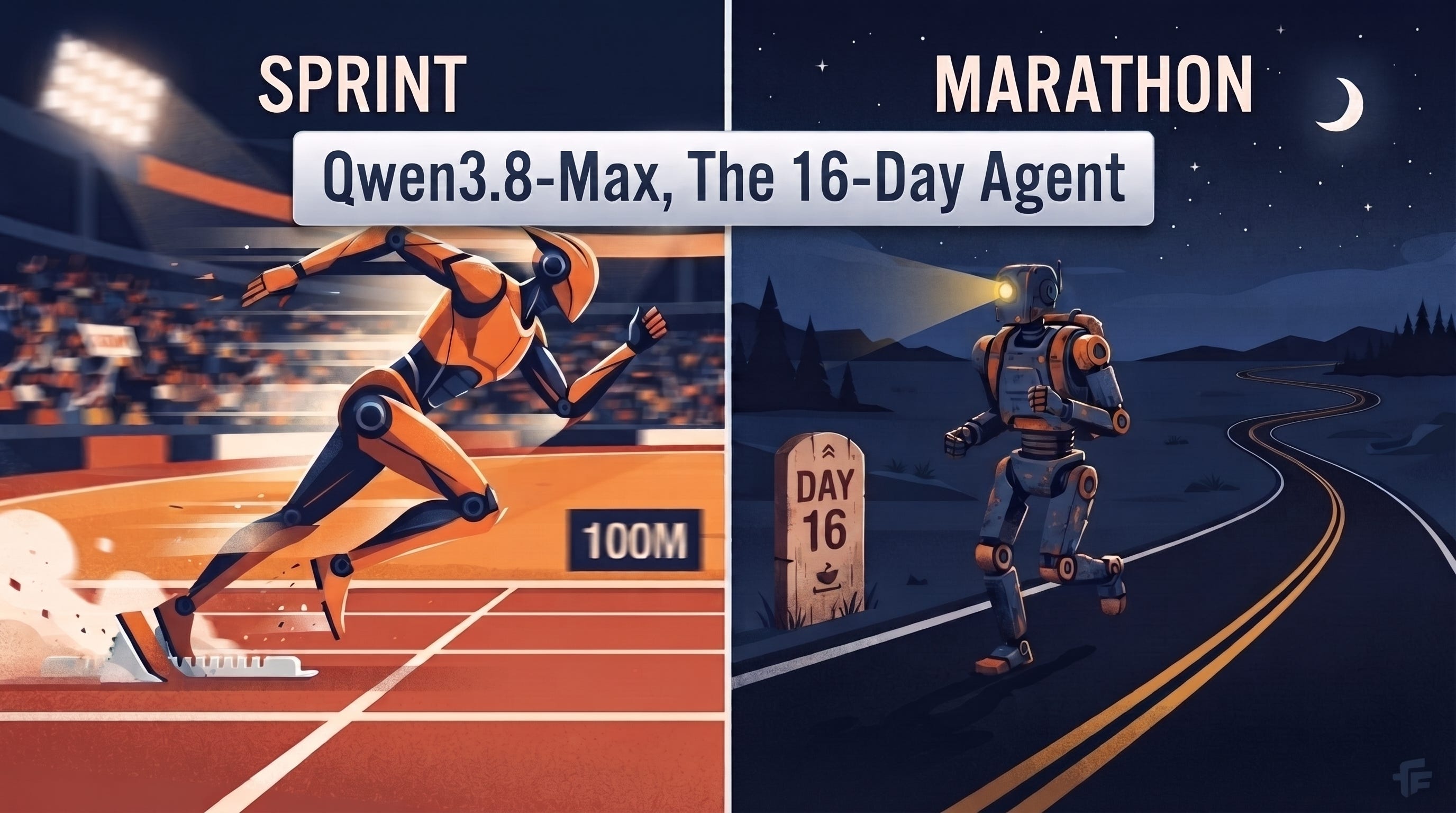
On Monday, Alibaba claimed it built something closer to a line cook. One that clocked in, started a project from an empty folder, and did not clock out for sixteen days.
The model is called Qwen3.8-Max. By the end of this piece you’ll know what it is in plain English, what it actually did during those sixteen days, what it costs, and whether any of it deserves your attention.
The verdict, up front: this claim is more checkable than the usual vendor demo, because the receipts sit in a public GitHub repo. The specs are real and the pricing is aggressive. The asterisks are real too, and the biggest one involves a license that does not exist yet. Either way, this release shows where the AI race is heading. It’s moving away from smarter answers and toward agents that don’t stop.
The two-week test
We need a foundation before the specs, because the numbers only matter once this part clicks.
I judge every agent announcement with one question I call the Two-Week Test. If you handed an AI a real project and walked away for two weeks, would it still be on task when you came back?
Almost everything fails this test in an afternoon. The model forgets the goal, or the context window fills up and it quietly loses the plot like me at minute forty of any movie with a dream sequence.
That failure is why “agents” have been more demo than product. Writing one great function got solved a while ago. Staying coherent across days of feedback, errors, and shifting requirements is a different sport entirely.
Qwen3.8-Max is Alibaba’s attempt to pass the Two-Week Test in public.
What Alibaba says happened
The centerpiece demo is a project called oh-my-cli. According to Alibaba, the model started from an empty repository and ran a full engineering loop on its own. Incoming requests became GitHub issues. The model claimed those issues, wrote the code, ran the tests, and merged its own pull requests when everything passed.
Alibaba’s own write-up describes the run as ten-plus days. The tally posted for July 30 works out to roughly sixteen days of unattended operation, and sixteen is the number most coverage settled on. I’m flagging the wobble because you deserve to know the vendor said “10+” while the headlines said sixteen.
The output is easier to pin down. The run produced 265 commits. Behind those sat 127 pull requests. The model also worked through 151 issues. And this is what separates the demo from every glossy AI flex you’ve scrolled past this year: the entire trace is public at qwen-code-dev-bot/oh-my-cli on GitHub. You don’t have to take Alibaba’s word for anything. You can read the commit history like a diary.
A second demo pushed further. Alibaba handed the model a research paper, “Unified Data Selection for LLM Reasoning,” with zero starter code, and told it to reproduce the results and then beat them. The run took roughly five days. In that window the model wrote about 7,600 lines of code and completed 33 rounds of GPU training. Alibaba says the method it invented at the end scored 2.7 points above the paper’s approach on a math benchmark. Those numbers come from Alibaba’s own harness, and no outside lab has audited them yet.
What the thing actually is
In plain English, Qwen3.8-Max is a huge model that only wakes up a small piece of itself for each request.
With that picture loaded, the technical version lands easier. It’s a sparse mixture-of-experts model carrying 2.4 trillion total parameters, of which about 95 billion activate per token. Imagine a hospital with 2.4 trillion staff on payroll where each patient only gets paged the specialists relevant to their case. It would be a terrible hospital, but it’s a great architecture, because you get frontier scale without paying frontier compute on every token.
The model takes text, images, and video as input, holds up to one million tokens of context, roughly 750,000 words, and builds on the Qwen3.5 architecture. It also plugs into tools you already use, since the API speaks both the OpenAI format and the Anthropic format. You can point Claude Code at it by changing a base URL.
What it costs, and the license problem
Let’s talk money, because this is where the announcement gets slippery.
The hosted API is paid and live today. Input costs $2 per million tokens, output runs $6, and cached input drops to $0.25. That sounds cheap next to Western flagships. One catch hides in the defaults, though. Thinking tokens bill as output, and the model ships with reasoning effort cranked to its highest setting, so real agentic sessions will land noticeably above the sticker math.
The open weights are the headline everyone repeated, and they remain a promise. Alibaba committed to releasing them within about a week of launch, for both the flagship and a smaller Qwen3.8-27B. As I write this, neither has appeared on Hugging Face and no license has been named. That last part matters more than it sounds. A model with no license isn’t open source yet, no matter what the headline says. Until words like Apache 2.0 appear next to an actual repository, don’t build a business plan on these weights.
And even when they land, a free license is not free hosting. The 2.4 trillion parameter checkpoint is a multi-node datacenter artifact, and nobody is running that at home. The 27B sibling is the one ordinary hardware can hold, and it’s the release worth watching if you’re a self-hosting builder.
One more piece of context: this lands in the middle of a Chinese pricing war. DeepSeek’s V4-Flash officially runs $0.14 per million input tokens and $0.28 per million output. Chinese labs keep pushing capability up while dragging prices down, and American labs are left defending the premium tier.
The honest asterisks
Every headline number in this release traces back to Alibaba’s own testing, run inside Alibaba’s own environment. On the crowdsourced Arena leaderboards, the model debuted as the top-ranked Chinese model for text while still trailing Anthropic’s Claude Fable 5, and Alibaba’s own benchmark table shows it beating some Western flagships on terminal tasks while losing to others. That mixed picture is normal. It’s also exactly why the weights release is the real event, because once outside labs can poke at the model directly, we find out how much of the endurance story survives contact with someone else’s sandbox.
There’s a quieter insight buried in the technical coverage, and it’s the punchline of the Two-Week Test. The model was not alone out there for sixteen days. It sat inside scaffolding: an issue state machine, a dispatcher, a monitor, and a watchdog that restarted things when they stalled. The model decides what to do next, and the harness keeps it alive long enough for that decision to matter. Systems pass the Two-Week Test. Models just take it. If you’re building agents, that idea is worth more than any benchmark in this piece.
So what
Do this: skim the commit history at qwen-code-dev-bot/oh-my-cli. Ten minutes in that repo will teach you more about the current state of autonomous coding than any launch thread.
Skip this: any plan involving self-hosting the full 2.4T model. That checkpoint belongs to datacenters, and pretending otherwise burns money.
Wait on this: the license. No named license means the “open” part hasn’t happened, and fine print has sunk better stories than this one.
Steal this line: stop asking whether your AI is smart, and start asking how long it stays on task.
Because that’s the shift underneath all of this. For three years the industry raced to build the model with the best answer. Alibaba just spent sixteen days arguing the next race belongs to the model with the best attention span. And if endurance really is the new battleground, the labs with the smartest models won’t be the only winners. The builders who learn to construct the scaffolding that keeps a model on task will win right alongside them.
That part is not reserved for trillion-parameter labs. That part is learnable, right now, by people like us.
See you in the next one.
Sources
Quartz: Alibaba launches Qwen3.8-Max, its largest AI model yet
The New Stack: Alibaba’s AI coded for 16 days straight and every commit is on GitHub
Developer Tech: Alibaba Qwen3.8-Max claims 16-day autonomous coding run
Yotta Labs: Qwen 3.8-Max release date, specs, and how to access it
The Daily Star: Alibaba releases Qwen 3.8-Max, its largest AI model yet