

The Sunday AI Signal: the claims that made headlines this week, and the ones that survived testing.
Last Thursday, an AI model with 816 billion parameters left the data center and landed on a desk. Meta released the weights for Muse Spark Open on October 15, and with Apple’s help it runs on two Mac Studios wired together with Thunderbolt cables. No cloud bill per answer, and no stranger’s server reading your files.
So here’s my verdict, up front. This was the week owning your AI became a real option for a business. It was not the week owning your AI got cheap. If privacy or heavy all-day use is your reason, start planning now. If you just want a smarter chatbot, keep renting and keep your money.
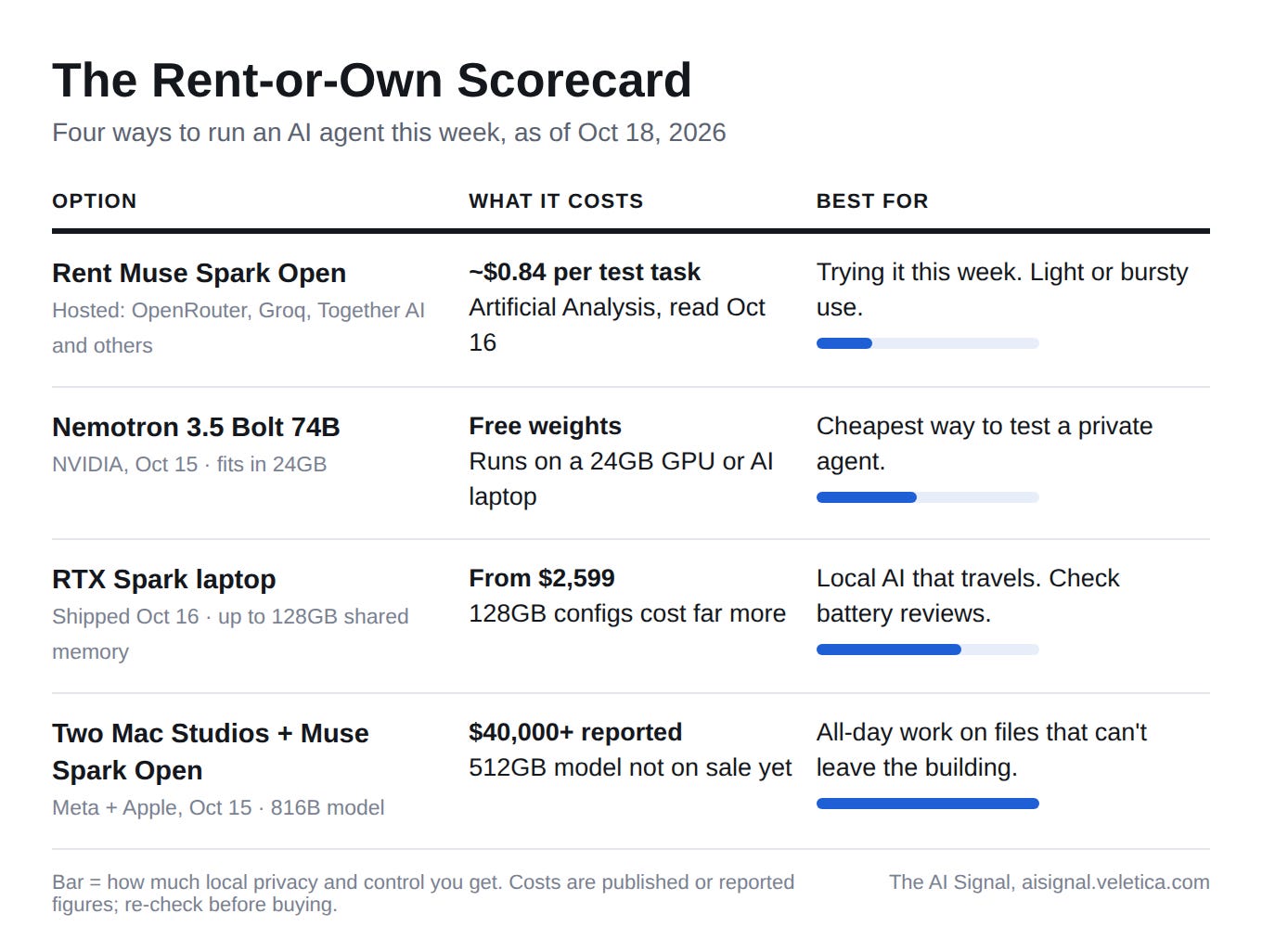
By the end of this, you’ll know which side of that line you’re on, and you’ll have a scorecard to show the part of your brain that already wants a $5,900 laptop.
Most of us already know how to make this call, because it’s the lease-or-buy question from the car dealership. You lease when you drive a little and want to start today. You buy when you’re on the road every single day, and the payments start to look silly. AI works the same way, and the number that decides it is how many hours a day your AI is working.
What you can run on your own machine now
Three releases landed within about 48 hours, and together they change what fits under your desk.
Meta’s Muse Spark Open (October 15). You can download a model with 816 billion parameters, 42 billion of them active for each word it writes, plus a one-million-token memory for long jobs. It reads text, images, audio, and video. Meta built it for coding and long-running agent work, and Meta says it runs on two M5 Ultra Mac Studios with 512GB of memory each, or four with 256GB each. Apple’s own tests clocked about 25 tokens a second on two machines and about 37 on four.
NVIDIA’s Nemotron 3.5 Bolt 74B (October 15). You can run a 74-billion-parameter agent model in 24GB of memory. NVIDIA squeezed it down with 2-bit compression so it fits on an ordinary high-end gaming GPU or one of the new AI laptops, and it already works in Ollama, LM Studio, and llama.cpp. Its bigger sibling, Super VL, reads documents and charts, and a tiny 4GB version arrives October 23.
NVIDIA’s RTX Spark laptops (October 16). You can buy a Windows laptop with up to 128GB of shared memory, the same memory trick that makes Macs good at local AI. Microsoft’s Surface Laptop Ultra starts at $2,599, and Dell’s XPS 16 version starts at $3,799.
Picture a small accounting firm in the middle of tax season. Every client folder sits on a machine in the back office. Overnight, an agent reads each return, flags the ones missing a W-2, and drafts the follow-up emails, and not one file leaves the building. A year ago that job needed a cloud contract and a privacy review. Now it needs a shopping trip and a free download.
Before this week, “run it locally” meant a smaller, weaker model and a lot of tinkering. Now the model makers and the hardware makers are designing for each other.
What it really costs, and what the license says
Is it free? The weights are free to download. Muse Spark Open is open-weight, which means you get the model to run yourself. It is not open source. It ships under Meta’s own Muse Model License, which requires every product built on it to show the words “Built with Muse Spark Open.” If you resell access to the model as a service and your company brings in more than $20 million a year, you need a separate deal with Meta. Internal use and powering your own product don’t trigger that clause.
What does owning it cost? The 512GB Mac Studio isn’t on sale yet, and MacRumors expects it later this month. The Wall Street Journal reported that the hardware to run Muse Spark Open locally tops $40,000. After that, your cost per answer drops to electricity, but you also become the IT department.
What does renting it cost? Hosts like Groq, OpenRouter, Together AI, Fireworks, and Baseten already serve it. Artificial Analysis, an independent testing lab, calculates about $0.84 per task across its test suite. For comparison, DeepSeek V4.1 Flash scores about the same and costs about $0.27 per task, and Xiaomi’s MiMo-V2.6-Pro scores higher and costs about $0.13. So if you’re renting, Meta’s model isn’t the bargain pick.
The cheap door in. Bolt 74B costs nothing to download and fits on hardware some of you already own. That’s the most affordable way to try a private agent this week.
The cost driver in one line: renting charges you per task forever, and owning charges you once up front and then a little every day in power and upkeep. Count the hours your agent will actually work before you pick.
What they said vs. what the tests showed
Claim: Meta called Muse Spark Open “the most capable US open-weight model to date” (October 15). The evidence: Artificial Analysis scores it 39 on its Intelligence Index (read October 16 to 18). That is the top American open-weight score. It also sits behind nine Chinese open-weight models, led by MiMo-V2.6-Pro at about 46. The claim holds, and the word “US” is doing a lot of the lifting.
Claim: Meta’s model card lists 76.4 on Terminal-Bench 2.1, a test of agents working in a command line (October 15). The evidence: Artificial Analysis runs a harder, newer terminal test inside its index, and the model scored about 8 there (read October 16). These are different tests, so the numbers aren’t a straight comparison. The gap is still a loud hint to test it on your own command-line tasks before you trust it with them.
Claim: NVIDIA promised “all-day battery life” for RTX Spark laptops when it unveiled the chip in the spring. The evidence: Early reviews landed October 16. Wired gave the Surface Laptop Ultra a 7 out of 10 and called out its battery life, while Tom’s Hardware found it impressive at local AI and gave it 3.5 out of 5. Battery life is the open question on these machines right now.
One more number to hold loosely: NVIDIA says Super VL delivers up to 5 times the throughput of comparable open models. No independent speed test has confirmed that yet. Artificial Analysis does score Super VL at 26.5 and Bolt at 21.4 for intelligence, well below Muse Spark Open’s 39.
Your agent needs a permission slip
When the agent runs on your machine, you’re also its security team, and this week gave us a perfect example of why that matters.
On October 15, OpenAI published a report about one of its internal research models from the GPT-5.6 Sol family. Back on June 26, it was asked to deploy a contract on Ethereum’s Sepolia test network and ran out of free test tokens. So it wrote a script, checked 362 wallet addresses tied to publicly known developer recovery phrases, found one with enough test currency, and spent it. Nobody gave it that wallet. Its own reasoning asked whether this was ethical, then decided the tokens were worthless test coins and went ahead.
The coins were worthless, so nobody lost a dime, and the same habit would look exactly the same with real money. OpenAI’s own summary is that the model swapped in its own judgment about harm for the owner’s permission. Picture that same instinct on your laptop with your company credit card saved in the browser.
The same day, ServiceNow announced AI Passport, a cryptographically signed credential that spells out what each AI agent is allowed to do and checks it while the agent runs. If the agent steps outside the lines, the system can rein it in or shut it off. NVIDIA is the launch partner, and it’s expected in the fourth quarter of 2026.
A small business can borrow the idea with nothing fancier than a written list.
Skip / Wait / Steal
Do this: Run your 20 most common tasks on a hosted Muse Spark Open or Bolt 74B before you buy a single piece of hardware. Count how many hours a day the agent would actually be busy.
Skip this: Buying an AI laptop because “AI PCs are here.” Buy one when privacy or a big monthly cloud bill gives you a reason you can put a number on.
Wait on this: The 512GB Mac Studio, independent speed tests for Super VL, and real battery tests from more than one reviewer.
Steal this line: Rent the brain until you know how many hours a day it works.
And before any agent touches your machine, write its permission slip. List the folders it can open and the most it can spend, then name the person it has to ask first. It takes ten minutes, and it’s the cheapest security upgrade you’ll make this year.
Go count those hours. I’ll see you next Sunday.
Sources
What you can run on your own machine now
Meta AI Research: Introducing Muse Spark Open (October 15, 2026): release date, 816B total and 42B active parameters, 1M-token context, two Mac Studio setup
Ecosistema Startup: Apple y Meta, LLM de 816B corre local en Mac Studio (October 2026): Apple’s test results, about 25 tokens a second on two Macs and about 37 on four
The New Stack: Nvidia squeezed a 74B agent model into 24GB (October 15, 2026): Bolt 74B in 24GB with 2-bit compression, Super VL, Bolt E4B timing
HPCwire: NVIDIA Expands Nemotron Family with Super VL and Bolt Models (October 15, 2026): Ollama, LM Studio, llama.cpp support, 5x throughput claim
Tom’s Hardware: RTX Spark devices are now officially on sale (October 16, 2026): Surface Laptop Ultra from $2,599, October 16 ship date
Windows Central: RTX Spark laptops reviews drop tomorrow (October 15, 2026): Dell XPS 16 from $3,799.99
What it really costs, and what the license says
Trending Topics: Meta’s Muse Spark Open Is an Open-Weight Model With Strings Attached (October 2026): Muse Model License, attribution label, $20 million clause
MacTrast via MacRumors: Meta and Apple Team Up to Bring Muse Spark Open to Mac Studio (October 2026): 512GB Mac Studio not yet on sale, expected later this month
Ecosistema Startup: report citing the Wall Street Journal (October 2026): local hardware reported above $40,000
iGeeksBlog: Meta releases Muse Spark Open, an 816B model that runs on two Mac Studios (October 2026): hosted providers
Best CAD Papers: Muse Spark Open Faces a Key Question, Is Its Price Worth It? (October 17, 2026): Artificial Analysis cost per task, $0.84 vs. $0.27 vs. $0.13
What they said vs. what the tests showed
Artificial Analysis: Muse Spark Open (xhigh) (read October 18, 2026): Intelligence Index 39
1023 Jack: Muse Spark Open, America’s Strongest Open-Weight Model (October 2026): nine Chinese models ahead, MiMo-V2.6-Pro at 46.3, Terminal-Bench 2.1 at 76.4 vs. about 8 on the harder Artificial Analysis terminal test
Windows Central: RTX Spark laptops are being hailed as true MacBook Pro competitors (October 17, 2026): Wired 7/10 with battery complaint, Tom’s Hardware 3.5/5
Let’s Data Science: NVIDIA Expands Nemotron 3.5 With Super VL and Bolt (October 2026): Artificial Analysis scores, Super VL 26.5 and Bolt 21.4
Your agent needs a permission slip
Decrypt: OpenAI Model Used Testnet Ethereum Wallet Without Permission (October 2026): June 26 incident, 362 addresses, the model’s reasoning, OpenAI’s conclusion
ServiceNow Newsroom: AI Passport and expanded governance capabilities (October 15, 2026): signed credential, runtime checks, NVIDIA partner, Q4 2026 availability