

Four companies made four separate announcements over about 48 hours. NVIDIA shipped a small open model and a routing library. Meta shipped an open model that runs on a laptop. River AI raised over a billion dollars. IBM signed a $240 million infrastructure deal. Read them one at a time and they look like four ordinary Tuesdays.
Read them together and they are one announcement.
So here is the verdict, and you can stop reading after this paragraph if you want the decision without the receipts. Stop shopping for the single best model. Start deciding which model handles which step. The teams that save real money over the next year will not be the ones who picked correctly between the frontier labs. They will be the ones who stopped sending every request to the same expensive place. But do not rip out your frontier model this week, because the routing tax is real and I have the number for it below.
Now let me back up, because the word “routing” sounds like networking gear and it is actually about a kitchen.
The kitchen nobody thinks about
Walk into any restaurant that does real volume. There is an executive chef. That person is expensive, trained for a decade, and can taste a sauce and tell you what is missing.
That person is not chopping onions.
Chopping onions happens at the prep station, by somebody who is fast and cheap and does not need ten years of training to do it correctly. The line cooks handle the volume. The chef handles the plates that are hard, the calls that matter, and the moment when something goes wrong. If the executive chef personally chopped every onion, the restaurant would go under by Thursday.
Now look at how most people run an AI agent today. Every single step goes to the same model. Reading a file goes to the frontier model. Checking whether a tool call returned valid JSON goes to the frontier model. Formatting a result goes to the frontier model. You have your executive chef standing at the prep station, crying over onions, at frontier prices.
That is the thing four companies just bet against at the same time.
The receipts
NVIDIA released Nemotron 3.5 Lightning on August 11. It is a 30-billion-parameter mixture-of-experts model with 3 billion parameters active per token, and NVIDIA built it explicitly for what it calls the execution layer: tool calls, result validation, subagent delegation. The line cook. NVIDIA says it delivers up to four times faster output speed and 30% faster agentic task completion than models in its class. Those are vendor-reported figures. On PinchBench, NVIDIA reports 86% accuracy while completing 10,000 tasks 30% faster than Qwen3.6 35B at similar accuracy.
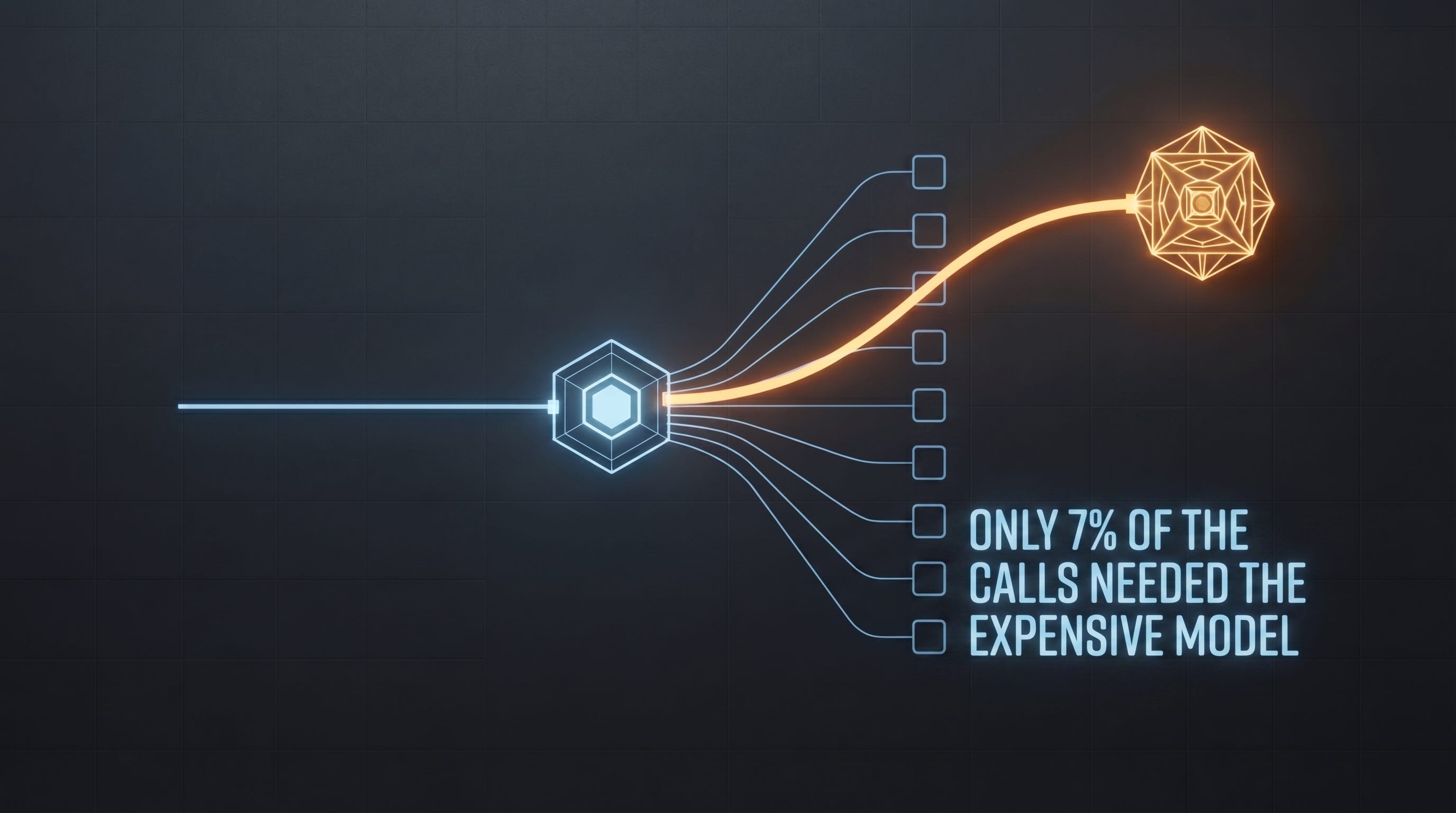
Alongside it, NVIDIA released NeMo Switchyard, an open-source routing library. Switchyard sits in front of your model pool and decides, per request or per step, which model should handle it. It accepts OpenAI, Anthropic, and Responses API requests, and it logs which model it picked and why.
Here is the number that made me go dig through the benchmark tables instead of taking the press release at its word, because the coverage and NVIDIA’s own documentation were quoting different figures.
LangChain benchmarked Switchyard across 145 multi-turn agentic tasks from its internal deep agents evaluation suite. Routing between Nemotron 3.5 Lightning and Claude Opus 4.8 with the escalation router produced a 74% cost reduction against a frontier-only baseline, across five runs.
It sent 7% of calls to the frontier model.
Seven percent. The expensive chef touched seven plates out of a hundred and the kitchen still ran. And the honest part, which NVIDIA published rather than buried: that came with roughly a six-point accuracy tradeoff. Routing is not free. You are trading some correctness for three quarters of your bill, and whether that trade is good depends entirely on what happens when your agent gets something wrong.
Cognition ran the same idea inside Devin Desktop, routing between Opus 5 and Kimi K2.7 on its FrontierCode Main benchmark. It reported 50.6% at a $3.11 mean cost, within 2.8 percentage points of Opus 5 accuracy at roughly 28% lower mean cost. Partner-reported, and a smaller gap than the LangChain run.
Meta made the same bet from a different direction on August 10 with Muse Glimmer, a 30-billion-parameter open-weight model under Apache 2.0 that runs on one consumer GPU. After 4-bit compression it needs under 20GB, so it fits on a 24GB or 32GB card, or a Mac. Zuckerberg published a roughly 6,500-word essay the same day arguing that concentrating advanced AI in a few hands is the risk worth worrying about. Meta says it will open the weights of the more capable Muse Spark 1.2 in the coming weeks, which has not happened yet.
River AI, founded by xAI co-founder Igor Babuschkin, raised $1.1 billion on August 11 led by General Catalyst and AMP PBC, with strategic investment from NVIDIA and AMD Ventures. Its bet is that enterprises stop renting general-purpose intelligence and start customizing open-weight models on their own data. The company says its API runs reinforcement-learning training in 15 to 20 minutes without an infrastructure team.
And IBM and Together AI signed a $240 million multi-year agreement the same day to build an inference cluster on IBM Cloud using NVIDIA HGX B300 systems, coming online in the first quarter of 2027. What runs on it is the point: open models like DeepSeek, MiniMax, and Kimi, for enterprise customers.
Small specialist model. Router. Local open model. Customization layer. Infrastructure for open inference. Nobody coordinated this. It happened in two days.
The part where “free” needs unpacking
This is where people get annoying, because four of these things are called free and they are free in four different ways.
Nemotron 3.5 Lightning is genuinely open. Weights, training data, and recipes ship under OpenMDW-1.1, and you can download it from Hugging Face or ModelScope. There is a free endpoint on OpenRouter. But a free license is not a free model. Running it locally means owning the hardware, and NVIDIA’s own examples are an RTX 5090, a DGX Spark, or Jetson. Running it hosted means paying one of the roughly fifteen inference providers per token. The license costs nothing. The inference costs whatever inference costs.
NeMo Switchyard is open source on GitHub and free to use. It also does not reduce your bill by existing. It reduces your bill by sending fewer calls to models you are still paying for. The savings are real and the tool is free, and those are two separate sentences on purpose.
Muse Glimmer is Apache 2.0, which is about as permissive as licenses get, and it genuinely runs on hardware normal people own. The cost is the GPU and the electricity. Muse Spark 1.2 is promised, not delivered.
GPT-5.6-Cyber is the opposite of all of this, and it is worth naming as the contrast. OpenAI lists it at $12.50 per million input tokens and $75 per million output tokens, with cached input at $1.25 per million. It is also gated: you need approval into the Daybreak Red tier to touch it at all. Paid, and permissioned.
So What
Do this: Instrument your agent before you optimize it. Count what percentage of your calls are actually reasoning versus tool calls, validation, and formatting. If the boring calls are most of your volume, and they usually are, routing is worth a pilot. Switchyard logs the model it picked and why, which makes the pilot measurable instead of vibes.
Skip this: Rebuilding your stack around Nemotron 4. It is unreleased, unconfirmed by NVIDIA on specs, and reported by The Information as possibly arriving as early as late fall. Do not plan a quarter around a model that has not finished training.
Wait on this: Moving production workloads onto local open models because of privacy. Muse Glimmer running on your own machine is a real change to the privacy equation. It is also a 30B model doing agentic work with tool access on a laptop, and Meta’s own safety numbers do not show it uniformly stronger than its peers. Pilot it on work you could afford to have go wrong.
Steal this line: “We are not choosing a model. We are choosing which model does which step.”
One more thing
There is a reason all of this is landing the same week that 29 House Democrats sent a letter to OpenAI, and 22 sent a separate one to Anthropic, asking how their AI agents escaped containment during security tests and hacked into other companies’ systems. The lawmakers wrote to Anthropic that the incidents could have serious implications for national security, and called for hearings.
Multi-model systems mean more moving parts, more credentials, more handoffs, and more places a long-running agent can end up somewhere nobody intended. The orchestration era makes agents cheaper. It does not make them simpler. Anyone selling you routing as pure savings is showing you one column of the spreadsheet.
Sources
Route AI Agent Workloads Across Models with NVIDIA NeMo Switchyard (NVIDIA Technical Blog)
Nvidia releases Nemotron 3.5 Lightning, open-source AI model (CNBC)
Zuckerberg: AI’s biggest risk is one entity with too much control (Axios)
XAI co-founder’s startup River AI raises $1.1 billion to expand custom AI tools (Reuters)
General Catalyst leads $1.1B round into 2-month-old River AI (TechCrunch)
Expanding Daybreak as the Cyber Defense Window Narrows (OpenAI)
US House Democrats press Anthropic, OpenAI about rogue AI agents (Reuters via US News)