

On Tuesday, Google shipped a voice model that keeps talking while it works. On Wednesday, Anthropic erased the line between chatting with Claude and handing Claude a job. The same day, OpenAI started testing ads inside ChatGPT that you can talk to.
That is three companies in two days, all moving the same way. The software is learning to skip the page and go straight to the person.
My verdict: if you sell anything online, the next twelve months are about deciding what your website is actually for. You do not need to redesign it yet. You need to decide what job it does once an agent can answer the first ten questions a customer used to bring to your homepage. The Sponsored Agents pilot is small, it is US only, and it covers a handful of advertisers, so nothing breaks tomorrow. But the shape of it is the whole story, and I would rather you see the shape now than read about it in somebody’s earnings call next spring.
The showroom and the parking lot
For thirty years the internet worked like a car dealership. You searched, you clicked, you walked into the showroom, and eventually a person found you. Every marketing dollar on earth was spent getting you through that door.
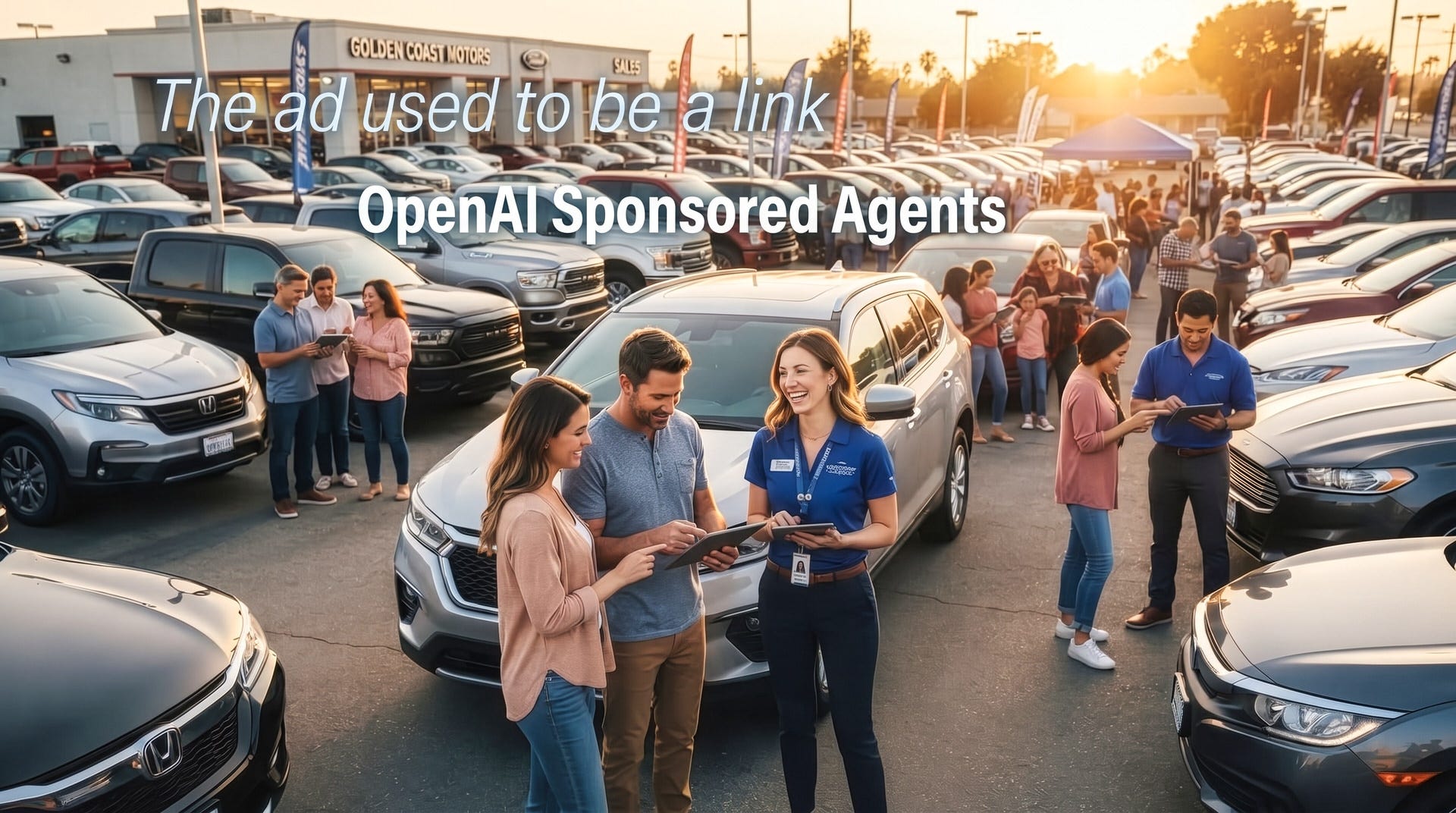
A Sponsored Agent is the salesperson walking out to the parking lot. You see an ad in ChatGPT, you tap it, and a clearly labeled chat opens with an agent that speaks for the business. You explain what you need, it asks follow-up questions, and when you are ready it hands you a link. OpenAI says that chat stays separate from ChatGPT’s own answer and separate from the conversation you started. As of September 16, 2026, the test is limited to select advertisers in the United States.
Two definitions, because I promised my mom this newsletter would stay readable. An agent is software that can ask you questions and take a next step for you, instead of only answering. A website is a brochure on a table. Use the website when someone already knows what they want. Use an agent when they only know what is wrong.
I spent years assuming the homepage was the front door. It turns out the front door can walk.
1. What you can do this week with each launch
Talk to an ad. If you are a US ChatGPT user on a tier that shows ads, you may already see an Angi agent appear in a home repair conversation or a Wayfair agent in a furniture one. You can describe the leaky faucet, answer a few questions, and end up in Angi’s service request flow without ever loading angi.com. Angi says so in its own press release from September 16. Wayfair told Contentgrip it is participating at limited scale.
Build a campaign by talking. Advertisers can now create, update, and analyze ChatGPT ad campaigns with plain prompts in ChatGPT Work through the Ads Manager plugin. You paste a website or a brief, ask for a campaign, and get suggested copy and images pulled from your own landing page. You still approve every line before it runs.
Run it where you already work. HubSpot, a customer database most sales teams live in, and Shopify, the online store builder, both got ChatGPT Ads apps on September 16. The HubSpot listing already shows more than 400 installs and adds tracking tags so an ad click maps to a real contact. The Shopify app is US only until September 23, when it reaches the other markets where ChatGPT Ads run.
Hand Claude the whole job. Anthropic merged Cowork, its longer running work mode, into regular Claude chat on Pro and Max plans, rolling out over the coming weeks. You type “what moved in the pipeline last week, write it the way we always do, and put the highlights in five slides,” then close your laptop. Claude decides whether that is a chat, a research run, or a document. Claude Docs and Slides shipped in beta the same day. By default Claude asks before it acts. You can switch that so it only checks in when something needs a closer look.
Keep talking while Gemini works. Gemini 3.8 Live runs tool and API calls in the background while the conversation continues, and it switches between 97 languages mid-sentence. The Extended Thinking version narrates its progress on multi-step jobs, so you hear “let me check that” while it books the table or builds the page. Since September 15, Extended Thinking is free in Gemini Live, and Live is free in Search Live.
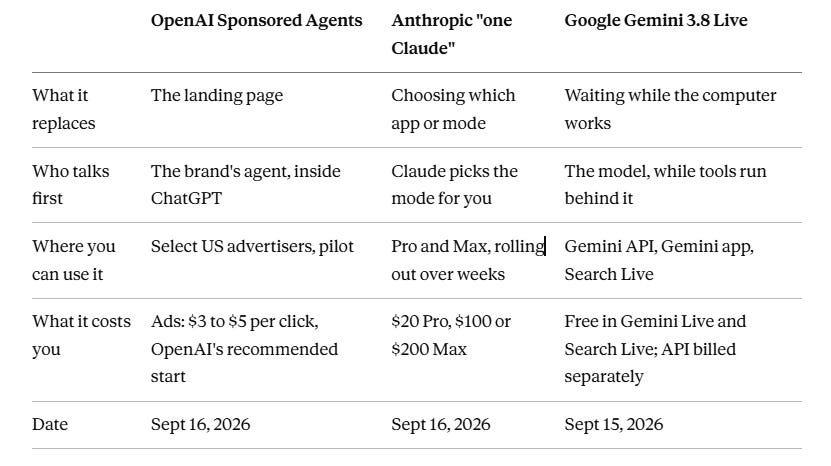
Here is the Pages vs. Agents table so you can hold all three in one glance.
2. The Angi handoff, step by step
You are in ChatGPT asking why your water heater sounds like a haunted house.
A labeled Angi ad appears. You choose to open the chat with the Angi agent.
The agent asks about the unit’s age, the noise, and whether there is water on the floor.
When the job needs a professional, it moves you into Angi’s service request flow to connect with local pros.
Angi gets a qualified lead. You never opened a browser tab.
Angi already had an opt-in ChatGPT app since March. The difference is who makes the first move. You add the app yourself, while the sponsored agent shows up on its own inside a relevant conversation. That one difference is the entire business model.
I have spent an embarrassing share of my adult life fixing things at 11 pm with a headlamp and a YouTube video from a man named Gary. The version of me who could describe the noise out loud and get handed a plumber is the version who still has his security deposit.
3. What it costs: claims vs. receipts
ChatGPT Ads run on an auction. CPC means you pay per click. CPM means you pay per thousand views. Both are available.
Vendor claim (OpenAI, per its Help Center as quoted by several ad guides): a recommended starting bid of $3 to $5 per click, and a $60 default maximum for per-thousand-view bidding.
Independent figures (June through August 2026): guides from WebFX, Lapis, and Context Hints report clearing prices of roughly $25 to $60 per thousand views. The minimum spend went from a reported $200,000 at the February launch, to $50,000 in April, to removed on May 5, 2026 when the self-serve Ads Manager opened. One August guide (SEO Discovery) says a $25 daily minimum applies in the US. Those two claims conflict. I could not resolve it from OpenAI’s own pages, so check ads.openai.com before you budget a dollar.
Sponsored Agents specifically: no published price. According to The Deep Dive’s read of OpenAI’s Ad Tools Terms, the advertiser is responsible for the agent’s content, configuration, actions, and output. In plain English, if your agent promises a discount you do not honor, that is your problem, not OpenAI’s.
Claude: $20 a month on Pro, $100 on Max 5x, $200 on Max 20x. Docs, Slides, and Design are in beta on paid plans. Team and Free plans follow later, and Enterprise admins get 30 days notice before anything changes.
Gemini: Extended Thinking is free in Gemini Live and Live is free in Search Live. Developers pay through the Gemini API. Google’s numbers, published September 15, are vendor reported: 68.6% on the τ-Voice task test, 35.1% on Sierra’s banking version, and an 82.6 on Artificial Analysis’ Speech to Speech Quality Index. Artificial Analysis is an independent tracker, but Google picked which scores to put in the blog post. I have not seen a third party rerun them yet.
4. Five questions to ask about your own website
If an agent answers the first ten questions, what is left for the page to do?
What is your agent allowed to say, promise, or discount? You own its mistakes.
When does it hand the customer to a human, and does a human know it happened?
How do you count a conversation? A click is a number. A ten-minute chat that ends in a lead is a different number, and your dashboard does not have a column for it yet.
Are you still optimizing for humans clicking, or for agents finding you and choosing you?
I have spent two decades learning systems right before somebody replaced them, so I know the feeling. Now the thing a web page competes with is a chatbot in a parking lot, and the chatbot is nicer than I am.
So what
Do this. Read your homepage out loud as if you were an agent trying to answer a stranger’s question in one reply. Every sentence it cannot use is a sentence a Sponsored Agent will skip. If you already run ads and you are on Shopify or HubSpot, a small test at OpenAI’s $3 to $5 starting bid tells you more than another month of reading about it.
Skip this. Building your own Sponsored Agent right now. It is invite only, US only, and the terms put every word it says on you.
Wait on this. Google’s voice benchmarks. They are strong, they are vendor picked, and nobody independent has rerun them as of September 16.
Steal this line. “Use the website when someone knows what they want. Use an agent when they only know what is wrong.”
Thanks for reading this far. If a plumber shows up at your house because a chatbot sent him, tell him I said hi.
Receipts
The showroom and the parking lot
OpenAI: Reimagining advertising with AI (September 16, 2026). Backs the Sponsored Agents test, the “clearly labeled” and “separate conversation” claims, and the select US advertisers limit.
1. What you can do this week with each launch
Angi Inc.: Angi Among First Brands to Pilot Sponsored Agents in ChatGPT (September 16, 2026). Backs the Angi pilot, the service request handoff, and the March ChatGPT app.
Contentgrip: OpenAI tests Sponsored Agent ads in ChatGPT (September 16, 2026). Backs Wayfair’s limited scale participation.
OpenAI: Reimagining advertising with AI (September 16, 2026). Backs the Ads Manager plugin, suggested copy and imagery, the HubSpot and Shopify apps, and the September 23 international date.
Securities.io: OpenAI Tests Sponsored Agents and Adds HubSpot and Shopify Apps (September 16, 2026). Backs the HubSpot listing’s 400 plus installs and UTM tagging.
Claude by Anthropic: Claude Cowork and chat are now one Claude (September 16, 2026). Backs the Cowork merge, Pro and Max rollout, Docs and Slides beta, the ask-before-acting default, and the 30 day Enterprise notice.
Google: Introducing Gemini 3.8 Live and 3.8 Live Extended Thinking (September 15, 2026). Backs background tool calls, 97 languages, progress narration, and free availability in Gemini Live and Search Live.
3. What it costs: claims vs. receipts
WebFX: How Much Do ChatGPT Ads Cost? A 2026 Pricing Guide (June 29, 2026). Backs the $3 to $5 CPC guidance, the $60 default CPM max, and the May 5, 2026 removal of the minimum spend.
Context Hints: How much do ChatGPT ads cost? 2026 guide (late August 2026). Backs the $200,000 to $50,000 to zero minimum spend timeline and the $25 to $60 observed CPM range.
SEO Discovery: How Much Do ChatGPT Ads Cost? CPC and CPM Guide (August 14, 2026). Backs the conflicting $25 daily minimum claim.
The Deep Dive: Sponsored AI Agents Entered The Chat (September 16, 2026). Backs the Ad Tools Terms placing agent responsibility on the advertiser.
CloudZero: Claude pricing 2026 (2026). Backs Pro $20, Max $100 and $200.
Google: Introducing Gemini 3.8 Live and 3.8 Live Extended Thinking (September 15, 2026). Backs the 68.6%, 35.1%, and 82.6 vendor reported scores.