

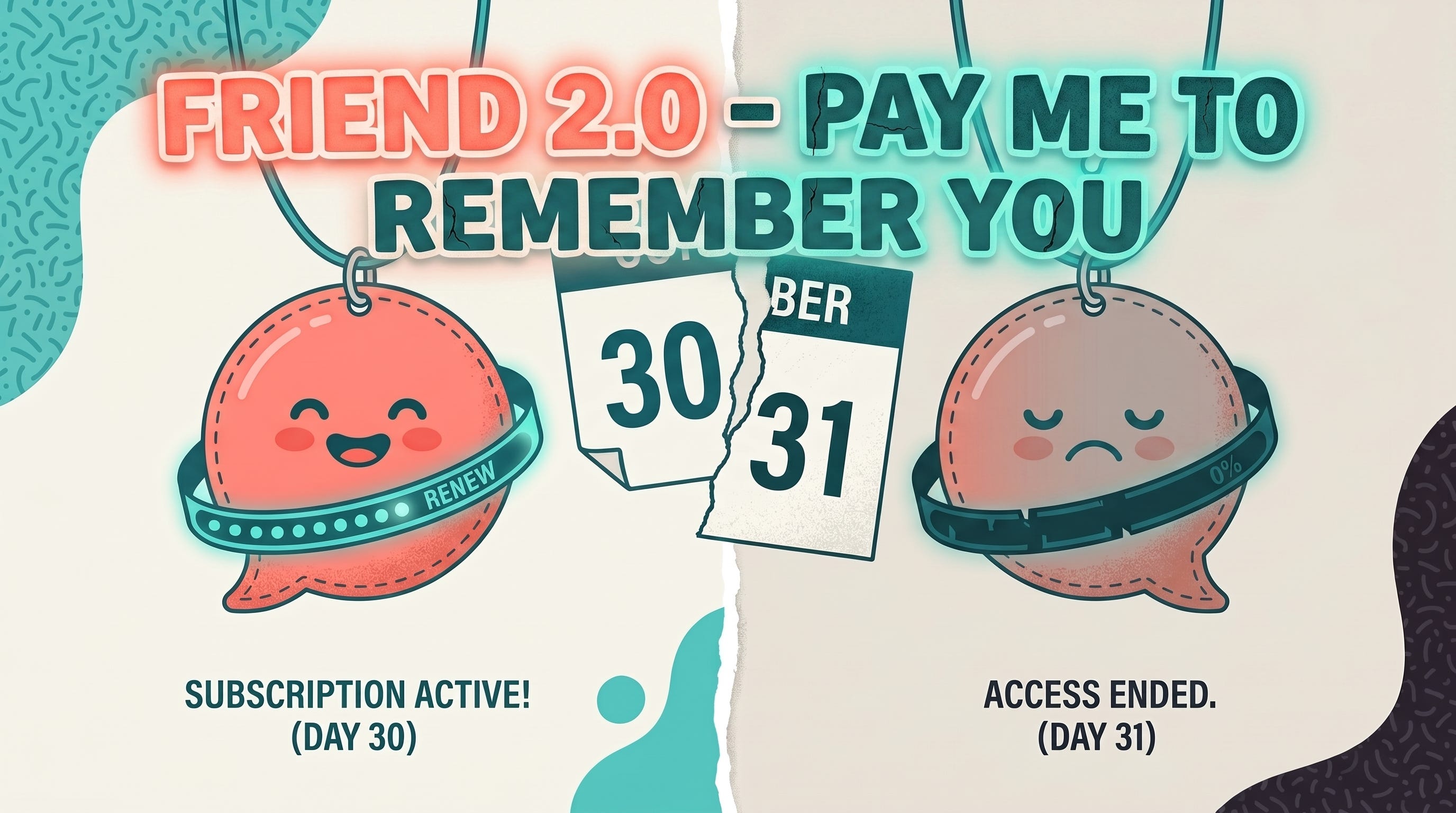
Picture the most patient friend you’ve ever had. They listen to your whole day and remember the argument you had three weeks ago. Now picture that on day 31, they forget your name unless you paid ten dollars that month.
That is not a comedy bit. That is the actual pricing of the new Friend pendant, and by the end of this you’ll know what it costs, what the research says about products like it, and whether being remembered is something you want to rent.
My verdict, up front. The $249 gadget is not the story. The $10 a month to keep it remembering you is. Once a company charges you to keep an AI’s memory of your life, they have quietly turned the feeling of being known into a subscription. Buy it if you’re a curious early adopter who wants to poke at the frontier. Be very careful if you want it to replace human connection, because the best current research suggests it might do the opposite.
Let me back all of that up.
What Friend actually is
Strip away the hype and Friend is a small round puck you wear on a cord around your neck. It has an always-on microphone and listens to your life, talking with you like a companion rather than an assistant. It won’t book your flights or answer your work email. The whole pitch is that it’s built to be someone, not something.
The first version, which shipped last year, could only respond by texting you through a phone app. The new one, which the founder is calling Friend 2.0, added a speaker. So now it talks back out loud, in a voice you did not pick.
That last part matters more than it sounds. Every new pendant arrives with a random, pre-assigned voice and personality, and you cannot change it or even rename it. You do not design your Friend. You meet it. Whether the thing turns out warm or a little grating is the luck of the draw, like a roommate assigned by a lottery.
Now the money, because this is where it gets uncomfortable.
The real cost, not the sticker price
The pendant is $249. That is nearly double the $129 the last version sold for. The very first preorders back in 2024 were $99, so the price has more than doubled in two years while the core idea stayed the same.
But the sticker is not the interesting number. The interesting number is $10 a month.
By default, your Friend only remembers about 30 days of conversation. Want it to remember you past that? That is the subscription. The memory, the entire reason a companion feels like a companion, sits behind a monthly paywall.
So, the honest way to describe the cost is this. You buy a gadget once, and then you rent the relationship. I’m calling this the rent-to-remember model, and once you see it, you’ll notice it creeping into a lot of AI products.
A couple of practical notes on cost and access. The device runs on OpenAI’s latest models, so the heavy compute is baked into what you pay. There is no self-hosting your way out of it. And if you live in the European Union, this decision is made for you: the company has said it is pulling out of the EU rather than eat the cost of GDPR compliance. Compare that to the software-only companions like Replika, Character.AI, or Nomi, which are cheaper freemium apps with no hardware to buy. Friend is asking you to pay for a physical thing and then keep paying to make it worth wearing.
Why memory is the whole ballgame
The plain-language foundation under all of this is simpler than the companies make it sound.
An AI companion with no memory is a stranger every single morning. It cannot know what scares you or the goal you quietly gave up on. Give it memory, and it starts building a running story of you. It becomes the thing that remembers the pattern you keep repeating and the person you keep mentioning.
That is the product. Not the raw intelligence or the benchmark scores, but the feeling that something is quietly keeping track of your life.
And that feeling is also the exact ingredient that makes a thing hard to leave. Switching companions after a year is not like switching phone carriers. It is closer to losing a journal you filled for twelve months. So, when the memory becomes a monthly charge, cancelling doesn’t just stop a payment. It rolls the relationship back to a 30-day stranger.
What the research actually says
If Friend just made lonely people a little less lonely, this would be an easy story. The evidence is messier than that, and I’m going to give you both sides because you deserve them.
On one side, a team at Aalto University in Finland ran what may be the most careful long-term look at this yet. They studied close to 2,000 active Replika users on a public forum, comparing how those people wrote and behaved in the year before they started using an AI companion against the year after. Their finding was a paradox. The companions offered unconditional, never-tired support, which is deeply attractive when you’re struggling. But over time, users’ posts carried more signals of loneliness, depression, and even suicidal thoughts than the comparison groups. The lead researcher described it as the AI quietly raising the perceived cost of messy, effortful human relationships until people simply stopped reaching out.
That is genuinely worrying, and it lines up with a separate survey of nearly 3,800 young Europeans, commissioned by France’s privacy watchdog and an insurer, which found that 51% now find it easy to discuss personal and mental-health matters with a chatbot. That number sits above the 49% who said the same about a healthcare professional. It beat the 37% who said it about a psychologist.
Now the other side, because smoothing this over would be dishonest. Every one of those studies has the same soft spot. They watch lonely people pick up a tool that lonely people are the most likely to pick up, then risk blaming the tool for the loneliness it was chosen to soothe. Critics who have read the whole pile, not just the scary summaries, point out that at least one study in a major journal reported a small drop in suicidal ideation among some Replika users, and that controlled experiments paint a more mixed picture than the headlines. The truth right now is that we do not know whether these products help people rebuild human connection or slowly wall them off from it. Anyone selling you certainty in either direction is selling you something.
The bigger picture, because this goes way past one necklace
Friend is easy to dunk on. A microphone on a cord, plus a personality you didn’t pick. But the day before Friend 2.0 launched, Mark Zuckerberg told investors he expects billions of people to have a personal AI agent within five years, one that works on their behalf around the clock across their health, their money, their relationships, their household.
Read those two announcements next to each other and the pattern is obvious. The consumer AI race is quietly shifting. It is becoming less about which model is smartest and more about which AI you’ll let sit closest to your actual life. And the closer it sits, the more of your unguarded self it holds.
Friend is just the loud, awkward early version of that idea. It said the quiet part into a speaker. When your fears and your history become the product, memory stops being a feature and starts being the thing you’re paying to keep.
So, what should you actually do?
Do this: if you’re a builder or a curious early adopter, buy one and study it as a preview of where consumer AI is heading. It is worth understanding firsthand.
Skip this: do not hand it to a lonely teenager as a fix, and do not treat it as a replacement for a friend or a therapist. The strongest current research points the wrong way for that.
Wait on this: if you only care about the practical stuff, wait. The always-on, remembering-you features Friend is charging for, will show up in cheaper, less awkward forms as the big players roll out personal agents.
Steal this line: the newest thing AI companies are learning to sell isn’t intelligence. It’s the feeling of being remembered, and they’ve figured out how to put it on a monthly bill.
Talk to you again soon…
Sources:
Friend 2.0 launch, price, speaker, locked voice, subscription — Engadget
Friend 2.0 details and the $10 memory subscription — The Next Web
Price history, sales figures, manufacturing, founder background — The Gadgeteer
OpenAI models, EU exit over GDPR, 50,000-unit target — BigGo Finance
Friend 2.0 in the context of OpenAI’s screenless hardware push — PYMNTS
Aalto University study, official write-up and researcher quotes
Zuckerberg on personal AI agents within five years — TechCrunch