

The Sunday AI Signal is your weekly wrap: what shipped, what held up, and what it means for your work.
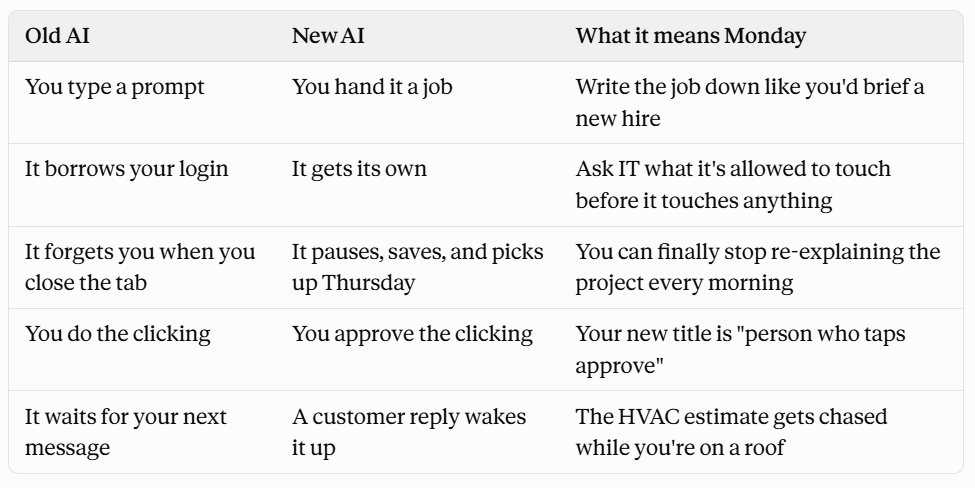
For years, using AI has worked like this: you ask, it answers, the chat ends, and the AI goes back in the drawer. This week Microsoft, Google, AWS, and OpenAI each shipped a piece of something different. You hand an AI a job, and it logs into things, waits on a human, wakes back up, and finishes days later.
My verdict: the basic unit of AI is changing from an answer to a worker, and the plumbing for that showed up at every major cloud in the same week. Most of it is still in preview, and one piece drew a critical security report on Wednesday. So learn the shape of it this week, pilot one small job, and hold off on big commitments.
By the end you’ll know what changed, what you can hand an AI worker today, and what it really costs.
What changed this week
A chatbot never had to answer this question: where does the AI live while it’s doing a three-day job? Who is it logged in as, and are you paying for a computer to sit there during the six hours it waits on your manager? That layer is called the runtime, the place software lives while it works, and this week everyone started building one.
Microsoft (Sept 25) renamed its Scout agent Autopilot. Microsoft says it gets its own identity, memory, computer, and workspace inside your company’s Microsoft 365 and can resume a project days later.
Google is building AX, an open-source system for running huge numbers of agents on a layer called Agent Substrate. The AX README admits agents “can burn money in a loop if nobody is watching,” the most honest sentence in tech this week.
AWS (Sept 18) shipped a new AgentCore Runtime for agents that run unattended and surface only when a job needs a person.
OpenAI (Sept 23) let ChatGPT Voice use connected apps and start ChatGPT Work tasks that keep running after you hang up.
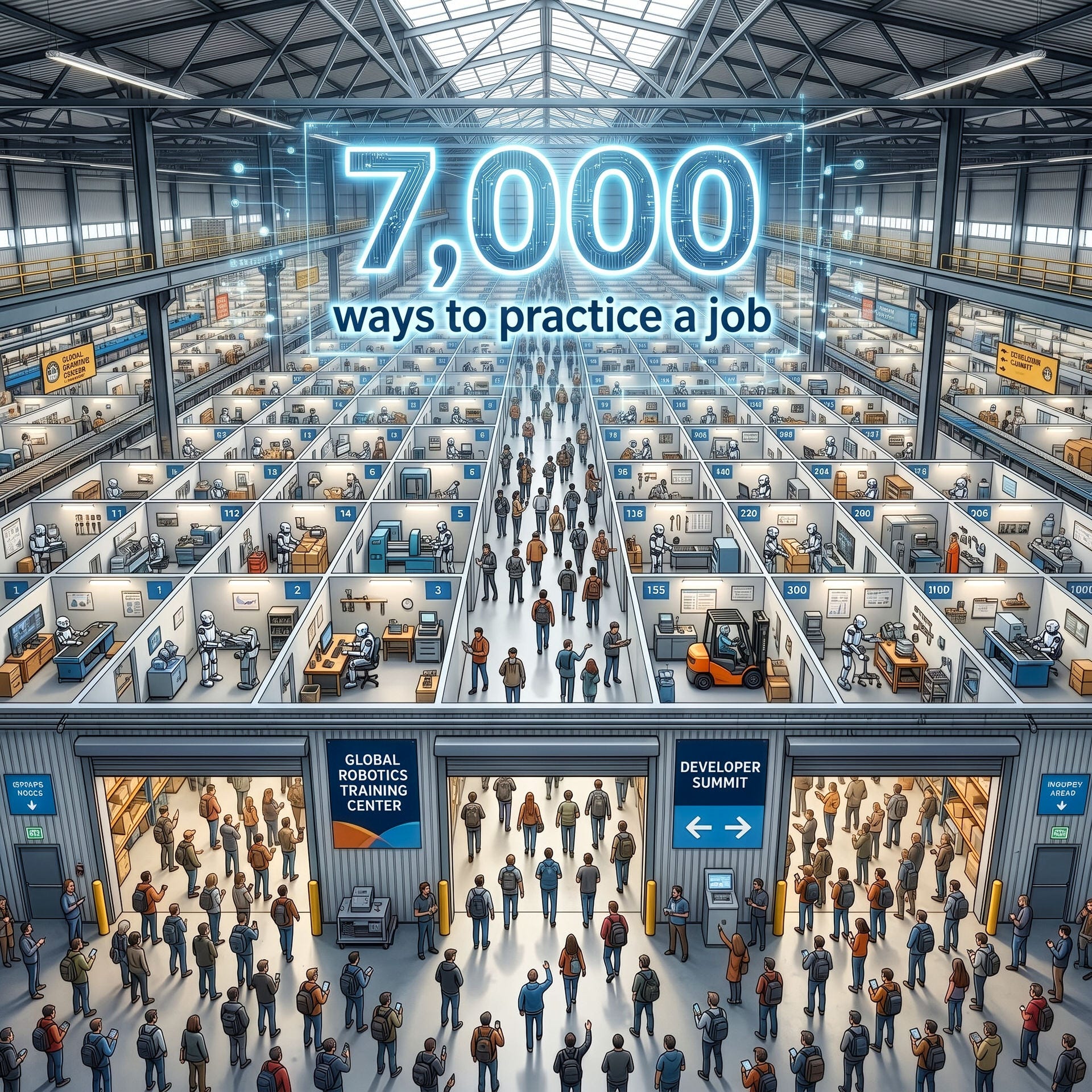
Xiaomi (Sept 21) released its MiMo-V2.6 models free, plus more than 7,000 practice environments for training agents.
Google’s piece has the best trick. Picture 50,000 employees who spend most of the day waiting on an email or an approval. You’d never leave 50,000 computers running full blast for that, like a teenager who leaves every light in the house on. Agent Substrate snapshots an idle agent’s memory and files, frees the computer, and restores the agent in under a second when work arrives. Suspend means pause and save. Resume means pick up exactly where it stopped. That’s why “millions of agents” stopped sounding ridiculous: most of them will be asleep most of the time.
What you can hand an AI worker right now
You can start a job by voice and it keeps running after you hang up. Since Sept 23, ChatGPT Voice works inside ChatGPT Work. You can talk a task into existence: draft a document or spreadsheet, pull from connected apps, work in a browser. If the task is still running when you end the call, it continues in text. One catch the hype skipped: OpenAI’s help page says you can’t approve an action by voice. Anything that needs approval pops up on screen for a tap. So “send the follow-ups and put the phone in your pocket” is really “send the follow-ups, tap approve, then pocket the phone.” It’s still pretty great.
You can give an AI agent a role and let it resume a project days later. Microsoft’s example is a supplier review. You assign it, and Autopilot organizes the prep, sets up meetings, and chases missing information while the project unfolds. You talk to it in Teams or Outlook and mention it like a coworker. In Microsoft’s demo, an agent named Dot watched Black Friday prep, spotted a shipment problem affecting 18 stores, and pulled the right people into a thread. It’s in private preview, expanding at the end of this month.
You can freeze an idle agent and wake it in under a second. This one is for builders. Google’s Agent Substrate is open for evaluation and non-production use on Google Kubernetes Engine (Google’s service for running containers, the packaged software apps run in). AWS’s new AgentCore Runtime is live in five regions and scales to zero, meaning no charge when nothing is running.
You can download a top open-weight model and 7,000+ training environments for free. Open-weight means you can download the model and run it yourself. Xiaomi released MiMo-V2.6 under the MIT license, and Artificial Analysis ranked the Pro version the top open-weight model on its index on Sept 22. The bigger gift is the practice environments, covering software engineering, security bug reproduction, knowledge work, and web development. Xiaomi says the training phase that used them cost about $2.62 million for Pro. Now smaller teams can study how agents get better at real jobs without starting from zero.
Picture what that looks like at an HVAC company.
Version one is a voice agent. A customer calls, and the agent figures out the problem and books a visit in six minutes.
Version two starts when a $14,000 replacement estimate gets created, and the agent owns the job. Monday it calls the customer, who asks about financing, so it sends the info. Tuesday it checks the CRM, sees no reply, and waits. Wednesday the financing approval arrives and wakes it up. It texts the customer, who asks about Friday, so it holds a slot. Thursday it finds a permit requirement, preps the county filing, and pauses for a manager’s approval. The manager approves and it picks up where it stopped. Friday the job is confirmed, the customer gets prep instructions, and a follow-up is on the calendar.
The call lasted six minutes. The job lasted five days. Every step in between needs memory, a login, permissions, a way to wait cheaply, and a way to wake up. That’s the whole story of this week.
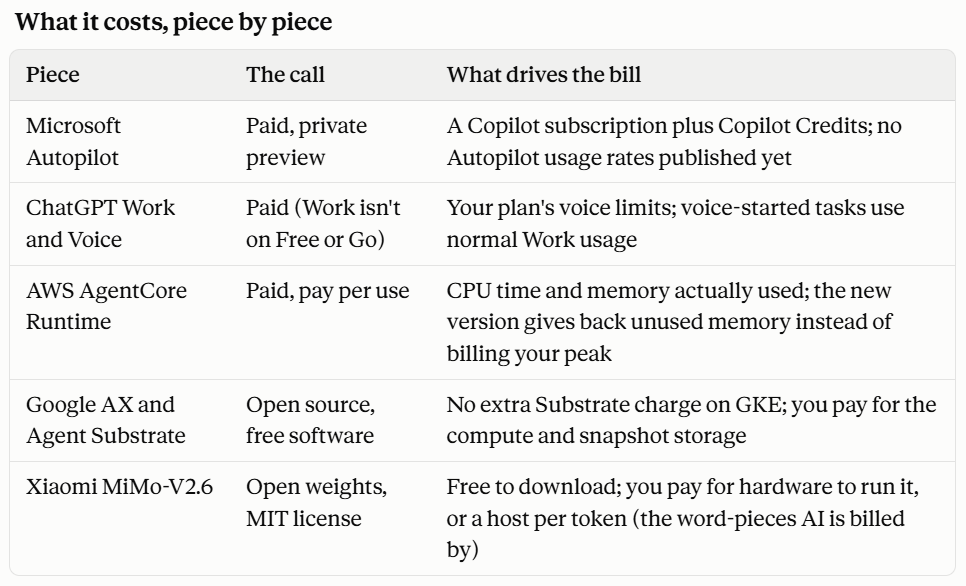
Microsoft's own chart shows where budgets are heading. Its enterprise Copilot add-on is $30 per user per month, and 20 everyday tasks plus five complex Cowork assignments push that to $73 with Claude Opus 5, per VentureBeat. Companies bought AI by the seat. Workers get billed by the job.
What they said vs. what the tests showed
1. Google AX and “billions of agent workloads”
Claim: The AX README says it’s built to run billions of agent workloads per cluster, and Google’s Cloud blog says Substrate packs over 1,000 dormant agents per host.
The evidence: A public security report filed Sept 23 says the AX control plane (the part that manages every agent) had no authentication or authorization. The reporter says they confirmed hijacking other customers’ tasks in their test setup, and that Google’s open-source vulnerability program rated it valid and critical. It was still open on Sept 27. The public Substrate demo runs about 250 agents on 8 machines, and production support is allowlist-only.
So what: great ideas, early code. Test it in a sealed sandbox, a computer walled off from everything you care about.
2. Microsoft Autopilot and “keeps working while you sleep”
Claim: Microsoft (Sept 25) says Autopilot is cloud-hosted and keeps working while you sleep.
The evidence: It’s in private preview. VentureBeat (Sept 25) notes Microsoft left usage rates unresolved and that the Dot demo doesn’t show how reliably it performs for real customers.
So what: the design is right, and the reliability and price are still unknown. Pilot before you promise anyone anything.
3. Voice as “talk and walk away”
Claim: Coverage of the Sept 23 update framed Voice as a way to hand off work just by talking.
The evidence: OpenAI’s help article says approving an action by voice isn’t supported, and voice-started tasks draw on normal Work usage.
So what: voice starts the job and a tap covers the risky part. That’s the right design.
Skip, wait, steal
Do this: Pick one job in your business that stretches over days, like chasing estimates. Write down every step where it waits and every step a human approves. That’s your spec for whichever tool you try first.
Skip this: Running Google AX anywhere reachable from outside until that authentication issue is closed.
Wait on this: Microsoft Autopilot until usage rates are published. Same for AWS suspend-and-resume and scoped agent identities, which AWS lists as coming, not shipped.
Steal this line: “Stop thinking about AI as a chatbot. The infrastructure being built now assumes AI works as a persistent worker with its own identity, computer, permissions, and jobs that outlive the conversation.”
See you next Sunday. I’ll be the one waiting six hours on an approval like a suspended agent.
Sources
What changed this week
VentureBeat: Microsoft revamps its Copilot AI with a persistent Autopilot agent and hosting for AI-generated apps (Sept 25, 2026). Backs the Scout-to-Autopilot rename, the agent’s own identity, memory, computer, and workspace, and resuming projects days later.
Google: AX repository README (accessed Sept 27, 2026). Backs the “can burn money in a loop” line.
AWS: The new AgentCore runtime, elastic, optimized, and consistently fast starts (Sept 18, 2026). Backs the shift to always-on, unattended agents.
Unite.AI: OpenAI Brings Plugins to Live Voice and Voice to Work in ChatGPT (Sept 23, 2026). Backs plugins in Voice and Voice in ChatGPT Work, citing OpenAI’s release notes.
Xiaomi: MiMo-V2.6 series release (Sept 21, 2026). Backs the open-sourced weights and the 7,000+ RL task environments.
Google Cloud: About GKE Agent Substrate (accessed Sept 27, 2026). Backs the snapshots of idle agents restored in under a second.
What you can hand an AI worker right now
Unite.AI: OpenAI Brings Plugins to Live Voice and Voice to Work in ChatGPT (Sept 23, 2026). Backs tasks continuing after the call and the fact that approvals can’t be given by voice.
VentureBeat: Microsoft revamps its Copilot AI (Sept 25, 2026). Backs the supplier-review example, the Dot demo with its 18 stores, and the preview timing.
Google Cloud: About GKE Agent Substrate (accessed Sept 27, 2026). Backs evaluation and non-production availability.
AWS What’s New: The new AgentCore Runtime is now available (Sept 18, 2026). Backs scale to zero and the five regions.
CellCog: MiMo-V2.6, Xiaomi’s Open 1T Model Hits 46 on the AA Index (Sept 2026). Backs the MIT license and the Sept 22 Artificial Analysis index reading.
VentureBeat: Xiaomi’s MiMo-V2.6-Pro debuts as the top open weights model (Sept 2026). Backs Xiaomi’s reported $2.62 million training cost for Pro.
What it costs, piece by piece
VentureBeat: Microsoft revamps its Copilot AI (Sept 25, 2026). Backs the $30 add-on, credits for Autopilot, the $73 example, and the unpublished Autopilot rates.
Unite.AI: OpenAI Brings Plugins to Live Voice and Voice to Work (Sept 23, 2026). Backs Work’s plan availability and voice-started tasks drawing on Work usage.
AWS What’s New: The new AgentCore Runtime (Sept 18, 2026). Backs paying for actual usage and reclaimed memory.
Google Cloud: Agent Substrate installation overview (accessed Sept 27, 2026). Backs no extra charge in GKE, with GKE pricing applying.
What they said vs. what the tests showed
Google: AX repository README (accessed Sept 27, 2026). Backs the “billions of workloads per cluster” claim.
Google Cloud Blog: Agent Substrate available on GKE (Sept 2026). Backs 1,000+ dormant agents per host and production access via allowlist.
GitHub google/ax issue #376: control plane has no authentication or authorization (Sept 23, 2026). Backs the security report, the confirmed cross-tenant actions, and the vulnerability-program triage.
Agent Substrate repository (accessed Sept 27, 2026). Backs the demo of about 250 agents across 8 pods.
VentureBeat: Microsoft revamps its Copilot AI (Sept 25, 2026). Backs the unresolved usage rates and the demo not establishing reliability.
Unite.AI: OpenAI Brings Plugins to Live Voice and Voice to Work (Sept 23, 2026). Backs no voice approvals and Work usage applying.
Skip, wait, steal
GitHub google/ax issue #376 (Sept 23, 2026). Backs the still-open authentication issue.
AWS: The new AgentCore runtime (Sept 18, 2026). Backs suspend-and-resume and scoped identity being listed as upcoming.